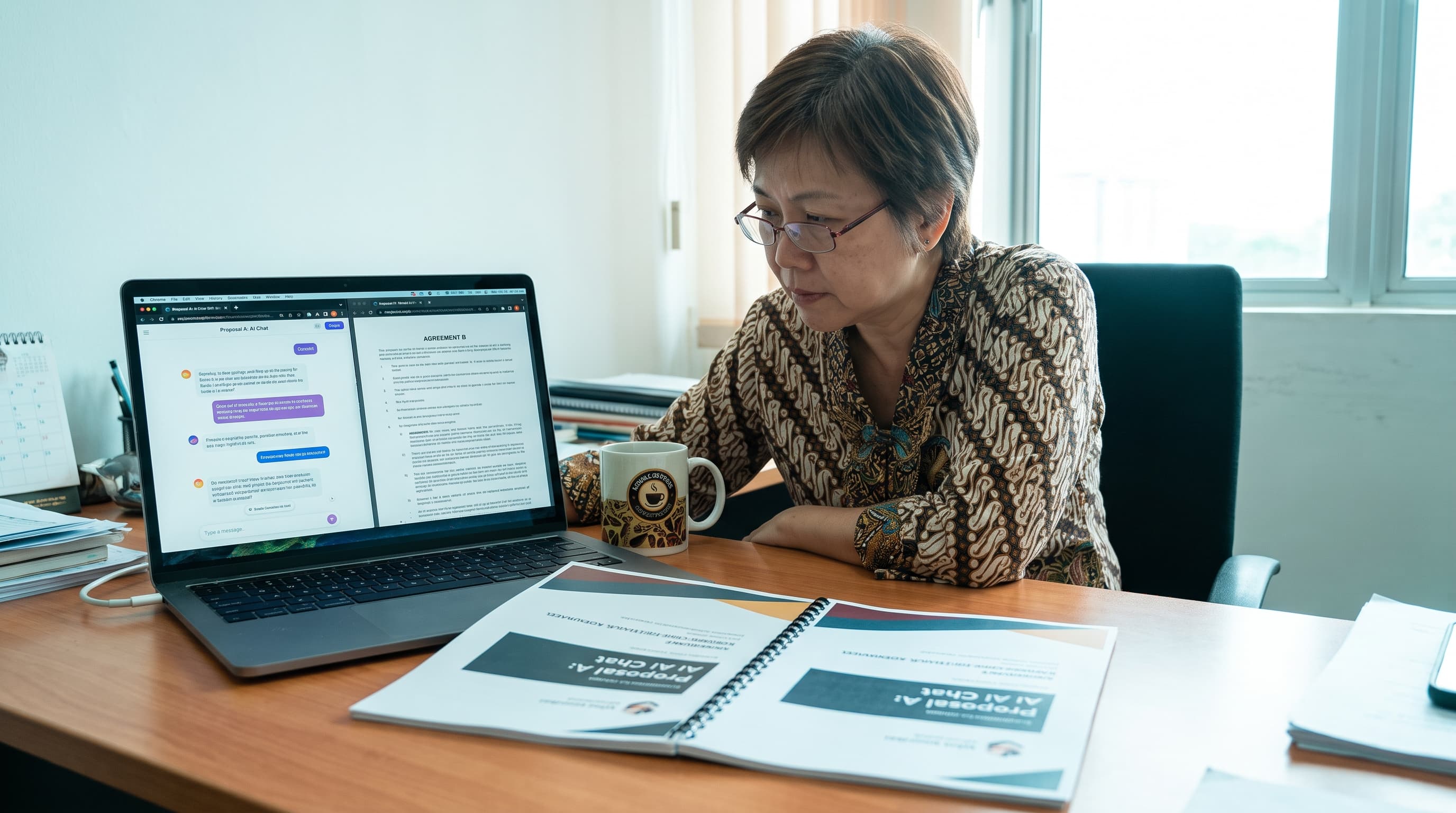
How to choose an AI agency in Malaysia (without getting burned)
By The pitchdeck.my team
This is the pillar guide for choosing an AI agency in Malaysia in 2026. If you run a business in Alor Setar, Kulim, Langkawi, Sungai Petani, Shah Alam, Petaling Jaya, Ipoh, Johor Bahru, or anywhere in between — and someone has pitched you an "AI system" with a quote and a slide deck — this is the one read before you sign anything.
We're going to walk through six things, honestly:
- The AI agency market in 2026 — the four vendor types you'll actually meet, and which one fits your business.
- The 12-point checklist — the questions to ask every agency before you sign a contract.
- The red flags that mean walk away.
- The contract clauses that protect you if things go wrong.
- The discovery engagement — what the first two weeks of a real engagement should look like, and what it should cost.
- How to compare two AI agency quotes when they're RM 80,000 apart.
No vendor pitch. We're an AI agency — pitchdeck.my's AI Your Business arm — so we're biased, and we'll name it. But the framework below is what we use ourselves when a Malaysian SME owner asks: "how do I tell a real AI agency from a salesperson who learned the word 'GPT'?"
The market is full of both, and the difference is hard to spot from the outside. This guide exists because that difference is the difference between an RM 80,000 build that pays back in 6 months and an RM 80,000 build that sits half-used on a server. We answer that question both ways depending on the business. About a third of the time the right answer is "don't hire an agency at all — buy a RM 200/month SaaS with AI features built in." The other two-thirds the right answer is "yes, but the agency has to be one of the four types below, with the checklist applied, with the contract clauses we cover, and with the discovery engagement that proves they understand your business."
If you want to skip the framework and go straight to the case studies, jump to Real case studies: the AI builds that worked (and the ones that didn't). The four primary builds are real Malaysian SMEs — Kulim, Langkawi, Ipoh, Taiping — and they're the closest thing to evidence we have.
If you'd rather book a 30-minute call to talk through your specific situation — including the question of whether the right answer is us, a different agency, or no agency at all — contact us. We don't pitch either way.
And if you're on the other side of the table — a founder with a working business looking to raise capital, not deploy AI — that's a different platform on this site. You can browse Malaysian businesses raising on pitchdeck.my, or submit your own listing if you've got a business that fits.
The AI agency market in 2026: what Malaysian SMEs are actually buying
The Malaysian AI agency market in 2026 has four distinct vendor types, and the difference between them is the single biggest predictor of whether your project pays back. Most SMEs pick the wrong type because they don't know the type exists, or because the agency's pitch deck is good enough to make the difference invisible. Here's the honest map.
1. The boutique AI studio (2-5 people, founder-led).
A small team — usually a former CTO or senior ML engineer, plus 1-3 other technical people. Their pitch is "we only do AI." Their work is narrow: a WhatsApp concierge, a vision spot-checker, a predictive maintenance model, a fine-tuned classifier. Their prices are mid-range: RM 25,000 – RM 150,000 for a small AI build, RM 150,000 – RM 500,000 for a multi-site or platform project. The honest strength: the senior person actually does the work — you get 30-50% of a senior AI engineer's time, not 5%. The honest weakness: one or two senior people, single point of failure if they're sick or move on; narrow technical range if the project needs a web app and a model and a data pipeline; documentation is often thinner because the founder writes it on Sunday evening.
2. The full-service digital agency adding AI (30-100 people, account-manager-led).
A Malaysian digital agency that built its revenue on websites, mobile apps, and e-commerce over the last 10 years, and added an "AI" arm in 2024-2025. They have a sales team, a PMO, a design team, a development team, and an "AI team" that is usually 1-3 people wearing a lot of hats. Prices are RM 50,000 – RM 500,000+, pitches are polished — decks with case studies (some real, some borrowed from the website team), timelines, a senior partner in the pitch. The honest strength: they ship a polished production system. A real AI team can deliver a WhatsApp concierge with a proper admin dashboard, user management, and integrations in 10-14 weeks. The honest weakness: the AI is usually 20% of the project — the 80% is the same website-app-integration work with a thin LLM wrapper bolted on. The senior partner in the pitch is rarely the senior person in delivery. The actual AI work is done by a junior or mid-level engineer with 1-2 years of model experience, supervised by a tech lead running three other projects.
3. The freelance AI consultant (one person, no team).
A single senior AI engineer or data scientist working independently — LinkedIn full of "I built X for Y," a Notion portfolio, a Calendly link. They charge RM 8,000 – RM 25,000/month as a fractional AI lead, or RM 5,000 – RM 50,000 per project. The work is hands-on, the senior person is the senior person, the price is often 40-60% below an agency. The honest strength: 100% of one senior person's attention. The freelancer writes the spec, trains the model, deploys the system, is on the WhatsApp group when something breaks. The honest weakness: single point of failure if they get sick or take another contract; narrow scope if the project needs ongoing support or a handover; contract paperwork is usually thinner.
4. The fractional CTO + AI-augmented dev team (the new way).
A hybrid: a senior architect (usually a former CTO or technical co-founder) who works 1-2 days a week as the "fractional CTO" for your business, plus a small team of 1-3 developers who use AI coding tools (Claude, Cursor, GitHub Copilot) to ship the build 3-5x faster than a traditional agency. The fractional CTO studies the business, writes the build spec, owns the architecture; the build team does the implementation. The honest strength: senior thinking at a fraction of the cost and time of a traditional agency. A RM 12,000/month fractional CTO plus a RM 30,000 – RM 80,000 build often replaces a RM 200,000+ traditional agency engagement. The honest weakness: the model depends heavily on the quality of the fractional CTO. A bad one is worse than a bad agency, because the failure mode is silent — the architecture looks fine, the model trains, the system deploys, and then 6 months in you discover the data model is wrong. This is the model we use at pitchdeck.my's AI Your Business arm, so we have skin in the game.
Which one fits your business:
- Budget under RM 50,000, simple AI workflow: Freelance AI consultant, validated with a no-code prototype first.
- RM 50,000 – RM 150,000, well-scoped AI build with a real production system: Boutique AI studio OR full-service agency with a real AI team. The deciding factor is the senior person's time on the project.
- RM 150,000 – RM 500,000+, multi-site or platform: Full-service agency with a proven AI team, OR fractional CTO + AI-augmented dev team.
- Multi-year, in-house team, product business: Hire your own senior AI engineer (RM 12,000 – RM 25,000/month) and skip the agency.
If you want to see what each of these costs in your state, the state-level pages — AI services in Selangor, Kuala Lumpur, Penang, Kedah, Perak, Johor — give you the local market angle. The national service page — AI agency at pitchdeck.my — gives the cross-state view.
The 12-point checklist (the questions to ask every AI agency)
This is the AI-specific version of the framework from our custom software pillar. Same 12-point structure, but every point is sharpened for the AI subset — because the failure modes are different. An AI agency that can't answer the AI-specific questions in this list is one you should not be hiring.
1. They tell you when NOT to build (with AI).
If an agency says yes to every AI project, they're not an agency — they're a sales team. The first call should include the question "should I even deploy AI for this workflow?" If the agency's first instinct is to find a way to make the AI project work, find another agency. The right answer to "I want AI for my customer service" is sometimes "you need a part-time front-of-house person, not AI" — the agency should be willing to say that out loud.
2. They study your business AND your data before they quote.
A serious AI agency will spend 5-10 hours of unpaid time studying your business before giving you a price. They'll talk to your team, walk your floor, read your current process, AND ask to see a sample of your data — the CSV exports, the operator logs, the historical orders, the training images. If the agency quotes you in the first call without studying the data, the quote is wrong. If the agency says "we don't need to see the data, we know what to do," walk away. The Kulim vision system was 30% model and 70% data preparation — the model was the easy part.
3. They give you a fixed price with a clear scope.
The quote should be a number with a clear scope, a clear timeline, and a clear list of what's NOT included. Vague quotes ("RM 60,000 – RM 200,000 depending on requirements") are a tell. So are quotes that include lots of "TBD" line items. The right quote breaks down discovery, data preparation, model training, build, deployment, and post-handover as separate lines. A 200-word breakdown of "we'll do this in 10 weeks for RM 60,000" is fine. A one-line "RM 60,000 for an AI system" is a tell.
4. They have a named senior person on the project.
Ask who the project lead is. Ask for their LinkedIn. Ask how many other projects they're running. The senior person on an AI project should be doing 10-20% of the work, not 0%. If the senior person is "the founder" but the founder is also "running sales" and "speaking at a conference next month," the project will get the senior person for 5% of their time. That's not enough. The senior person should be reviewing the model evaluation, signing off on the architecture, and on the WhatsApp group when something breaks.
5. They have 2-3 reference customers in your industry or region.
Call the references. Ask them: "What was the most frustrating part of the project?" If the references say "nothing, it was great," the references are cherry-picked. Every project has a frustrating part. The right answer is something like "the data prep took longer than expected, but the agency flagged it early" or "we changed scope halfway through, and the agency handled it well." If the agency won't give you references, walk away. References are non-negotiable for an AI project.
6. They show you a working AI demo on data similar to yours (before you sign).
This is the AI-specific version of "ask to see the work." A serious AI agency will offer a 1-2 week paid or unpaid prototype on a subset of your data, before the full build. The prototype is throwaway — its job is to prove the AI is the right tool for this workflow, and to give you a real model evaluation (precision, recall, F1) on data that's actually similar to yours. If the agency says "trust us, the model will be great" without offering a prototype, walk away. The right answer is "we'll build you a 2-week prototype on a subset of your data for RM 3,000 – RM 8,000, and you'll see the model evaluation before you commit to the full build."
7. They have a clear plan for data preparation (and who owns it).
Data preparation is the silent killer of AI projects. A model trained on inconsistent, incomplete, or wrong data produces confident-sounding wrong answers. The right answer: "we'll spend 2-4 weeks on data preparation, here's what we need from you, here's the cost (included in the quote), and the deliverable is a clean, tagged dataset that we can show you before training starts." The wrong answer: "we'll figure that out as we go" or "you handle the data, we'll handle the model." If the agency isn't asking you about your data quality in the first call, they're not serious.
8. They have a clear retraining plan (and who owns the retraining).
AI models drift. The model you ship in month 3 will be wrong in month 12, because your data has changed, your customers have changed, and the underlying LLM or vision model has been updated. The right plan: a clear cadence for model evaluation (monthly for the first 3 months, then quarterly), a clear cost for retraining (included in the maintenance retainer, or a fixed-price per retraining cycle), and a clear answer to "what happens if the model's accuracy drops below the SLA?" If the agency doesn't have an answer to this, they haven't deployed an AI system in production before. Walk away.
9. They have an explicit plan for hallucination handling (and a fallback for when the model is wrong).
Every LLM-based system will eventually produce a wrong answer. Every vision system will eventually miss a defect. The question isn't whether the AI will be wrong — it's what happens when it is. The right plan: a confidence threshold below which the AI routes to a human, a clear escalation path for the human, a logged record of the wrong answer for retraining, and a measurable accuracy target (e.g. "the model catches 14 of 15 defects, the 15th is caught by the human QC team"). If the agency says "our model is 99% accurate, you don't need a fallback," they're either lying or they haven't deployed in production. Walk away.
10. They have transparent API cost projections (and who pays for usage).
Once the AI is live, you're paying the underlying model provider per request. Claude / OpenAI / Gemini pricing is roughly RM 0.50 – RM 5.00 per 1,000 requests for typical small-business use. A Langkawi-scale WhatsApp concierge handling 1,000 messages/day costs roughly RM 200 – RM 800/month in API bills. The right plan: the agency gives you a 12-month API cost projection based on your expected volume, the projection is in the contract, and the cost is either built into the maintenance retainer or billed transparently per month. The wrong plan: the agency hides API costs in a "platform fee" or refuses to give you the per-request breakdown. Walk away.
11. They have a real office (or a real distributed team), not a Gmail address.
This is a small thing, but it's a real tell. A serious agency has a registered company (SSM), a real address (not a PO box), a real team (LinkedIn profiles that match), and a real history (3+ years in business). AI work in particular requires trust — you're handing them your data, your customer interactions, sometimes your customer list. If the agency is a single person with a Gmail address and a Squarespace site, you're the customer funding their learning curve.
12. The people doing the work are the people in the pitch.
If the pitch team is a senior partner and a sales lead, and the delivery team is a junior ML engineer and a contract developer, that's a mismatch. Ask to meet the people who will actually do the work. If the agency won't show you, find another agency. The senior person who pitched the project should be the senior person in the delivery — that's the only way the project gets the senior thinking that justifies the price.
The red flags that mean walk away
The 12-point checklist above is what the right agency will do. The red flags below are what the wrong agency will say. If you hear more than two of these in the first three calls, walk away.
-
"We don't need to see your data." No. The model is only as good as the data. If the agency doesn't ask to see a sample, they don't know what they're building.
-
"We'll use our proprietary model." This is almost always a wrapper around Claude or OpenAI with a thin prompt layer. "Proprietary model" is a sales word, not a technical claim. Ask which base model they're using, then ask if you can swap providers.
-
"No, you don't need to see the training set or the model evaluation." The training data and the model evaluation are the proof that the model works. If the agency won't show you, the model probably doesn't work on your kind of data.
-
"Our AI is 99% accurate." The 99% claim is usually measured on the training set, not on production data. On production data, AI systems typically drop to 70-90% accuracy, and the worst-case examples are the ones that hurt. Ask for precision and recall on a holdout set, and ask what happens to the cases the model gets wrong.
-
"We'll handle everything — you don't need to be involved." AI projects require business input every week. The team needs to label edge cases, validate model outputs, and update the training set. If the agency is telling you to step back, they're about to build a system nobody uses.
-
"We can't tell you the API cost per request because it's variable." API costs are computable. Volume × cost-per-request = monthly cost. If the agency can't give you a 12-month projection, they haven't done the math, which means they haven't thought about your business.
-
"Trust us, the model is great." Trust is earned by evidence. The right answer is a 2-week prototype with a model evaluation you can read.
-
"We'll retain ownership of the model as a hosted service." This is the AI-specific version of "we'll retain ownership of the code." At the end of the project, you should own the model weights (or have an irrevocable license), the training data, the documentation, and the deployment credentials. If the agency retains ownership, you're renting the system, not owning it.
-
"100% upfront, then we start." A reasonable payment schedule is 20% on signing, 30% on data prep + prototype, 30% on milestone (usually UAT or first production deploy), 20% on go-live. If the agency asks for 50% upfront or more, that's a red flag — they need your cash flow to fund their other projects.
-
"We'll figure out the spec as we go." An AI project without a spec is an AI project that will be re-scoped three times and end up 50% over budget. The right answer is "we'll write a build spec in the discovery engagement, you'll sign off on it, and any changes after that go through a change-order process."
The simple rule: if an agency fails 2 of the 12 checklist points OR triggers 2 of the 10 red flags, walk away. The Malaysian AI market in 2026 has more agencies than good projects, and the bad ones are easy to spot once you know what to look for.
The contract clauses that protect you
The 12 checklist points above are what to ask before you sign. The contract clauses below are what to insist on in the contract itself. If the agency won't agree to these, walk away. If they agree verbally but the contract is silent, walk away. The contract is the only place these promises are enforceable.
1. Model ownership.
At the end of the project, you own the model weights, the training scripts, the evaluation scripts, and the right to retrain, fine-tune, or replace the model at any time. If the model is built on top of Claude / OpenAI / Gemini (the most common case), you own the fine-tuned weights, the prompt templates, the data pipeline, and the right to switch base models. The right clause: "All model artefacts, including but not limited to trained weights, fine-tuning datasets, prompt templates, evaluation scripts, and data pipelines, are the property of the Client upon final payment." If the agency says "we retain ownership of the model as a hosted service," find another agency.
2. Data ownership.
Your business data is yours. The training data, the customer interactions, the operator logs, the labelled images — all of it is yours, the moment it's created. The agency can use it to train the model for your project, and the contract can give them a non-exclusive license to use anonymised extracts for internal benchmarking, but the data itself doesn't leave your business. The right clause: "All data, including but not limited to source datasets, labelled training data, and model inputs, remains the property of the Client at all times. The Agency has a non-exclusive license to use the data for the duration of the project and a non-exclusive license to use anonymised extracts for internal benchmarking thereafter." If the agency says "we own the data we helped you label," find another agency.
3. Retraining rights.
You have the right to retrain the model, on your own data, with your own team or a different agency, at any time after the project ends. The agency must hand over the training scripts, the data pipeline, the evaluation framework, and the documentation to make this possible. The right clause: "Upon final payment, the Agency provides the Client with full documentation, training scripts, and a 30-day handover period during which the Client's team is trained to retrain, evaluate, and deploy the model independently." If the contract is silent on retraining, the agency is planning to be the only team that can maintain the system. That means you can't switch, which means the agency's ongoing fees are a hostage situation.
4. Hallucination liability (and the human-in-the-loop fallback).
The contract should specify what happens when the AI produces a wrong answer. The right clause: a clear accuracy SLA (e.g. "the model will achieve 90% precision and 85% recall on the agreed holdout set"), a clear fallback ("for predictions below the confidence threshold, the system routes to a human reviewer"), and a clear liability cap ("the Agency's liability for model errors is capped at the fees paid in the preceding 3 months, excluding cases where the Client has bypassed the human-in-the-loop fallback"). The last point matters: if you turn off the human review because the team is too busy, the agency isn't liable for the consequences. This is the right allocation of risk.
5. Performance SLA (and what happens when it's missed).
The contract should specify measurable performance criteria: model accuracy, system uptime, response time, error rate. The right clause: "The system will maintain 99% uptime, 95% of requests under 2 seconds response time, and the agreed model accuracy on a monthly holdout set. If the system misses the SLA for 2 consecutive months, the Client has the right to terminate the maintenance retainer with 30 days' notice and receive a pro-rated refund." Without this, the agency can degrade the system over time and you have no recourse.
6. Exit clause (and the post-termination handover).
The contract should specify what happens when the engagement ends — whether the project ships successfully, the engagement is terminated early, or the agency goes out of business. The right clause: "Upon termination, the Agency provides a 30-day handover period during which all source code, model artefacts, data, documentation, and deployment credentials are transferred to the Client or a designated third party. The handover is at no additional cost." Without this, an early termination can leave you with a half-built system and no way to finish it.
The simple rule: if the contract is silent on any of these 6 clauses, the agency is planning to be less available after they've been paid. Either negotiate the clause in, or find another agency.
The discovery engagement: what the first 2 weeks should look like
The discovery engagement is the most important part of an AI project, and the most commonly skipped. A serious AI agency will offer a 1-2 week paid discovery before the full build starts. A sales-first agency will skip it and go straight to a quote. Here's what a real discovery looks like, and what it should cost.
What the agency does in the first 5-10 hours (unpaid):
Before the discovery engagement starts, the agency should already have done 5-10 hours of reading about your business — your website, your process docs, your team's LinkedIn, your industry trade press. They'll have 10-20 specific questions written down. If the agency's first call is "tell us about your business," they haven't done the homework. If the first call is "we read your operations manual, we have 12 questions, can we walk your floor on Tuesday," they're serious.
What the agency does in the discovery engagement (paid, 1-2 weeks):
A real discovery has four deliverables:
-
Workflow mapping. 3-5 one-hour interviews with your team, walking through the specific workflow the AI is supposed to improve. The agency writes up the workflow as a series of steps, with the data inputs, the decision points, the exception paths, and the time spent at each step. Output: a 2-4 page workflow document.
-
Data audit. The agency looks at the actual data your business produces — the CSV exports, the database snapshots, the historical orders, the operator logs, the training images. They write up: what's clean, what's missing, what needs 2-4 weeks of preparation before the build starts. Output: a 1-2 page data readiness scorecard.
-
Model feasibility assessment. The agency evaluates whether the AI is technically feasible for this workflow, with a realistic accuracy range (not a 99% sales claim). For a vision system, a 2-day prototype on a subset of images. For an LLM-based system, a 50-message test of the chatbot on real customer questions. Output: a 1-2 page model feasibility memo.
-
Build spec. An 8-15 page document covering: scope, data prep, model training, build, deployment, post-handover, timeline, fixed price, payment schedule, retraining plan, hallucination handling, exit clause. This is the document you sign off on before the build starts.
What it should cost:
RM 5,000 – RM 15,000 for a small AI build. RM 15,000 – RM 30,000 for a larger one. The cost is credited against the full build if you proceed. The discovery is the agency's skin in the game — they're doing the work to write a build spec, and they're betting the spec will be good enough that you'll proceed with them. If the agency offers a "free discovery," ask who's paying for it. Free discoveries are usually sales calls dressed up.
The right question to ask: "Can I see a sample build spec from a previous project?" If the agency has done real discovery engagements, they have a sample they can share (with the previous client's details redacted). If they don't, they haven't done one.
Real case studies: the AI builds that worked (and the ones that didn't)
This guide is built from the same body of work as the AI case studies below. Each is a real Malaysian SME, an anonymised but specific business profile, the build we shipped, the numbers, and the honest read of what worked and what didn't. If you're evaluating an AI agency, these are the closest thing to evidence we have.
-
How a Kulim Hi-Tech Park electronics supplier caught 14 defects per shift with a custom vision-inspection camera — AI vision inspection for a 280-person PCBA plant. The clearest case study for "AI is the right call for a specific, narrow workflow" — vision inspection is a textbook AI win because the alternative (human inspection) is slow and inconsistent. Tier 2 build, RM 40,000 – RM 150,000. Agency was us; data prep took 3 weeks before the build; model is retrained quarterly.
-
How a Langkawi beach resort replaced its 4 separate booking systems with a single WhatsApp concierge — AI chatbot for a 32-room Langkawi resort. The clearest case study for "consolidation beats features" — the win was removing systems, not adding them. Tier 2 build, RM 15,000 – RM 60,000. Agency was us; the model is a Claude wrapper with a custom prompt layer and a human front-desk fallback; API cost ~RM 350/month.
-
How a 3-outlet Ipoh kopitiam group added RM 18,000/month in recovered reorders with a WhatsApp-first AI agent — AI chatbot + WhatsApp automation for a 3-outlet Ipoh F&B group. The clearest case study for "is AI the right call, or a buzzword?" The answer was yes — for a specific workflow (reorder capture), not for the whole operation. Tier 2 build. Model handles 70% of messages end-to-end, the rest routes to a human.
-
How a 200-person Taiping food-processing plant cut unplanned downtime 38% with an AI maintenance schedule — Predictive maintenance for a Perak food plant. The clearest case study for "AI for industrial workflows" — the model is the workflow, the AI is the optimiser. Tier 3 build, RM 80,000 – RM 200,000. Joint engagement with a KL full-service agency; data prep 4 weeks; model retrained monthly on operator logs.
-
How a 14-year-old Alor Setar auto-parts shop cut weekly stock work from 8 hours to under 2 — Mostly a non-AI build (a custom stock + order system), but with a thin AI reorder-prediction layer. The clearest case study for "the AI is the last 10%, the system is the first 90%." Reorder model is retrained weekly on sales velocity.
-
How a Sitiawan seafood processor passed its first major buyer audit with a custom batch-traceability system — Mostly a non-AI build, but the Phase 2 added a vision QA module for the finished-product line. The clearest case study for "build the system first, add AI in Phase 2 when the data is ready." Phase 1 created the clean, tagged dataset Phase 2 needed.
-
How a Sungai Petani retail chain cut month-end closing from 9 days to 2 with a custom order + stock + AR system — Mostly a business-automation build, but the case study is the example of "fix the data first, then deploy AI" — the AI reorder prediction only worked because the underlying stock and order data was clean.
These seven case studies aren't a complete picture of what an AI agency can do for a Malaysian SME. They're the ones we have public permission to share, and they're the ones whose numbers we can stand behind. If you want to see a build for a business like yours, contact us — we can usually show you a more relevant example in the first call.
The case study we DON'T include:
We don't have a public case study for an AI project that failed, but they exist. Two real patterns from 2025-2026: a Kedah retail group hired a full-service agency to deploy AI across 12 branches for RM 280,000, took 11 months, and shipped a system where the customer service AI worked, the inventory AI over-flagged 20% of reorders, the pricing AI was unusable, and the marketing and HR AIs were generic. 18 months later, most features are turned off — the only system still in production is the one that was scoped to one workflow. A Penang manufacturer hired a freelancer who said "we don't need to see your data, the model will be great," quoted RM 18,000 for a predictive maintenance AI, and built a generic ChatGPT prompt. The system was useless. The lessons: AI for one workflow, not the whole operation. The data audit, the model feasibility assessment, and the prototype are not optional. If the agency skips them, the build will skip the part that makes it work.
How to compare two AI agency quotes
The most common question we get from Malaysian SMEs is "I got two quotes, one's RM 60,000 and one's RM 140,000, which is right?" The answer is almost never "the cheaper one" or "the more expensive one." It's "neither, because they're quoting different scopes." Here's the 6-point framework for comparing two AI agency quotes side by side.
1. Fixed price vs time-and-materials.
The right answer for a first build is fixed price — the agency commits to a number, you commit to a scope, any changes go through a change-order process. The wrong answer is T&M ("we'll charge you RM 250/hour and we'll see how it goes"), which is fine for a discovery or a small change request, never for a first build. If one quote is fixed price and the other is T&M, you're comparing two different products.
2. Scope freeze (or "what's included").
The right answer is a written scope document, 8-15 pages, signed by both parties before the build starts. The wrong answer is a 1-paragraph description ("an AI system for your business"). The scope document should list: the specific workflows in scope, the data preparation included, the model training included, the integrations included, the deliverables (code, model, documentation, training), and what's explicitly NOT included. If one quote has a scope document and the other doesn't, the scope-document quote is the one to evaluate. The no-scope quote is a blank check.
3. What happens after go-live (and what's the maintenance cost).
The right answer: a maintenance retainer, 12-month commitment, RM 1,500 – RM 8,000/month, covering bug fixes, model retraining, system monitoring, and a small amount of feature work. The wrong answer: "we'll see what you need after go-live" or "the maintenance is on a per-request basis." If one quote has a clear maintenance retainer and the other doesn't, the first quote is the more honest number. The second quote's actual cost is the build price plus whatever the agency charges you in month 7 when something breaks.
4. Senior time (and who's actually doing the work).
Ask both agencies: "Who is the senior person on this project, and what percentage of their time is allocated?" The right answer is a name, a LinkedIn, and 10-20% of the senior person's time. The wrong answer is "our team" or "we'll assign the right people." If one quote names the senior person and the other doesn't, the named-senior quote is the one to evaluate. The no-name quote is going to be a junior team, and the price difference is the senior time you'll be missing.
5. Data prep ownership (and what happens if your data isn't ready).
The right answer: the agency owns the data prep as part of the build, with a clear deliverable (a clean, tagged dataset you can review) and a clear timeline (2-4 weeks). The wrong answer: "you provide the data and we'll train the model" or "data prep is out of scope." If one quote includes data prep and the other doesn't, the data-prep-included quote is the actual price. The other quote's actual price is the build plus 4 weeks of consultant time to clean your data.
6. Hallucination handling (and the human-in-the-loop fallback).
The right answer: a confidence threshold, a human fallback for low-confidence predictions, a logged record of wrong answers for retraining, and a measurable accuracy target. The wrong answer: "our model is 99% accurate" or "we don't have a fallback because the model is great." If one quote has a hallucination plan and the other doesn't, the with-plan quote is the lower-risk option. The no-plan quote is a system that will eventually produce a wrong answer, and the cost of that wrong answer is on you, not the agency.
The honest read:
When two quotes are RM 80,000 apart, the cheaper quote is rarely the better deal — it's usually cheaper because it has a thinner scope, a less senior team, less data prep, no maintenance plan, and no hallucination handling. The right comparison is to align the scopes (data prep included in both, senior time named in both, maintenance plan in both) and then compare the prices. When you align the scopes, the quotes usually end up within 20% of each other, and the decision becomes "which team do I trust more" — which is a 12-point checklist question, not a price question.
About the author
The pitchdeck.my team
I run pitchdeck.my — fifteen years building custom software, automation, and AI tooling for Malaysian SMEs, from Alor Setar family businesses to KL fintech desks. Most weeks I’m scoping a new build, writing the spec, and shipping the first version with the founder.
- AI for SMEs
- Custom software
- Malaysian markets
- Business automation
Related builds
Get ai agency in Kedah
Frequently asked questions
Three tells. First, ask to see a working demo on data similar to yours — a real prototype, not a polished sales demo. A technical agency offers a 2-week paid prototype for RM 3,000 – RM 8,000; a sales agency says "trust us." Second, ask who's the senior person on the project, and what percentage of their time is allocated. A technical agency names the person, shows their LinkedIn, commits 10-20% of their time. Third, ask about the model architecture — which base model, which fine-tuning approach, which evaluation metrics. A technical agency answers in specifics (Claude Sonnet 4.5, LoRA fine-tuning, 90% precision on the holdout set). A sales agency says "our proprietary AI platform." If all three answers are vague, the agency is selling, not building.
Tier 1 (pre-built AI tools, lightly customised — a HubSpot AI workflow, a Claude API wrapper, a Make.com flow with an LLM): RM 500 – RM 5,000 one-time + RM 50 – RM 500/month in API costs. Tier 2 (a small custom AI build — a WhatsApp concierge, a vision spot-checker, a custom reorder prediction): RM 15,000 – RM 80,000. Tier 3 (a multi-site AI platform, a fleet-wide predictive maintenance system, a multi-channel customer AI): RM 80,000 – RM 300,000+. The full breakdown is in the AI for small business in Kedah pillar. The cross-state market angles — AI services in Selangor, Kuala Lumpur, Penang, Kedah, Perak, Johor — give you the local market context.
Tier 1: 1-2 weeks. Tier 2: 4-10 weeks. Tier 3: 3-6 months. Add 3-6 months for the bedding-in period where the team is using the system, the agency is fixing rough edges, and the model is being retrained on real production data. A 6-month project from kickoff to "AI is paying for itself" is realistic for a Tier 2 build. The honest read: most AI projects underestimate the data preparation time. The build itself is 30-40% of the project; the data prep is 20-30%; the bedding-in and retraining is 30-40%. If an agency quotes you a Tier 2 build in 4 weeks, the data prep or the bedding-in is being skipped. Both will hurt.
The hallucination question, and the one most agencies don't want to talk about. The right answer has three parts: first, a confidence threshold below which the AI routes to a human, so the worst-case errors are caught by a person. Second, every low-confidence prediction and every human override is logged, so the model can be retrained on the cases it gets wrong. Third, the contract specifies a measurable accuracy target (e.g. 90% precision, 85% recall on the holdout set) and a clear consequence if the system misses it for 2 consecutive months. The wrong answer is "our model is 99% accurate, you don't need a fallback." The Kulim vision system catches 14 of 15 defects — not 15 of 15 — and the 15th is caught by the human QC team. That's the right pattern. "The AI handles everything because it's 2026" is the pattern that doesn't work.
The honest answer: it depends on the workflow and the budget. Under RM 50,000, and you can validate the workflow in 1-2 weeks: no-code prototype (Make.com + Claude API, Voiceflow, Botpress). RM 50,000 – RM 150,000, and you want senior thinking + fast build: freelance AI consultant or boutique AI studio, validated with a prototype first. RM 150,000 – RM 500,000+, and the project is genuinely complex: full-service agency with a real AI team, or fractional CTO + AI-augmented dev team. Multi-year, in-house team, product business: hire your own senior AI engineer (RM 12,000 – RM 25,000/month) and skip the agency. The decision tree in the custom software pillar covers the same framework for the non-AI subset. The AI subset is the same logic with two AI-specific additions: a data prep sprint before the build, and a hallucination plan in the contract.
The 12-point checklist above is the framework. Start with referrals from other SME owners in your network — the Malaysian SME community is small, and a good AI agency will have 3-5 reference customers you can call. Avoid agencies that won't give you a fixed price, won't show you references, won't name the senior person, or won't build a 2-week prototype on your data. If you're in Kedah or Perak, contact us — we're the partner for scope 1 and scope 2 AI builds in the northern belt, and we work across the AI agency service line. If you're in KL, Selangor, Penang, or Johor, we work with a few studios we trust; ask and we can introduce you. The deepest version of this question — how the agency-selection process actually plays out for a Malaysian SME evaluating AI vendors — is the pitchdeck.my vs hiring a dev team comparison, which is the framework applied to the build-vs-hire decision. If you want to go further than a self-serve read, the next step is a 1-2 week discovery engagement where we study your business, audit your data, and write a build spec. RM 5,000 – RM 15,000, credited against the build if you proceed. That's where scope, timeline, and price become real instead of estimates. We're pitchdeck.my's AI Your Business arm — the architect, AI is the builder, priced like a hire not a project. We're not the right partner for every Malaysian SME that asks about AI. We're the right partner for the two-thirds of AI projects that genuinely need to be built, and we're the first to say so when the right answer is "buy a RM 200/month SaaS with AI features and don't touch us at all."
Tell us what you run.
We’ll spec the fix in a week.
Priced like a hire, not a project — around the cost of one admin a month. Most builds pay back in 30 days or less.
Get a build specMore for Kedah

Case study: how a Kulim line cut mislabels 87% with AI vision
A 60-person Kulim Hi-Tech Park packaging line was scrapping 2% of finished output for mislabeled films. We spec'd a small AI vision checker. Scrap fell to 0.27% in 7 weeks.
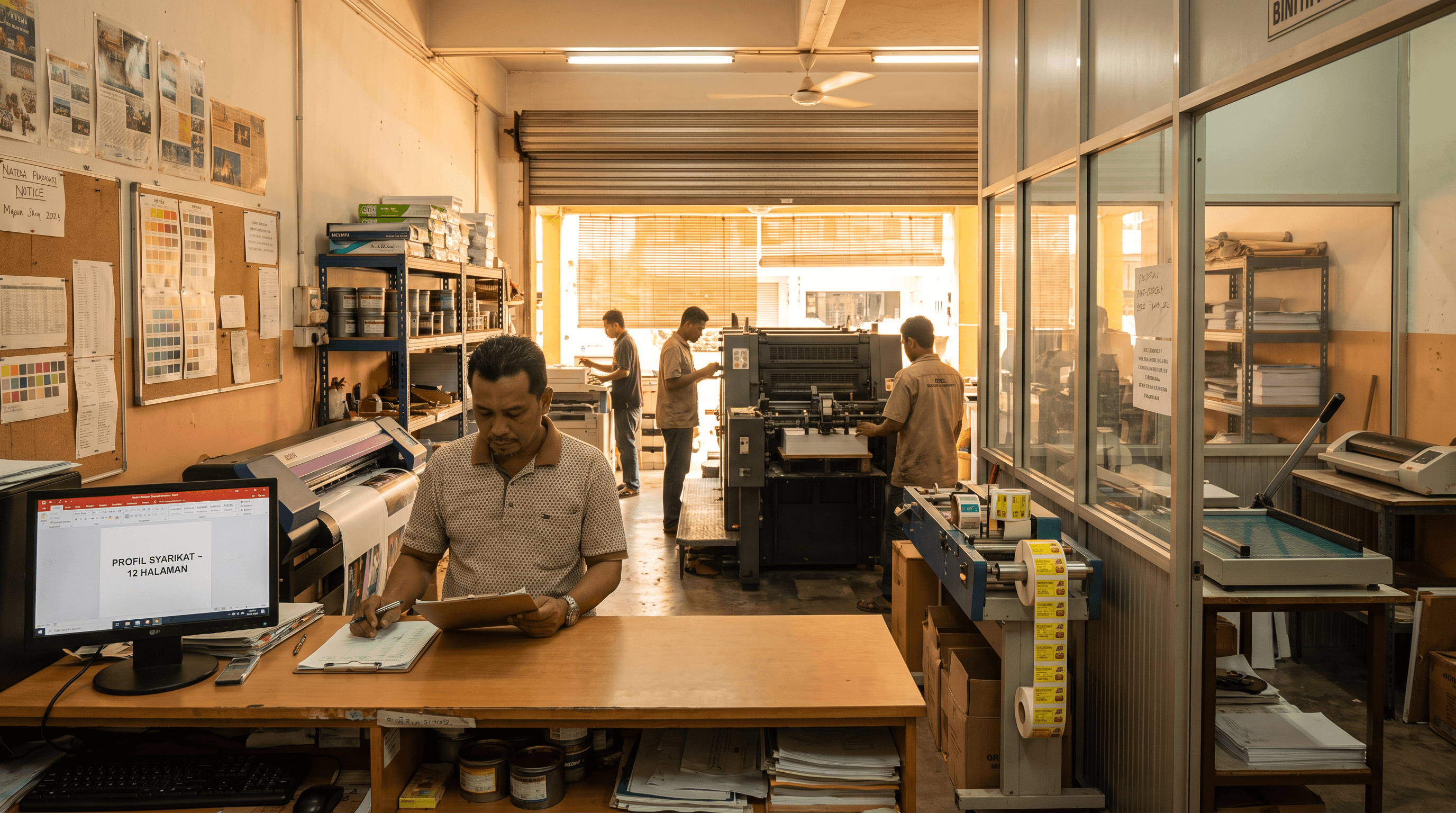
Case study: how an Alor Setar printing shop cut quote turnaround from 3 days to 4 hours with document-AI
A 22-year-old Alor Setar commercial printing shop was taking 2-3 days to turn a customer PDF into a firm quote. We built a document-AI pipeline. 5 weeks in, quotes land in 4 hours and the owner has stopped losing walk-in jobs to faster competitors in Penang.