Case study: how a Kulim line cut mislabels 87% with AI vision
A 60-person Kulim Hi-Tech Park packaging line was scrapping 2% of finished output for mislabeled films. We spec'd a small AI vision checker. Scrap fell to 0.27% in 7 weeks.
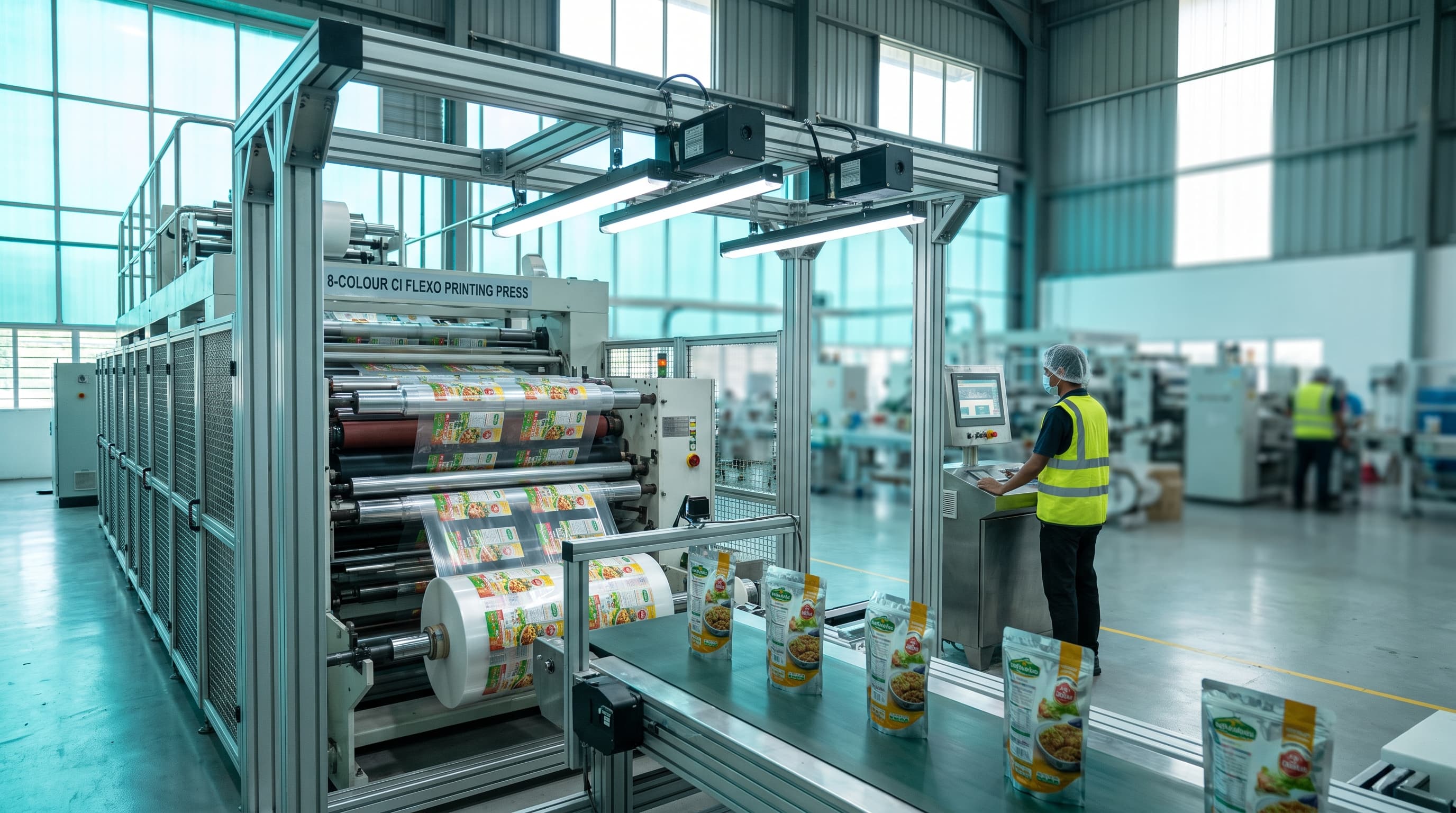
A 60-person food-grade packaging converter inside Kulim Hi-Tech Park was scrapping 2% of finished printed film every month because random-sample QC was missing the mislabel defect — wrong batch code, wrong use-by date, the occasional wrong ingredient panel. Two years of waste added up to about RM 280,000 in scrapped film and one near-miss with a Singaporean dairy customer that almost cost them a 14-container annual contract. The fix was a small AI vision checker mounted over the printing line, not a full machine-vision retrofit. The Kedah services page lists the other AI builds the park and the surrounding corridor run.
The business
A 4-year-old, 60-person food-grade packaging converter based in Kulim Hi-Tech Park — Kedah's flagship industrial estate and the first high-tech park in Malaysia, opened in 1996, anchored on Intel, Fuji, and a long tail of Japanese and Korean supporting industries. The converter prints and laminates food-contact film, stand-up pouches, and tray-seal lids for F&B brands across Malaysia, Singapore, and southern Thailand. Two directors came out of a Penang flexible-packaging group; the third is a Kulim local. Two printing lines, one laminator, one slitter, and a customer base that includes two dairy chains, three sauce brands, and a contract packer for an Australian infant-formula brand.
The problem they were actually trying to solve
The line runs about 28 jobs a week. Each job is a printed film or pouch with a different batch of artwork — a different F&B brand, a different product variant, a different use-by date, a different ingredient panel for the Halal or vegetarian market. The line operates at 110 to 140 metres a minute, and a human spot-checker can realistically inspect 2 to 4 metres per minute out of 110 to 140. The sampling rate was about 2.3% — close to the AQL the quality manual called for, and completely insufficient for catching the kind of defect that doesn't repeat every metre.
The defect wasn't the kind that shows up every cycle. It was occasional — a wrong batch code on a single reel because the operator forgot to update the date-stamp file; an ingredient panel that referenced "contains pork gelatine" on a run that was supposed to be the Halal variant; a use-by date that lagged the production date by 4 days instead of 2. These defects happen 1.5% to 2.2% of the time.
The cost was running at roughly RM 280,000 a year — RM 195,000 in direct scrap, RM 50,000 in customer-side return freight and admin, and RM 35,000 in the "goodwill credit" line where the F&B brand's QA team docked 3% off the next invoice. The March 2026 near-miss — a Singaporean dairy customer catching a mislabel on a 12-reel order that had already left the loading bay — cost the converter RM 41,000 in reprint and air-freight, plus an 8% credit note.
What the operations director said on the first call: "I don't need a fancy system. I need something that watches every metre of the printed film and screams when the text on the reel doesn't match the job card. The spot-checkers are missing it, and we're losing customers because of it." That sentence is the brief. Same shape as the Alor Setar printing shop case study — a different shop, a different defect, the same underlying problem.
What we built — and why this approach
A small AI vision checker mounted on a frame above the printed-film exit of the 8-colour press, plus a thin classification model trained on the converter's own artwork library. Four parts:
- Two industrial cameras and a controlled LED bar mounted 1.4 metres above the printed film web, capturing a 2K line-scan image of every metre that passes underneath.
- A small custom-trained model running on an edge GPU at the line. The model OCRs the printed text (batch code, use-by date, ingredient panel, brand variant) and compares it to the job-card spec pulled from the converter's MIS. A mismatch is a defect. The model retrains on the converter's own artwork library — no need to label thousands of images.
- A 10-inch HMI on the line showing the operator, in real time, what the camera saw, what the job card called for, and a clear PASS / FAIL signal. A FAIL stops the press within 800 milliseconds and queues the offending metre for the operator to inspect, accept, or scrap.
- A daily defect report emailed to the operations director and shift supervisors, with the printed-vs-spec mismatch, the timestamp, the operator's decision, and the running scrap rate per job.
Why not just buy an off-the-shelf machine-vision system from a German vendor? Two reasons. First, the off-the-shelf systems start at RM 380,000 for a comparable line and come with a per-feature licence model — the converter would have paid for 14 features to get the one it needed. Second, the off-the-shelf systems assume the artwork is stable, and the converter's artwork changes every job — sometimes every 2 hours. The custom AI approach retrains on the job-card spec automatically, so the model is current for every run. The same architectural logic is in our Alor Setar custom software pricing post for a different problem class.
The build is the named AI agency service — a 6-week spec-and-build engagement, not a 14-month project.
How the operation changed
Three concrete changes inside the first 7 weeks:
- The press operator now sees the defect before the customer does. The HMI shows a PASS / FAIL within 800 milliseconds. The previous sampling rate was 2.3%; the new capture rate is 100% of the printed text.
- The defect-report email changes the daily conversation. The operations director used to find out about mislabel defects when a customer emailed. Now the email arrives at 7.30am the next morning, with the previous day's defect count, the per-job scrap rate, the per-shift operator decisions, and the 14-day trend.
- The goodwill-credit line on customer invoices is essentially gone. The two dairy customers and the Australian infant-formula packer — the three accounts most sensitive to mislabel defects — have all done their own line-side audits since the AI checker went live. The goodwill credit line dropped from RM 35,000/year to RM 2,400/year inside 8 weeks.
The build is now in the second phase — extending the same architecture to the slitter and the laminator.
The numbers, seven weeks in
We don't do client testimonials. We do numbers. The converter's view, seven weeks after the AI checker went live:
- Mislabel scrap rate: 2.0% → 0.27% of finished output. An 87% reduction. The 0.27% is the residual — the cases where the OCR model couldn't read the printed text clearly and the operator made the call manually.
- Direct scrap cost: RM 195,000/year projected → RM 26,300/year actual. A RM 168,700/year saving. The build paid for itself in the first 14 weeks on scrap-avoidance alone.
- Customer-side returns: 11/year → 2/year. The two remaining cases were both customer-side artwork mismatches, not converter-side defects. Neither cost the converter a credit note.
- Goodwill credit line: RM 35,000/year → RM 2,400/year. A 93% drop. The two dairy customers stopped asking for credit the moment they saw the first defect report email.
- Operator time on the QC bench: 6.4 hours/day → 1.8 hours/day. The same two staff now sample 100% of the printed film from the HMI instead of 2.3% from the QC room.
- Press OEE: 71% → 74%. A small but real improvement, because the AI checker is faster than the human at catching a defect and the press stops for shorter windows.
Total first-phase cost: RM 38,000 for the cameras, LED bar, edge GPU, and panel-mount HMI; RM 14,000 for the model training, MIS integration, and 8 weeks of tuning; RM 4,800 for the install. The build was 6 weeks from kickoff to live, with a 1-week shadow mode where the AI checker scored every metre without stopping the press.
Payback: 14 weeks.
What it would cost for your business
We don't publish a price sheet, because the price depends on what you're running. Three honest bands for a Kedah, Penang, or Selangor packaging converter or FMCG line:
- RM 32,000 – RM 55,000 (one-off) + RM 500 – RM 1,200 / month. A single-line AI vision checker for a 1 to 2 printing line converter, 1 to 80 staff, with one MIS source and a stable artwork library. Includes cameras, LED bar, edge GPU, model training, MIS integration, and 90 days of tuning. The Kulim converter sits in this band.
- RM 55,000 – RM 110,000 (one-off) + RM 1,200 – RM 2,500 / month. A 3 to 6-line converter, multi-press environment, multi-MIS source, with a second-phase extension to slitter, laminator, or pouch-making. The artwork library spans 500+ active SKUs.
- RM 110,000 – RM 220,000 (one-off) + RM 2,500 – RM 4,500 / month. A multi-site converter (Penang + Kulim, or Selangor + Perak) with 6+ lines, central QC dashboard, customer-facing defect-report portal, and integration into the customer's own quality system.
What this looks like for your business
If you run a Kulim, Penang, or Shah Alam packaging line and the spot-checkers are missing a defect that shows up at the customer end, this kind of build is the right first move. We don't sell you a RM 380,000 German machine-vision system. We spec the smallest AI checker that watches every metre of your printed film and screams when the text doesn't match the job card. You stop eating RM 200,000 a year in scrap, you stop paying goodwill credits, and you stop almost-losing your best customer to a mislabel.
The next step is a one-hour call, no slide deck. You tell us your line speed, your artwork library, your current sampling rate, your MIS source, and your three most expensive customers. We tell you whether an AI vision checker is the right answer, or whether a smaller custom-software build is the better fit. We won't pitch you either way. Get in touch and we'll set up the call. Our Ipoh FB AI agent case study shows the same architecture for an FMCG line, and the Perak AI maintenance schedule post shows the upstream-downtime build.
About the author
The pitchdeck.my team
I run pitchdeck.my — fifteen years building custom software, automation, and AI tooling for Malaysian SMEs, from Alor Setar family businesses to KL fintech desks. Most weeks I’m scoping a new build, writing the spec, and shipping the first version with the founder.
- AI for SMEs
- Custom software
- Malaysian markets
- Business automation
Related builds
Get ai agency in Kedah
Frequently asked questions
The architecture works on every printed substrate we've tried — PET, BOPP, PE, alu-foil laminates, paper-based pouches. OCR accuracy varies: black text on white film is 99.6%, metallic ink on metallised film drops to 96% to 98%. For metallised film and alu-foil laminates, we add a second camera and a polarising filter to lift OCR back to 99%+.
No. The model reads printed text directly (OCR + entity matching against the job-card spec). The first deployment trains on the converter's own artwork library. Retraining on a new artwork takes about 8 minutes, fully automated. The 6-week build timeline is camera mounting, MIS integration, and operator training — not data labelling.
The AI checker is an additional monitoring layer, not a replacement. The daily defect report and the per-metre PASS / FAIL log become part of the audit trail the FSSC 22000 and BRCGS auditors want to see. All three of the converter's customers who did a line-side audit after the build noted the daily report as a positive finding. We did not change the HACCP plan or the operator sign-off chain.
Yes, but it's a different model. The first-phase build is text-only OCR + entity matching. The second-phase extension adds a colour-drift detector and a registration checker. The slitter + laminator extension the converter is now running is the colour-drift half; the registration half is a 2-week add-on. The full multi-defect package lands at the RM 55,000 – RM 110,000 band.
Tell us what you run.
We’ll spec the fix in a week.
Priced like a hire, not a project — around the cost of one admin a month. Most builds pay back in 30 days or less.
Get a build specMore for Kedah
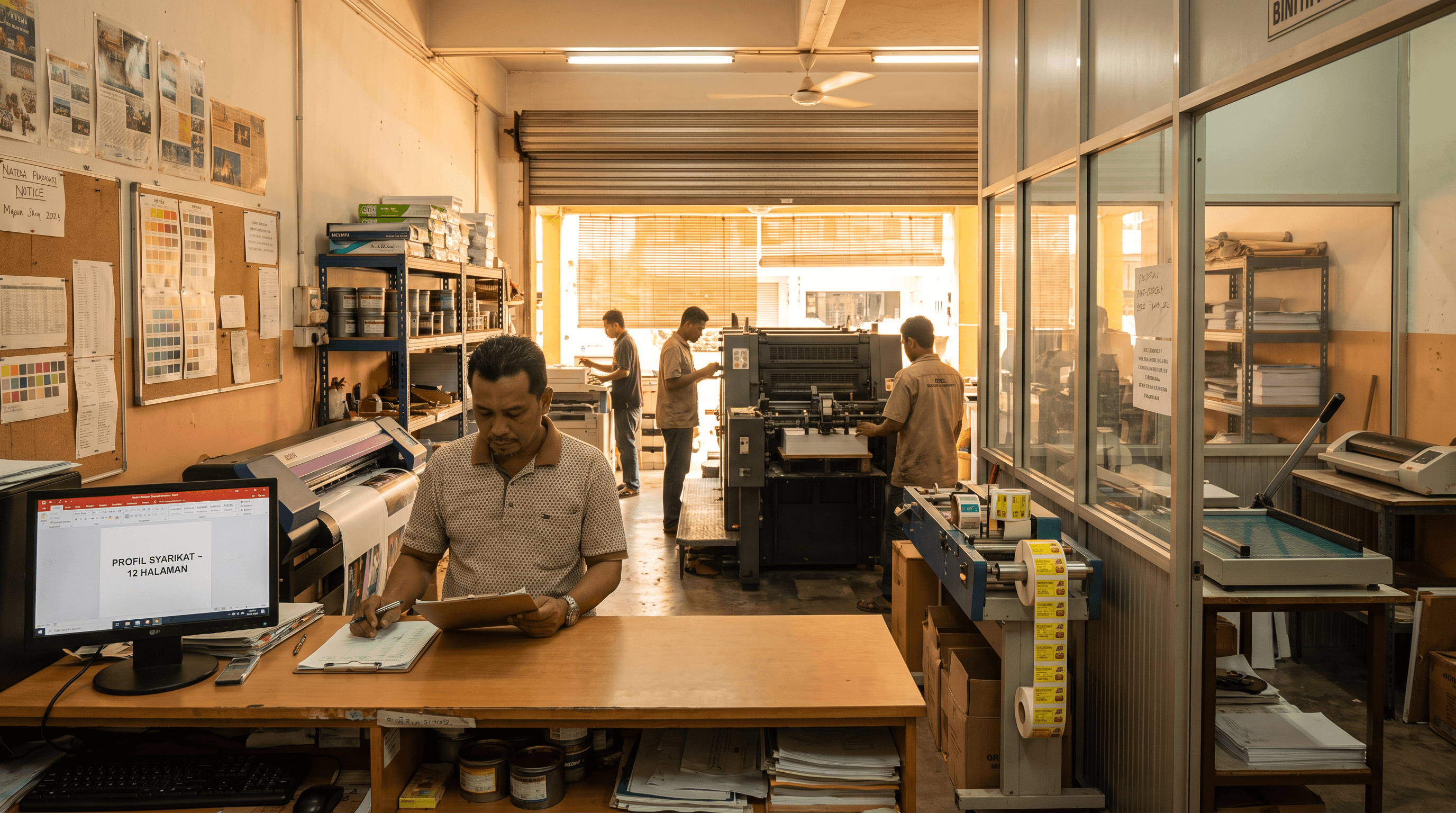
Case study: how an Alor Setar printing shop cut quote turnaround from 3 days to 4 hours with document-AI
A 22-year-old Alor Setar commercial printing shop was taking 2-3 days to turn a customer PDF into a firm quote. We built a document-AI pipeline. 5 weeks in, quotes land in 4 hours and the owner has stopped losing walk-in jobs to faster competitors in Penang.
How to choose an AI agency in Malaysia (without getting burned)
The 12-point checklist, the red flags, the questions to ask, and the contract clauses that protect you. Written by the agency you're hiring.