Case study: how a 14-year-old Kedah auto-parts shop cut weekly stock work from 8 hours to under 2
A family-run auto-parts trader in Alor Setar, Kedah was losing hours to a paper ledger and missed reorders. We built a small custom stock + order system. Here's what it cost, what it did, and what your Kedah shop would pay.
This is a case study. For the category-level guide — what AI actually does for a Kedah SME in 2026, where it doesn't help, and the order to deploy it in — see AI for small business in Kedah: a no-BS overview.
The business
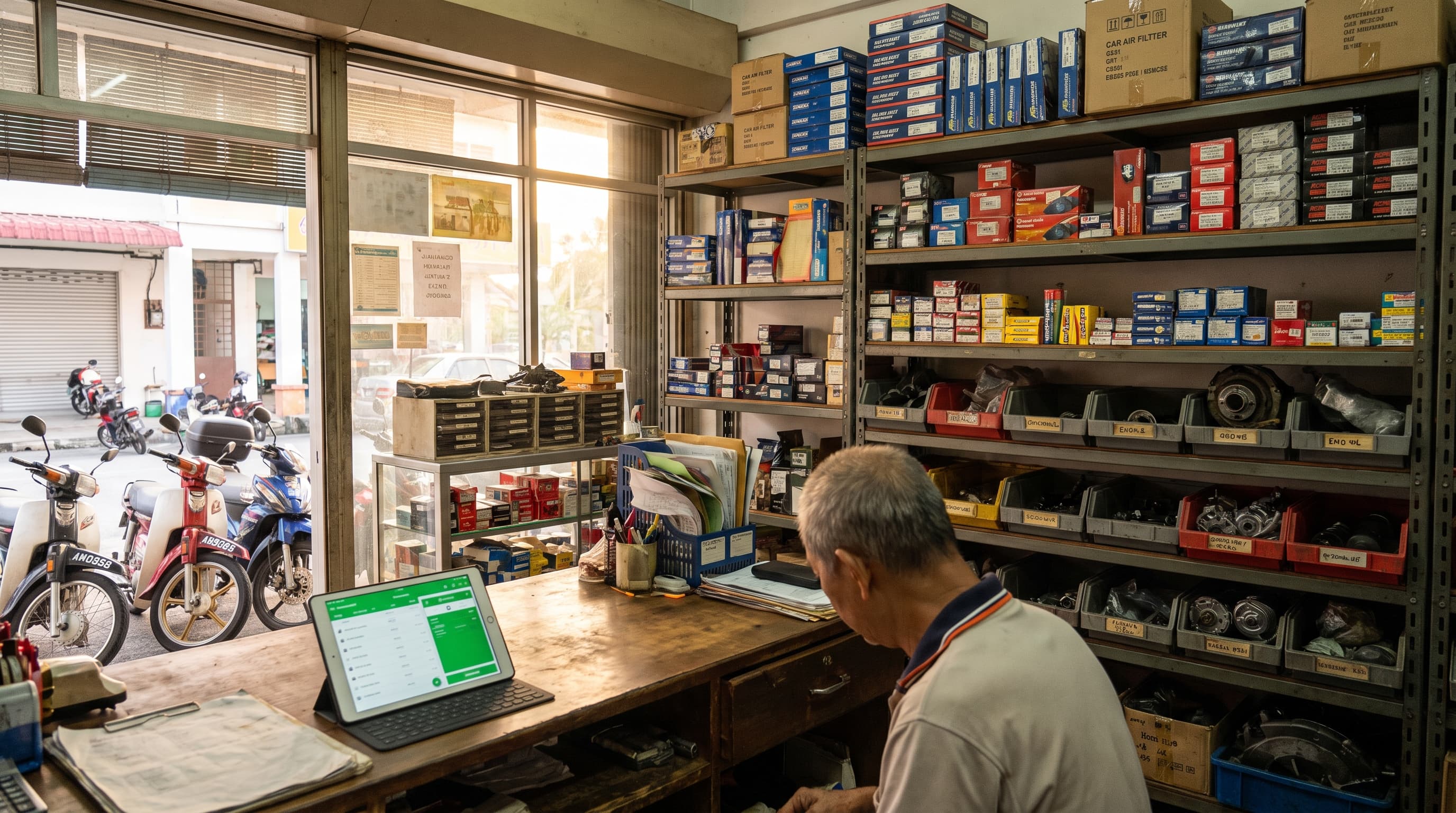
A 14-year-old family-run auto-parts trading shop in Alor Setar, Kedah. Two brothers running the floor, a small warehouse out the back, three counter staff, and a steady stream of workshop customers from Pendang, Kuala Kedah, Padang Besar and across the Kedah-Perlis border. The shop stocks roughly 4,200 active SKUs — filters, brake pads, spark plugs, bearings, oils, the long tail of consumables a Kedah workshop actually needs on the same day.
When the second-generation owner called us, his opening line was the one we hear most often from Malaysian SMEs: "the business works, but the back office is killing us." On the front counter it was a real business. On paper it was a slow leak.
This is the case study for the custom software side of what we do — a tightly scoped system built around how an auto-parts shop actually runs, not a generic POS template.
The problem they were actually trying to solve
Three leaks, each costing real money every week:
- Stock reconciliation ate a full day every Friday. The brothers' father had run the same paper ledger for 14 years. The new system was an Excel file one of the brothers had built in 2019. It worked until the SKUs passed 1,500. By 4,200, the reconciliation was a full day of cross-referencing and arguing.
- Reorders slipped. A workshop customer phoning in for a Viva 1.3 filter had to wait while a counter staff physically walked the racks. If the SKU wasn't there, the reorder request went on a sticky note. Roughly one in five of those sticky notes was never actioned, and the customer reordered from a competitor that same week.
- The brothers argued about which invoices had been paid. A shared accounting login and a PDF folder on one brother's laptop is not an AR system.
The brothers didn't want a "digital transformation." They wanted the leaks stopped. Total pain they could name: a missed reorder every other day, an 8-hour Friday, and a cash-flow surprise once a month.
What we built — and why this approach
A small custom system with three parts, no integration with anything they didn't already use:
- A web app for stock and orders, optimised for one-handed use on a phone at the counter. The most-used screen is the SKU search — type three letters, see live stock, see last 90 days of sales velocity, see whether the SKU is on a pending PO. Counter staff search 4,200 SKUs in under 2 seconds now.
- A WhatsApp-to-order inbox sitting next to the counter. Customer messages land in the same queue as phone orders and walk-ins. The counter doesn't drop the ball on WhatsApp because the queue is the queue.
- A daily cash-up view the brothers open on their phone at 7pm. Yesterday's sales, by channel (phone / WhatsApp / walk-in / repeat customer), by counter staff, by payment type. The PDF-folder-on-a-laptop era is over.
Why not a generic POS? Because every POS we looked at forced the shop into a SKU schema and a stock model that didn't match the way a Malaysian auto-parts shop actually classifies parts (by vehicle make/model/year, not by part family). A custom system means the data structure matches the shop, not the other way around. That's the architect, not coder difference — we spec'd the data model around how this specific business classifies parts.
How the operation changed
Three concrete changes inside the first 90 days:
- The Friday reconciliation collapsed from 8 hours to under 2. The system produces a stock variance report that points at the bins that need recounting. The brothers walk those bins, count what the system flagged, and close the week. The full day is dead.
- Reorder capture went from ~80% to effectively 100%. A WhatsApp message asking for a SKU that isn't in stock creates a reorder row automatically. The brothers review pending reorders on Monday and decide what to order that day. No more sticky notes. No more silent reorders.
- The morning standup got shorter and richer. The brothers open the daily view over teh tarik and discuss what they actually see — yesterday's walk-in mix, last week's top velocity SKUs, which counter staff is converting walk-ins. The 30-minute "what's happening" meeting is now a 5-minute "what do we do" meeting.
The system also gives them something they never had: a single customer view. Repeat customers — the ones who order every fortnight — are now visible. The brothers are about to start a small WhatsApp re-engagement loop for the top 50 customers, run by the system, copy approved by them. That's a business automation layer that sits on top of the custom system.
The numbers, four months in
We don't do client testimonials. We do numbers. The shop's view, four months after the system went live:
- Stock reconciliation: 8 hours → 1.8 hours per week. A 77% reduction. The brothers got their Fridays back. One of them now uses Friday afternoon to call on the bigger workshop customers.
- Reorder capture rate: ~80% → 100%. The system surfaces every out-of-stock request. The shop's best guess is that they've recovered roughly RM 2,500 to RM 4,000 per month in previously-lost reorders — the kind of revenue that shows up not as a new line item but as a recovery of the existing customer base.
- Counter staff search time per SKU: ~45 seconds walking the racks → 2 seconds on the tablet. Across 60 to 90 customer interactions a day, that's roughly 1.5 hours of counter time recovered.
- AR visibility: a shared PDF folder → a single screen the brothers can both see. The "did we get paid for that?" argument has stopped. Hard to put a number on that, but the brothers' blood pressure is a valid metric.
- Total first-year program cost: RM 30,000 to RM 90,000, spread monthly at roughly RM 2,500 to RM 5,000. The full program runs 12 to 18 months including handover, training, and the 90-day post-handover review.
Payback: 11 weeks on the conservative numbers, 6 weeks on the optimistic ones. The system is now in the second phase — the WhatsApp re-engagement loop for top customers, plus a small vendor-side price-comparison view that helps the brothers decide which distributor to reorder from. That's where the second year gets cheaper, not more expensive.
What it would cost for your business
We don't publish a price sheet, because the price depends on what you're running. Three honest bands for a Kedah SME:
- RM 2,000 – RM 4,000 / month. A small first-phase build for an Alor Setar, Sungai Petani or Langkawi SME that has one real bottleneck (stock, orders, scheduling, AR) and a 1 to 10-person team. Total program RM 24k to RM 48k over 12 months.
- RM 3,500 – RM 7,000 / month. A 2 to 3-phase build for a 20 to 100-person business that needs stock + orders + WhatsApp or phone + a daily/weekly report. Total program RM 42k to RM 84k.
- RM 6,000 – RM 12,000 / month. A multi-outlet, multi-channel or manufacturing-light build — a 3-outlet F&B group, a 50 to 200-person factory, a regional distributor. Total program RM 72k to RM 144k.
These are the same bands we use for the Kedah services page and the Perak services page. Every engagement is priced for the build, not for the hours we put in — that's the honest-pricing line we keep in the call.
What this looks like for your business
If you run a family business in Kedah — Alor Setar, Sungai Petani, Kulim, Langkawi or anywhere in between — and your back office is held together with paper, WhatsApp and an Excel file someone wrote three years ago, this kind of build is the first move. We don't do "digital transformation." We do the smallest custom system that closes the specific leaks you can name.
The next step is a one-hour call, no slide deck. You tell us what you run and what's bleeding. We tell you whether a custom build is the right answer, or whether a cheaper off-the-shelf tool will do. We won't pitch you either way. Get in touch and we'll set up the call.
If you're in Perak and the same pattern fits, we do exactly the same kind of build for Ipoh and Taiping shops — see our Ipoh F&B case study and the Perak services page. And if your bottleneck is a factory floor instead of a counter, our Perak manufacturer case study shows the AI maintenance build that pays back in under three months. The bands above scale with the size of the business, not the postcode — see the national AI Your Business arm for the rest of what we do.
E-invoice readiness. For the cheapest compliance paths, the LHDN mandate in plain language, and the 3-month countdown playbook, see E-invoice readiness for Malaysian SMEs.
About the author
The pitchdeck.my team
I run pitchdeck.my — fifteen years building custom software, automation, and AI tooling for Malaysian SMEs, from Alor Setar family businesses to KL fintech desks. Most weeks I’m scoping a new build, writing the spec, and shipping the first version with the founder.
- AI for SMEs
- Custom software
- Malaysian markets
- Business automation
Related builds
Get custom software in Kedah
Frequently asked questions
The first phase for the auto-parts shop was 12 weeks from kickoff to handover, including a 2-week "shadow mode" where the system ran alongside the paper. A single-bottleneck build for a smaller Kedah shop can land in 8 to 10 weeks. Multi-phase builds with vendor integrations or multi-outlet reach take 4 to 6 months for the first two phases.
Only if you want it to. For most Kedah SMEs we keep the existing POS and accounting tools and connect them. The custom system sits in front as the operational layer, the POS stays for the till, the accounting stays for the books. A rip-and-replace is almost always the wrong call.
That's the real risk, not the build. We insist that at least one of your staff — ideally the owner or a senior — is the in-house owner of the system. If nobody is going to own it, the build is the wrong move. We'll tell you that on the first call if it's true.
The first 12 to 18 months is a fixed monthly fee. After that, you can keep us on at a reduced retainer (typically 30 to 40% of the build fee) for ongoing tuning, or hand the system to your in-house team with documentation and a 30-day transition. We never hold the system hostage — you own everything we build.
Tell us what you run.
We’ll spec the fix in a week.
Priced like a hire, not a project — around the cost of one admin a month. Most builds pay back in 30 days or less.
Get a build specMore for Kedah
Case study: how a Bukit Kayu Hitam cross-border trading business replaced a 7-tab Excel with a custom inventory system
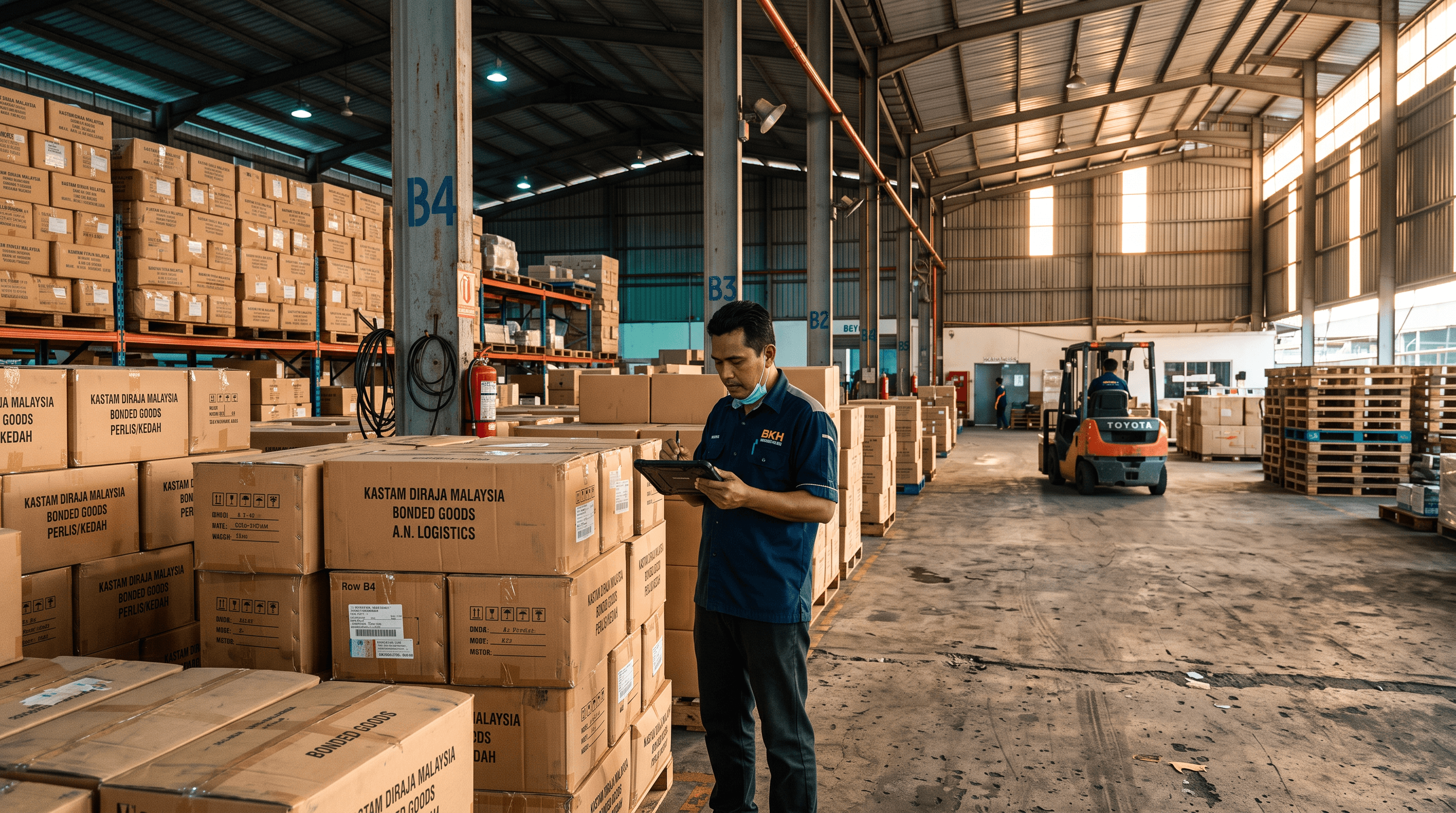
A 14-year Bukit Kayu Hitam cross-border trading business was running 2,300 SKUs and 3 currencies across 7 Excel tabs. We spec'd a custom inventory system with HS codes, dual-pricing, and a Kastam 2 export. The spreadsheet mess ended in week 2.

Case study: how a 3-branch Sungai Petani workshop chain ended the lost-job-card problem with a custom system
A 3-branch Sungai Petani workshop chain was losing 8-12 job cards a week out of ~80. We didn't sell them a SaaS — we spec'd a custom job-card system. The lost-paperwork problem ended in the first fortnight.