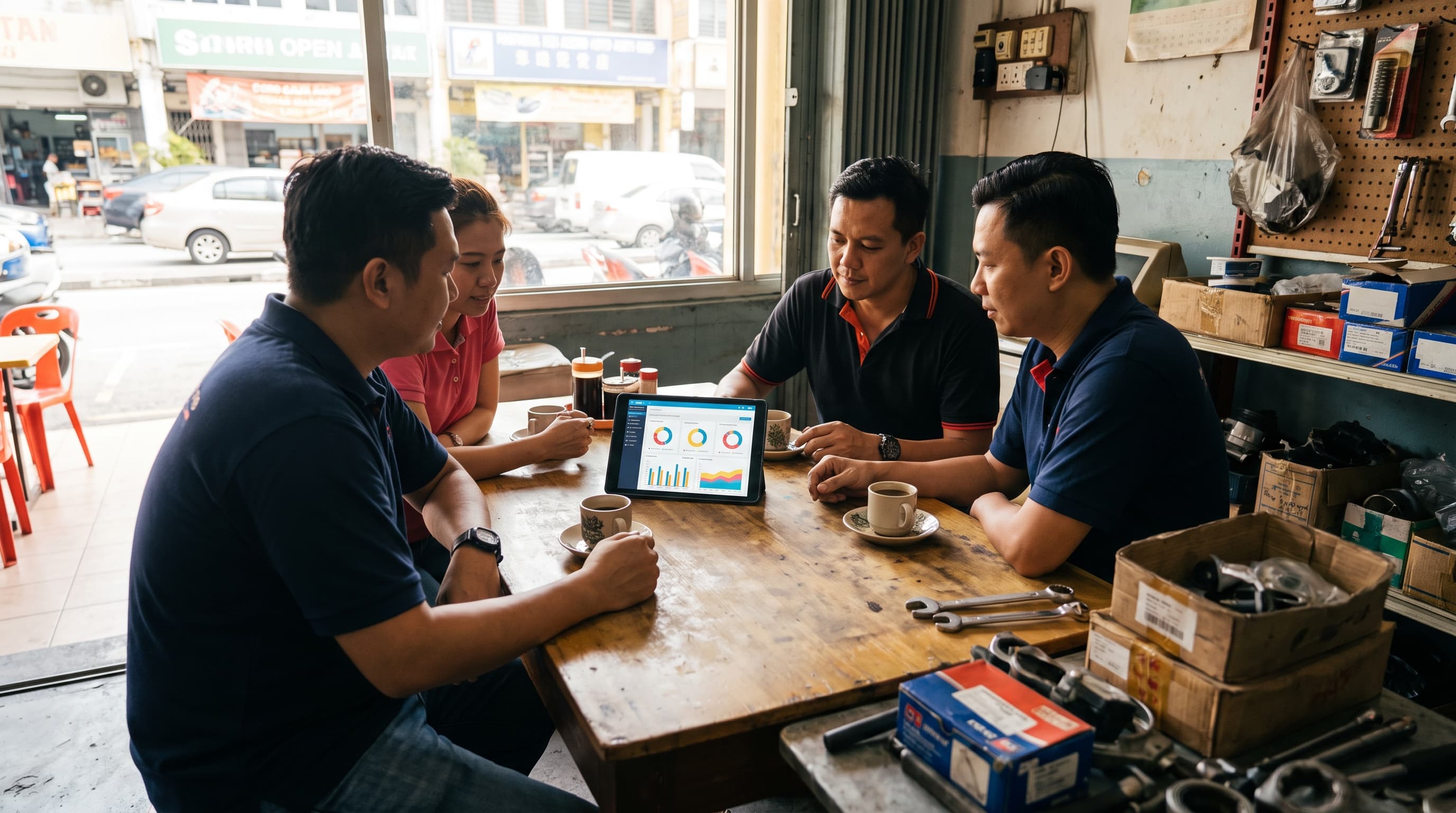
Custom software for Malaysian SMEs: the honest 2026 guide
By The pitchdeck.my team
This is the pillar guide for custom software in Malaysia. If you're an SME owner in Alor Setar, Ipoh, Petaling Jaya, Johor Bahru, Kota Kinabalu, or anywhere in between — and you've been Googling "custom software Malaysia" or "should I build my own system" — this is the one read.
We're going to walk through four things, honestly:
- What "custom software" actually means in 2026 (and what it doesn't).
- When custom is the right call — and when you should walk away.
- What it really costs a Malaysian SME in 2026, with real RM ranges.
- How to pick a build partner without getting burned.
No vendor pitch, no "transformation journey," no "unlock the power of." Just the framework we use ourselves when a Malaysian business owner asks us the question: "should I build custom, or buy something off the shelf?"
We answer that question both ways depending on the business. About a third of the time the answer is "don't build custom — buy a RM 200/month SaaS and stop overthinking this." This guide exists because that honest answer is the difference between an agency you can trust and one that's just trying to close a deal.
If you want to skip the framework and go straight to the case studies that informed it, jump to Case studies from the field. The five builds linked there are real Malaysian SMEs — Alor Setar, Sitiawan, Ipoh, Kulim, Sungai Petani — and they're the closest thing to evidence we have.
If you'd rather book a 30-minute call to talk through your specific situation, contact us. We don't pitch either way — if the answer is "buy a RM 200/month SaaS," we'll tell you to do that.
And if you're on the other side of the table — a founder with a working business looking to raise capital, not build software — that's a different platform on this site. You can browse Malaysian businesses raising on pitchdeck.my, or submit your own listing if you've got a business that fits.
What "custom software" actually means in 2026
Let's define the term honestly, because the Malaysian market is full of agencies that use "custom software" to describe things that aren't.
Custom software is code written specifically for one business's workflow, data model, and integration needs. It's not a template. It's not a configuration. It's not "we customised the settings on a SaaS product." It's a system whose data model and business logic match how your business actually runs — not how a generic vendor thinks your business should run.
That distinction matters because it's the source of almost every "custom software failure" story you'll hear. The Kedah auto-parts shop we worked with had been sold "customisation" of a generic POS twice before they called us. What they got was the same POS every other auto-parts shop gets, with their logo on top and a "configuration fee" of RM 18,000. The data model was wrong (parts were organised by part family, not by vehicle make/model/year — the way every Malaysian auto-parts shop actually classifies them). The shop kept a parallel paper ledger because the POS couldn't represent how they actually worked.
That wasn't custom software. That was a dressed-up SaaS with a configuration fee.
Here's the spectrum, most common to least common in Malaysia:
- SaaS subscription — you pay monthly, you get a multi-tenant product, you fit your business into the vendor's data model. Examples: StoreHub, Qashier, Xero, AutoCount, SQL Account, HubSpot. Cheap (RM 50 – RM 2,000/month), fast to deploy, but rigid. Good for 70% of Malaysian SMEs.
- Off-the-shelf with customisation — you buy a license or annual subscription and pay a partner to configure it. Examples: SQL Account with custom reports, an AutoCount deployment with a bespoke stock module, a HubSpot implementation with custom integrations. Moderate cost (RM 5,000 – RM 50,000 one-time + subscriptions), moderate flexibility, vendor lock-in.
- No-code / low-code on a platform — you build on Bubble, Glide, Airtable, AppSheet, Notion, or a similar platform. Cheap (RM 0 – RM 500/month in subscriptions), fast to iterate, but limited when you hit a workflow the platform doesn't support. Good for internal tools, prototypes, and small ops dashboards. Breaks down around 10,000 records or 5 concurrent users.
- Custom software — code written for your business, by a team that studies your operation. Most expensive (RM 30,000 – RM 300,000+ for a first system, RM 1,500 – RM 8,000/month to maintain), slowest to start (6 – 12 weeks minimum), but it matches the way your business actually runs. Pays for itself when the SaaS off-the-shelf option can't model the workflow — which, for a non-trivial Malaysian SME, is often.
The mistake most Malaysian SMEs make isn't choosing the wrong option. It's choosing option 4 (custom) when option 1 or 2 would have done the job fine, because an agency sold them on the dream of "a system built around your business." That dream is real — but only for the businesses that actually need it. The other 60% would have been better off with a RM 200/month StoreHub deployment and the time it would have freed up.
The mistake in the other direction is choosing option 1 (SaaS) when the business has a workflow the SaaS can't model — a 4,200-SKU auto-parts shop, a Sitiawan seafood processor with batch traceability requirements, a 200-person food processing plant with multi-stage QA. The SaaS gets them 80% of the way, then the business builds parallel paper processes to cover the 20% it can't do, and the team ends up with two systems and double the admin.
The job of this guide is to help you figure out which side of that line your business is on.
When custom is the right call (and when it isn't)
Before you talk to any agency, run yourself through these four questions. Be honest. The wrong answer here will cost you six months and RM 80,000.
Question 1: Can you name the specific workflow that an off-the-shelf product can't model?
Not "our reporting isn't great" or "we want it to look like our brand." Specific. Like: "Our parts are classified by vehicle make, model, year, and engine code, and every generic POS we've looked at forces us into a part-family structure that doesn't match how we work." Or: "We need to trace every finished-product batch back to the fisherman, the receiving date, every operator who handled it, and every freezer temperature reading — for a buyer audit in 9 weeks."
If you can name the workflow, and the off-the-shelf product genuinely can't do it (you've tried, you've talked to the vendor, you've looked at the roadmap), you're a candidate for custom. If the answer is "we want a better experience" or "we want our own dashboard," you're a candidate for off-the-shelf with customisation, not custom.
Question 2: Will the build pay for itself within 12 months?
The honest math. A RM 60,000 custom system that saves your business RM 5,000/month in recovered reorders, reduced overtime, and fewer audit-prep hours pays for itself in 12 months. That's a yes.
A RM 60,000 custom system that "modernises the operation" but doesn't have a concrete, measurable payback line is a no. You'll feel good about it for a quarter, then quietly go back to the old way of working when the novelty wears off.
Most Malaysian SMEs that should build custom can name the payback line in RM/month. The ones that shouldn't, can't.
Question 3: Do you have someone on the team who will own the system after handover?
This is the question most agencies don't want you to ask. A custom system without an internal owner is a system that gets abandoned in 6 months when the founding team gets busy with the next fire.
The owner doesn't need to be technical. They need to be the person who (a) uses the system daily, (b) cares about the data quality, and (c) has the authority to push the team to actually use it. The Alor Setar brothers were both owners. The Sitiawan QA manager was the owner. The Ipoh kopitiam operations manager was the owner.
If you don't have this person — if the system is going to be "everyone's job" or "the IT guy will figure it out" — you don't have a custom software project, you have a custom software purchase that will fail.
Question 4: Is the business stable enough to absorb a 3-month build?
Custom software is a 6-to-12 week build plus a 3-to-6 month bedding-in period. During that time, your team is doing double-entry (old way + new system), the agency is asking you questions every Tuesday, and someone senior is spending 2-4 hours a week on the project.
If the business is in crisis mode — sales down 30%, key person just left, regulatory deadline next month — a custom software project is the wrong move. Fix the crisis first. Custom software is for businesses stable enough to invest in the next 2-3 years of operation, not for businesses trying to survive the next 3 months.
If you answered "yes" to all four questions, you're a candidate for custom software. The next two sections cover what it costs and how to pick a build partner.
If you answered "no" to any of them, you probably want options 1, 2, or 3 above. Skip to the Case studies from the field section to see how the framework applies to real Malaysian SMEs — including the ones where the right answer was "buy a SaaS, don't build."
The honest cost: what a Malaysian SME actually pays
No agency publishes their actual price list, so the market is full of "it depends" answers. Here's what it actually depends on, with real RM ranges from the builds we've done in 2025-2026.
Scope 1: A small internal tool or dashboard. RM 15,000 – RM 50,000.
Examples: a daily cash-up view that pulls from your existing POS, a WhatsApp-to-order inbox for the counter, a single-screen inventory lookup for a 4,200-SKU auto-parts shop. 3-6 weeks. One agency, one developer, one project manager. Paid monthly over 6-12 months at roughly RM 2,500 – RM 5,000/month. The build is small enough that one or two founders are the primary stakeholders, and a single ops person is the post-handover owner.
This is where most Malaysian SMEs should start. Not with a "full digital transformation." With one specific tool that solves one specific pain. The 4,200-SKU auto-parts shop's first build was this scope — a stock and order system, not a full POS replacement. The Sitiawan seafood processor's first build was this scope — a batch-traceability module, not a full ERP. Both are good candidates for scope 1. If you want to see what a scope 1 build costs in your state, the state-level pages — custom software in Selangor, Kuala Lumpur, Penang, Kedah, Perak, Johor — give you the local market angle.
Scope 2: A small operational system. RM 50,000 – RM 150,000.
Examples: a custom stock + order + AR system for a multi-branch retail operation, a batch-traceability + QA + dispatch system for a mid-sized food processor, a WhatsApp-first customer ops platform for a 50-person services company. 8-16 weeks. One agency, 2-3 developers, one project manager, one QA. Paid monthly over 12-18 months at roughly RM 4,000 – RM 10,000/month. The system has internal users across multiple roles, and the post-handover owner is a senior ops or finance person.
This is the right scope when the off-the-shelf product genuinely can't model the workflow, but the build is still scoped enough to ship in one release. Most of the SMEs we work with fall here. The national service page — custom software at pitchdeck.my — gives the cross-state view of how scope 2 builds are typically structured.
Scope 3: A larger platform with integrations. RM 150,000 – RM 500,000+.
Examples: a multi-tenant marketplace, a fintech ops platform, a logistics aggregator, a system with multiple external integrations (LHDN e-invoicing, banking APIs, payment gateways, WhatsApp Business API at scale). 4-9 months. One agency or a small studio, 4-6 developers, one project manager, one QA, sometimes a part-time DevOps. Paid monthly over 18-36 months. The post-handover owner is usually a CTO or a senior tech lead.
This is the scope where a Malaysian SME is essentially building a product, not a tool. It's also the scope where the failure rate is highest, because the business usually hasn't yet validated the underlying workflow at a smaller scale.
What the price includes (and doesn't):
The RM amounts above include discovery (1-2 weeks of studying your business and writing a build spec), the build itself, UAT (user acceptance testing) with your team, deployment, training, and a 30-to-90 day post-handover review. They do NOT include:
- Ongoing maintenance after the post-handover period. That's a separate RM 1,500 – RM 8,000/month retainer, depending on scope.
- Hosting / cloud bills. RM 100 – RM 2,000/month for a small system, RM 2,000 – RM 10,000/month for a larger one. Most Malaysian agencies bundle this into the retainer.
- The cost of changing your own internal processes to use the new system. This is the hidden cost most agencies don't price. The Alor Setar brothers spent 30-40 hours in the first 90 days training staff, fixing data quality issues, and changing how they ran the morning standup. That time was on them, not us.
- Future feature work. The system you ship in month 3 is rarely the system you want in month 12. Plan for a Phase 2 of roughly 30-50% of the Phase 1 cost, 6-12 months after go-live.
Two cheap tells about whether an agency is being honest with you:
If the quote is a single number with no breakdown, walk away. The breakdown should clearly separate discovery, build, deployment, and post-handover. A 200-word breakdown of "we'll do this in 12 weeks for RM 80,000" is fine. A one-line "RM 80,000 for a custom system" is a tell.
If the agency won't give you a fixed-price quote (or refuses to commit to a number with a cap), walk away. The right answer is "we'll fix the price at RM 80,000 for the scope we've agreed, and we'll flag any change to scope before we do it." The wrong answer is "it depends on how the build goes" or "we'll do time and materials at RM 250/hour." Time-and-materials is fine for a Phase 2, never for a first build.
The 4 build approaches (and the trade-offs)
Once you've decided to build, the next question is how. There are four realistic options for a Malaysian SME in 2026.
1. In-house development (hire a developer or two).
You hire one or two full-time developers, give them a desk, and have them build the system. Cost: RM 5,000 – RM 12,000/month per developer, plus the management overhead of being their PM. Total cost over 12 months: RM 60,000 – RM 200,000+, but the asset is on your payroll, not with a vendor.
Best for: businesses that have already validated the system at small scale (via no-code or a small agency build) and want to bring it in-house for the long run. Or businesses that have a strong technical founder / CTO who can manage the developers directly.
The honest problem: hiring developers in Malaysia in 2026 is hard. The good ones have offers. The ones who are available are often the ones who are available for a reason. And managing a developer when you're not technical yourself is a real skill. Most Malaysian SMEs underestimate the management cost.
2. Traditional software agency (the slow way).
You hire a software agency, they assign a team, they build the system over 3-9 months at RM 80,000 – RM 400,000+. The agency handles project management, development, QA, and deployment. You handle the business input.
Best for: businesses that need a large, complex system and have the budget to pay for a senior team. Mid-market and enterprise projects.
The honest problem: traditional agencies are expensive, slow, and often over-engineer. The 2026 market has a wave of Malaysian SMEs who paid RM 250,000 for a system that took 14 months to deliver, missed the regulatory deadline, and now sits half-used on a server. The agency has moved on. The business is stuck with the system.
The honest upside: when the project is genuinely complex (multi-team, multi-system integration, regulatory), a traditional agency is the right call. Just budget 30% more time and 30% more money than the initial quote, and plan for the project to be 6-9 months late.
3. Fractional CTO + AI-augmented development (the new way).
You hire a fractional CTO (RM 8,000 – RM 25,000/month for 1-2 days a week) to study your business, write the build spec, and own the build outcome. The build itself is done by a small team using AI coding tools (Claude, Cursor, etc.), which can be in-house, agency-based, or a hybrid. The fractional CTO is the architect; AI is the builder.
Best for: Malaysian SMEs that want the senior thinking of a traditional agency at a fraction of the cost and time. Works especially well for scope 1 and scope 2 projects (small internal tools, small operational systems).
This is the model we use. It's the model that produced the Alor Setar auto-parts case study (RM 30,000 – RM 90,000 first-year program, 4-month payback), the Sitiawan batch-traceability case study (RM 80,000 – RM 130,000 first-year program, contract saved), and most of the systems we've shipped. The architectural thinking is senior. The build speed is 3-5x faster than a traditional agency because the AI handles the boilerplate. The cost is closer to scope 1 than scope 3.
The honest trade-off: the model depends heavily on the quality of the fractional CTO. A bad one is worse than a bad agency, because the failure mode is silent — the system looks fine but the data model is wrong, or the workflow is mis-modelled, and you find out 6 months in. Vet the CTO the same way you'd vet a senior hire.
4. No-code / low-code on a platform.
You build on Bubble, Glide, Airtable, AppSheet, or similar platforms. Cost: RM 0 – RM 500/month in subscriptions, plus 50-200 hours of your own time or a no-code agency's time. Total cost for a small internal tool: RM 5,000 – RM 30,000.
Best for: internal tools, prototypes, small ops dashboards, business workflows that fit cleanly inside the platform's data model. Works especially well for the "first 90 days" of a custom project — you can validate the workflow on a no-code prototype, then decide whether to graduate to a real build.
The honest problem: the platform will eventually constrain you. The question is whether the constraint shows up at month 3 (in which case you've lost a small amount of time) or month 18 (in which case you've built a business-critical system on infrastructure that can't scale). Most no-code platforms have hard limits around 10,000 records, 5-10 concurrent users, and complex data relationships.
A simple heuristic for picking:
- Under RM 50,000, and you can validate the workflow quickly: no-code.
- RM 50,000 – RM 150,000, and you want senior thinking + fast build: fractional CTO + AI-augmented.
- RM 150,000 – RM 500,000+, and the project is genuinely complex: traditional agency (with a fixed-price quote and a senior PM).
- You're a tech company and you have a technical founder: in-house.
If you can't decide, talk to us. The answer isn't always "build with us" — sometimes it's "buy a RM 200/month SaaS and don't build at all." We mean that.
The 30-day / 90-day / 6-month economics
Custom software doesn't pay back on day one. It pays back on a curve, and you should know what the curve looks like before you sign the contract.
The 30-day mark: a working system, not a finished one.
At 30 days post-go-live, the system should be functional. The core workflows should work. The data should be flowing. But the system will have rough edges — missing reports, edge cases that crash a screen, features that are 80% done and need a tweak. The team will be frustrated. The honeymoon is over.
The right expectation: at 30 days, you're still in the "did we make a mistake?" phase. Resist the urge to declare the project a failure. Most successful custom software builds feel rough at 30 days and great at 90 days.
The 90-day mark: the moment of truth.
At 90 days post-go-live, you should see the first hard ROI numbers. The Alor Setar brothers' stock reconciliation dropped from 8 hours to 1.8 hours per week by week 8. The Sitiawan QA manager passed the buyer audit in week 11. The Ipoh operations manager had the first month of recovered reorders by week 10.
The 90-day mark is also when the agency should be doing a structured post-handover review. If your agency doesn't do one, ask for one. The review should cover: what worked, what didn't, what to fix in the next 30 days, and whether the system is on track for the payback line you agreed at the start of the project.
The 6-month mark: the system is the system.
At 6 months, the system should feel like the way you work, not a tool you're using. The team has forgotten the old way. The data is clean. The reports are being read. The new features you didn't have time to build in Phase 1 are now top of mind for Phase 2.
This is also when the payback math is honest. If you agreed on a 12-month payback and you're at 6 months with 40% of the projected savings realised, the system is on track. If you're at 6 months with 10% of the projected savings realised, the system isn't paying back and you need a hard conversation with your agency about why.
A real example, full curve:
The Alor Setar auto-parts shop's first-year program cost RM 30,000 – RM 90,000. By month 4, the measured savings were:
- Stock reconciliation: 8 hours/week → 1.8 hours/week (saving roughly 6 hours/week of brothers' time, valued at roughly RM 1,500/month)
- Reorder capture: ~80% → 100% (recovered RM 2,500 – RM 4,000/month in previously-lost reorders)
- Counter staff search time: ~45 seconds → 2 seconds per SKU (recovering roughly 1.5 hours/day of counter time, valued at roughly RM 2,000/month)
Total monthly ROI: roughly RM 6,000 – RM 7,500/month against a program cost of RM 2,500 – RM 7,500/month. The payback is 6-12 months on the lower end, 12-18 months on the higher end. By month 6, the system is paying for itself. By month 12, it's net positive.
Not every build has numbers that clean. The Sitiawan seafood processor's payback is harder to put a number on — the system saved a contract that was 35% of annual revenue. The Ipoh kopitiam's payback is faster but smaller in absolute terms. The honest read: most well-scoped custom software builds pay for themselves within 12-18 months, or they don't pay for themselves at all. There isn't a lot of middle ground.
How to choose a build partner
The hardest part of a custom software project isn't deciding to build. It's picking the right partner. Here's the no-BS checklist, in the order to use it.
1. They tell you when NOT to build.
If an agency says yes to every project, they're not an agency — they're a sales team. The first call should include the question "should I even build custom for this?" If the agency's first instinct is to find a way to make the project work, find another agency.
2. They study your business before they quote.
A serious agency will spend 5-10 hours of unpaid time studying your business before giving you a price. They'll talk to your team, walk your floor, read your current process, and ask questions that make you slightly uncomfortable. If the agency quotes you in the first call without studying the business, the quote is wrong.
3. They give you a fixed price with a clear scope.
The quote should be a number with a clear scope, a clear timeline, and a clear list of what's NOT included. Vague quotes ("RM 80,000 – RM 200,000 depending on requirements") are a tell. So are quotes that include lots of "TBD" line items.
4. They have a named senior person on the project.
Ask who the project lead is. Ask for their LinkedIn. Ask how many other projects they're running. The senior person on a custom software project should be doing 10-20% of the work, not 0%. If the senior person is "the founder" but the founder is also "running sales" and "writing the blog" and "speaking at a conference next month," the project will get the senior person for 5% of their time. That's not enough.
5. They have 2-3 reference customers in your industry or region.
Call the references. Ask them: "What was the most frustrating part of the project?" If the references say "nothing, it was great," the references are cherry-picked. Every project has a frustrating part. The right answer is something like "the third-party integration took longer than expected, but the agency flagged it early" or "we changed scope halfway through, and the agency handled it well."
6. They show you the system every week.
A custom software project should have a demo every Friday, even if the demo is small. The agency's project manager should send a weekly email with what was done, what's next, and any decisions you need to make. If the agency goes dark for 3 weeks and then shows you a finished module, the project is going to surprise you in bad ways.
7. They have a clear post-handover plan.
The contract should specify what happens after go-live. How long is the post-handover period? What's included? What's the hourly rate for additional work? What's the SLA for bug fixes? If the contract is silent on these, the agency is planning to be less available after they've been paid.
8. The contract has a fixed-price cap with a clear change-order process.
The right contract has a fixed price for the agreed scope, with a clear process for any changes (called "change orders" or "variations"). The change-order process should be in writing: how the agency flags a change, how the price is re-agreed, and how the timeline shifts. If the contract is time-and-materials with no cap, the project can run 2x over budget before you notice.
9. They own the data and the code at the end of the project.
This is the contract clause most founders forget to negotiate. At the end of the project, you should own the source code, the data, the documentation, and the deployment credentials. If the agency retains ownership of any of these ("as a license" or "as a hosted service only"), find another agency. The whole point of custom software is that it's yours.
10. They don't ask for 100% upfront.
A reasonable payment schedule is something like 20% on signing, 30% on milestone 1 (usually the spec/first prototype), 30% on milestone 2 (usually UAT), 20% on go-live. If the agency asks for 50% upfront or more, that's a red flag — they need your cash flow to fund their other projects, which means their cash flow is fragile.
11. They have a real office (or a real distributed team), not a Gmail address.
This is a small thing, but it's a real tell. A serious agency has a registered company (SSM), a real address (not a PO box), a real team (LinkedIn profiles that match), and a real history (3+ years in business). If the agency is a single person with a Gmail address and a Squarespace site, you're the customer funding their learning curve.
12. The people doing the work are the people in the pitch.
If the pitch team is two senior partners and the delivery team is two junior developers, that's a mismatch. Ask to meet the people who will actually do the work. If the agency won't show you, find another agency.
Red flags that mean walk away:
- "We can't give you a fixed price because every project is different." → Walk.
- "We just need a quick brief and we'll get started this week." → Walk.
- "We'll figure out the spec as we go." → Walk.
- "We don't do references because of client confidentiality." → Walk.
- "We'll retain ownership of the code as a hosted service." → Walk.
- "The senior person is the founder, but they'll be hands-off once we start." → Walk.
Case studies from the field
This guide is built from the same body of work as the case studies below. Each is a real Malaysian SME, an anonymised but specific business profile, the build we shipped, the numbers, and the honest read of what worked and what didn't.
If you're evaluating whether to build custom, these are the closest thing to evidence we have.
-
How a 14-year-old Kedah auto-parts shop cut weekly stock work from 8 hours to under 2 — Custom stock + order system for a 4,200-SKU Alor Setar auto-parts shop. RM 30,000 – RM 90,000 first-year program, payback in 6-12 months. The clearest case study for scope 1 — a small system that solved one specific pain.
-
How a Sitiawan seafood processor passed its first major buyer audit with a custom batch-traceability system — Custom batch-traceability system for a 60-person Sitiawan seafood processor with a 9-week buyer audit deadline. RM 80,000 – RM 130,000 first-year program, contract saved. The clearest case study for scope 2 — a system that had to ship on a regulatory timeline, not a "transformation timeline."
-
How a 3-outlet Ipoh kopitiam group added RM 18,000/month in recovered reorders with a WhatsApp-first AI agent — AI chatbot + WhatsApp automation for a 3-outlet Ipoh kopitiam group. The clearest case study for the question "is AI the right call, or is it a buzzword?" The answer here was yes — but for a specific workflow (reorder capture), not for the whole operation.
-
How a Langkawi resort replaced its 4 separate booking systems with a single WhatsApp concierge — AI chatbot for a Langkawi resort that was running 4 separate booking systems. The clearest case study for "consolidation beats features" — the win was removing systems, not adding them.
-
How a Kulim Hi-Tech Park electronics supplier caught 14 defects per shift with a custom vision-inspection camera — AI vision inspection for a Kulim Hi-Tech Park electronics supplier. The clearest case study for "AI is the right call for a specific, narrow workflow" — vision inspection is a textbook AI win because the alternative (human inspection) is slow and inconsistent.
-
How a Sungai Petani retail chain cut month-end closing from 9 days to 2 with a custom order + stock + AR system — Business automation for a Sungai Petani retail chain. The clearest case study for "the real cost of month-end is the 9 days your finance team can't do anything else."
-
How an Ipoh boutique hotel doubled direct bookings by replacing its OTA-only website with a custom direct-booking site — Custom web design for an Ipoh boutique hotel. The clearest case study for "off-the-shelf website builders aren't built for direct conversion" — the OTA was extracting 18% of every booking, and the new site paid for itself in 4 months.
-
How a 200-person Taiping food-processing plant cut unplanned downtime 38% with an AI maintenance schedule — AI for maintenance scheduling in a Taiping food-processing plant. The clearest case study for "AI for industrial workflows" — the model is the workflow, the AI is the optimiser.
These eight case studies aren't a complete picture of what custom software can do for a Malaysian SME. They're the ones we have public permission to share, and they're the ones whose numbers we can stand behind. If you want to see a build for a business like yours, contact us — we can usually show you a more relevant example in the first call.
About the author
The pitchdeck.my team
I run pitchdeck.my — fifteen years building custom software, automation, and AI tooling for Malaysian SMEs, from Alor Setar family businesses to KL fintech desks. Most weeks I’m scoping a new build, writing the spec, and shipping the first version with the founder.
- AI for SMEs
- Custom software
- Malaysian markets
- Business automation
Related builds
Get custom software in Kedah
Frequently asked questions
For a small internal tool or dashboard, RM 15,000 – RM 50,000. For a small operational system (the most common scope for a Malaysian SME), RM 50,000 – RM 150,000. For a larger platform with integrations, RM 150,000 – RM 500,000+. These are total program costs including discovery, build, deployment, and a 30-90 day post-handover period. Ongoing maintenance is a separate RM 1,500 – RM 8,000/month retainer. The full breakdown is in the cost section above.
Scope 1 (small internal tool): 3-6 weeks. Scope 2 (small operational system): 8-16 weeks. Scope 3 (larger platform): 4-9 months. Add 3-6 months for the bedding-in period where the team is using the system and the agency is fixing rough edges. A 12-month project from kickoff to "system is the system" is realistic for a scope 2 build.
Run yourself through the four questions in the "when custom is the right call" section above. If you can't name the specific workflow that an off-the-shelf product can't model, you probably don't need custom. If you can't put a number on the monthly payback, you probably don't need custom. If you don't have an internal owner for the system, you probably don't need custom. If your business is in crisis mode, you definitely don't need custom right now. The honest answer to "should I build custom?" is "no" about 60% of the time. That's the right ratio.
Custom software is code written specifically for your business — the data model and business logic match how your business actually runs. A SaaS with customisation is a multi-tenant product that you've configured to fit your business, with the vendor's data model underneath. The difference matters when your workflow doesn't match the vendor's data model, which is when "customisation" becomes parallel paper processes.
The honest answer: maybe, but not as a default. AI is the right call for a specific, narrow workflow — vision inspection, reorder capture, WhatsApp-first customer ops, batch QA, document classification, fraud detection. AI is the wrong call for "we want AI in the system because it's 2026." The Kulim vision inspection case study is a textbook AI win. The Alor Setar stock system is a textbook non-AI win — it's a normal CRUD app with a clean data model. The Langkawi WhatsApp concierge is an AI win because the alternative (human concierge 24/7) doesn't scale. The pattern: AI where the alternative is human labour at scale; not AI where the alternative is a database query. We're going deeper on this in a future pillar — AI for small business in Kedah: a no-BS overview — which applies the same framework to the regional SME base.
Choosing to build when the right answer was to buy a RM 200/month SaaS. About 60% of the custom software projects we get asked to quote, the right answer is "don't build." The other 40% are real candidates, and the work is genuine. The mistake is that the 60% sometimes get built anyway, because the SME owner wanted the "transformation" narrative more than they wanted the honest answer. If an agency tells you the answer is "don't build," listen to them. If every agency tells you to build, the agencies are salespeople, not partners.
The 12-point checklist above is the framework. Start with referrals from other SME owners in your network. Avoid agencies that won't give you a fixed price, won't show you references, or won't name the senior person on the project. If you're in Kedah or Perak, contact us — we're the partner for scope 1 and scope 2 builds in the northern belt. If you're in KL, Selangor, Penang, or Johor, we work with a few studios we trust; ask and we can introduce you. We'll publish a deeper pillar on this question soon — how to choose an AI agency in Malaysia without getting burned — which is the agency-selection checklist applied to the specific AI subset. If you want to go further than a self-serve read, the next step is a 1-2 week discovery engagement where we study your business, talk to your team, and write a build spec. RM 5,000 – RM 15,000, credited against the build if you proceed. That's where scope, timeline, and price become real instead of estimates. We're pitchdeck.my's AI Your Business arm — the architect, AI is the builder, priced like a hire not a project. We're not the right partner for every Malaysian SME. We're the right partner for the 40% of custom software projects that genuinely need to be built.
Tell us what you run.
We’ll spec the fix in a week.
Priced like a hire, not a project — around the cost of one admin a month. Most builds pay back in 30 days or less.
Get a build specMore for Kedah

Case study: how a Bukit Kayu Hitam cross-border trading business replaced a 7-tab Excel with a custom inventory system
A 14-year Bukit Kayu Hitam cross-border trading business was running 2,300 SKUs and 3 currencies across 7 Excel tabs. We spec'd a custom inventory system with HS codes, dual-pricing, and a Kastam 2 export. The spreadsheet mess ended in week 2.

Case study: how a 3-branch Sungai Petani workshop chain ended the lost-job-card problem with a custom system
A 3-branch Sungai Petani workshop chain was losing 8-12 job cards a week out of ~80. We didn't sell them a SaaS — we spec'd a custom job-card system. The lost-paperwork problem ended in the first fortnight.