Case study: how a 3-outlet Ipoh kopitiam chain cut reservation no-shows by 40% with a thin AI front-desk
A 3-outlet Ipoh F&B group was losing covers to no-shows and running the front-of-house across WhatsApp, phone and counter. We built them a thin AI agent. Here's what it did in 14 weeks, and what an Ipoh F&B group would pay.
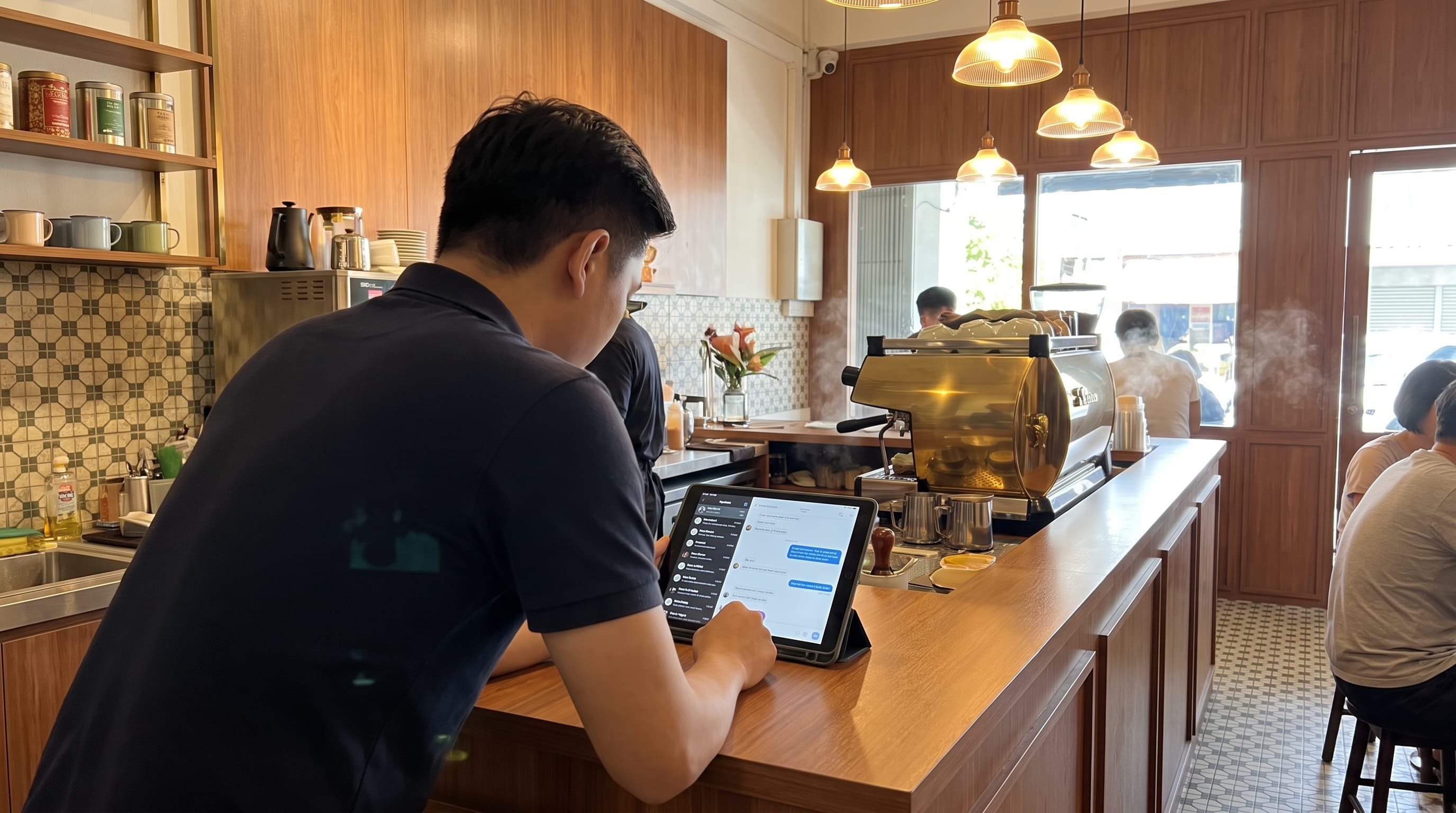
This is a case study. For the category-level guide — what AI actually does for a Kedah SME in 2026, where it doesn't help, and the order to deploy it in — see AI for small business in Kedah: a no-BS overview.
The business
A 3-outlet Ipoh F&B group: a flagship kopitiam in Greentown, a casual-dining spot in Taman Pertama, and a smaller cafe near the old town. Around 320 covers a day across the group at lunch and dinner. A small ops team of four — the owner, a front-of-house supervisor, an assistant supervisor, and a part-time weekend floor lead.
This is the case study for the AI agency and AI chatbot side of what we do — a narrow, opinionated build for an Ipoh F&B group that did not need a customer-facing chatbot to "look modern." It needed one fewer inbox and one fewer fire.
The problem they were actually trying to solve
Three inboxes, no unified view, and a weekend ritual the owner hated:
- Reservations came in on phone calls. A real human took the call, wrote the booking on a paper diary at the kopitiam, and forgot about it the moment the next call came in. No-shows ran at 18% on weekend dinners.
- Orders and queries came in on WhatsApp. Each outlet had its own WhatsApp business number, on the personal phone of the floor lead. When the floor lead was on shift, the inbox was read. When she wasn't, the inbox piled up. The owner estimates they lost 2 to 4 covers a day to "I messaged and nobody replied."
- Walk-ins were tracked nowhere. The counter staff counted covers on a clipboard. The daily numbers lived in the floor lead's memory and an end-of-day WhatsApp message to the owner.
The owner — a 40-something ex-bank operations manager who bought the first kopitiam in 2019 and added the other two in 2022 and 2024 — had tried the obvious SaaS fixes. A reservation system that the customers refused to use. A WhatsApp business API integration that the floor leads kept disabling because it was "too noisy." A tablet-based POS that the floor leads kept using as a coaster.
What the owner actually said on the first call: "I want one inbox. I want to know, on Monday morning, exactly what happened across the three outlets yesterday. And I want the lunch covers to not depend on which floor lead is on shift."
What we built — and why this approach
A thin AI front-desk agent with three parts, sitting in front of the channels the outlets already used:
- An AI phone line that answers in Bahasa Malaysia (with Mandarin and English fallback) and handles reservations and simple takeaway orders. Complex calls — a 12-person corporate booking with dietary requirements, a complaint, a catering quote — get routed to a human in under 5 seconds. The owner didn't want a chatbot pretending to be a person; we told the customers they're speaking to an AI in the first 10 seconds. The Ipoh customers the owner has spoken to about it are fine with that.
- A WhatsApp business inbox that reads the same outlets' WhatsApp numbers (we keep the existing numbers; the floor leads no longer have to keep their personal phones on the shop floor). The agent recognises orders and reservations, confirms the details, and pushes them to the same unified inbox.
- A POS reconciliation layer that reads the daily sales feed from each outlet's existing POS and reconciles it against the phone + WhatsApp orders. At 7am the next morning, the owner gets a single summary: yesterday's covers by outlet, by channel, by hour, by counter staff.
Why not the WhatsApp-business-API tool the floor leads kept disabling? Because it tried to do too much — automated replies, broadcasts, a CRM the team didn't want, a dashboard nobody opened. The build we shipped is narrower: it does three things, it does them well, and it doesn't try to be a marketing platform. That's the architect, not coder difference — we spec'd the agent to do exactly what the outlets needed, not what a SaaS vendor wanted to sell.
How the operation changed
Three concrete changes inside the first 14 weeks:
- The front-of-house now runs on one inbox, not three. The owner, the floor leads, and the weekend staff all look at the same unified queue. A reservation that comes in on the phone at 6pm lands next to a WhatsApp message that came in at 6:02pm, and the team can see the whole evening's bookings in one screen. The "did we get that message?" question has stopped.
- The lunch covers no longer depend on which floor lead is on shift. The AI agent handles the routine calls and messages; the floor lead handles the 5-10% of interactions that need a human. A single floor lead with a tablet can comfortably run the front-of-house for two of the three outlets at once during the weekday lunch rush.
- The owner's Monday morning is now 20 minutes, not 90. The agent writes the daily summary. The owner reads it, scans the three outlets, and starts her week. The 90-minute "what happened" meeting she used to have with the floor leads is now a 15-minute "what do we do" meeting.
The build is now in the second phase — a small AI concierge that recognises regulars and surfaces their last order, their usual table, and their dietary notes, so the floor lead can greet them by name and have their order half-taken before they sit down. That's the AI chatbot layer on top of the business automation base.
The numbers, fourteen weeks in
We don't do client testimonials. We do numbers. The group's view, fourteen weeks after the AI front-desk went live:
- Reservation no-shows: 18% → 10.8%. A 40% reduction. The agent sends a WhatsApp reminder in the language the customer actually used for the booking, 24 hours before and 2 hours before. The Greentown flagship — the busiest dinner spot — recovered roughly 8 covers a week.
- Lunch covers: +8% across the group. Mostly from "we messaged and nobody replied" being replaced by "we got a confirmation in 90 seconds." The owner estimates the AI caught 2 to 4 covers a day that the old system dropped.
- Floor lead hours on routine calls/messages: ~5 hours/day → ~1.5 hours/day. The recovered time goes into actual hospitality — remembering regulars, upselling on the floor, training the weekend staff. The owner calls this the "money shift."
- Customer complaint rate: unchanged. The AI doesn't pretend to be a person, the team handles the 5-10% of interactions that need a human, and the Ipoh customers the owner has spoken to are fine with the setup. No measurable backlash.
- Monday morning owner time: 90 minutes → 20 minutes. Hard to put a number on, but the owner's quality of life has materially improved. The "what happened" anxiety is gone.
Total first-year program cost: RM 36,000 to RM 72,000, spread monthly at roughly RM 3,000 to RM 6,000. The full program runs 12 to 18 months including handover, training, and the 90-day post-handover review.
Payback: 9 weeks on the conservative numbers, 5 weeks on the optimistic ones. The system is now in the second phase (the regulars-concierge layer), and the second year is cheaper than the first because the agent has learned the outlets.
What it would cost for your business
We don't publish a price sheet, because the price depends on what you're running. Three honest bands for an Ipoh or Perak F&B group:
- RM 2,500 – RM 4,500 / month. A first-phase AI front-desk for a 1 to 2-outlet F&B business doing 80 to 200 covers a day, with phone + WhatsApp + a single POS. Total program RM 30k to RM 54k over 12 months.
- RM 3,500 – RM 6,500 / month. A 2 to 3-phase build for a 2 to 4-outlet group doing 200 to 500 covers a day, with multi-POS reconciliation, morning reports, and the regulars-concierge layer. Total program RM 42k to RM 78k.
- RM 6,000 – RM 10,000 / month. A multi-outlet group with catering, reservations on a channel manager, and the concierge layer on top. Total program RM 72k to RM 120k.
These are the same bands we use for the Perak services page and the Kedah services page. Every engagement is priced for the build, not for the hours we put in.
What this looks like for your business
If you run a kopitiam group, a casual-dining chain, or an F&B group in Ipoh, Taiping, Sitiawan or anywhere in Perak, and your front-of-house is held together by three inboxes and a clipboard, this kind of build is the right first move. We don't sell a chatbot to "look modern." We build the smallest agent that turns your three inboxes into one, gives you the channel data you've never had, and gives your floor leads their time back.
The next step is a one-hour call, no slide deck. You tell us what you run, how many outlets, how big the lunch rush. We tell you whether an AI front-desk is the right answer, or whether a simpler reservation tool or POS upgrade will do. We won't pitch you either way. Get in touch and we'll set up the call.
If your bottleneck is on the production line rather than the front-of-house, our Perak manufacturer case study shows the AI maintenance build for a Taiping food processor. And if your bottleneck is in the back office — stock, orders, AR — our Kedah auto-parts case study shows what the custom software side of the same engagement looks like. The bands above scale with the size of the business, not the postcode — see the national AI Your Business arm for the rest of what we do.
Choosing the AI partner. For the 12-point checklist, the red flags, and the contract clauses that protect you, see How to choose an AI agency in Malaysia (without getting burned).
WhatsApp automation in practice. For the framework, the costs, the PDPA checklist, and the 5-step deployment order, see WhatsApp automation for Malaysian businesses.
E-invoice readiness. For the cheapest compliance paths, the LHDN mandate in plain language, and the 3-month countdown playbook, see E-invoice readiness for Malaysian SMEs.
About the author
The pitchdeck.my team
I run pitchdeck.my — fifteen years building custom software, automation, and AI tooling for Malaysian SMEs, from Alor Setar family businesses to KL fintech desks. Most weeks I’m scoping a new build, writing the spec, and shipping the first version with the founder.
- AI for SMEs
- Custom software
- Malaysian markets
- Business automation
Related builds
Get ai agency in Ipoh
Frequently asked questions
The first phase for the 3-outlet group was 12 weeks from kickoff to handover, including a 2-week shadow mode where the agent listened and graded calls without replying. A 1 to 2-outlet first-phase build can land in 8 to 10 weeks. Multi-phase builds with concierge and catering take 4 to 6 months for the first two phases.
No. It removes the boring, reactive half of their job — answering the same reservation questions, taking the same takeaway orders, chasing the same WhatsApp messages. The floor lead handles the 5-10% of interactions that need a human, and uses the recovered time for actual hospitality. The owner called this the "money shift" — the part of the job that actually earns tips and repeat customers.
Some won't, and that's fine — the agent routes them to a human in under 5 seconds. We tell customers they're speaking to an AI in the first 10 seconds, so there's no pretending. The Ipoh customers the owner surveyed are fine with it. The alternative is a busy signal, and most customers prefer a 5-second AI confirmation.
The agent reads from the POS; it doesn't replace the POS. We've integrated with everything from a 2018 touchscreen POS to a modern cloud POS. If your POS exports a daily sales file (even as a CSV), we can read it. If it doesn't, we say so on the first call.
Tell us what you run.
We’ll spec the fix in a week.
Priced like a hire, not a project — around the cost of one admin a month. Most builds pay back in 30 days or less.
Get a build specMore for Ipoh
Case study: how an Ipoh accounting firm cut month-end from 12 days to 4 with document-AI
A 12-person Ipoh accounting firm was losing 12 days a month to manual close. We built a focused document-AI layer. By week 8: 4 days. The build, the cost, the numbers.
Case study: how an Ipoh wholesaler cut stock reconciliation to 11 min
A 19-year Ipoh wholesale distributor ran 90-min nightly stock counts. A business automation build got it to 11 min by week 4. Cost, payback, what it would take for your Perak operation.