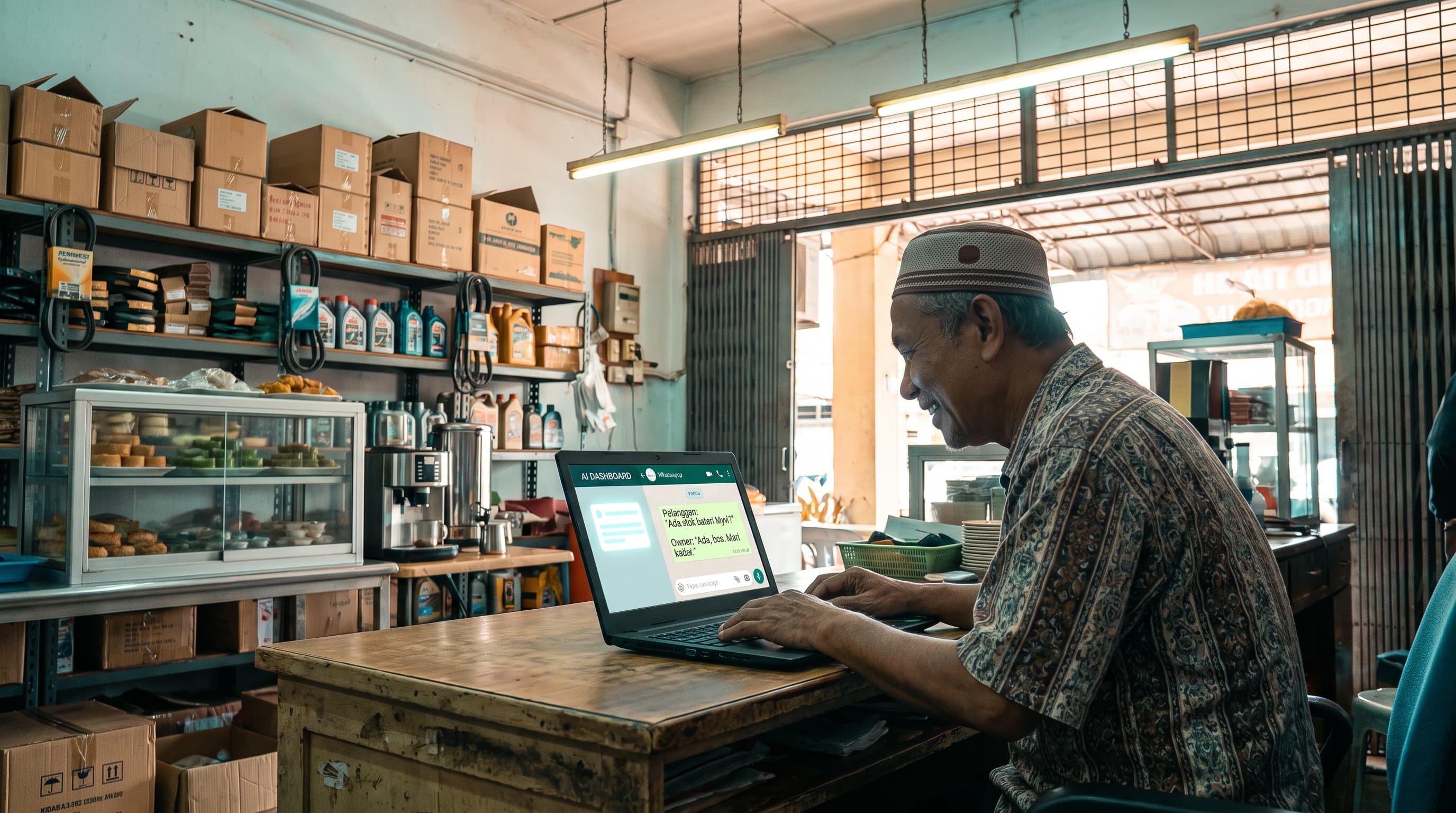
AI for small business in Kedah: a no-BS overview
By The pitchdeck.my team
This is the pillar guide for AI in a small Kedah business. If you run a shop in Alor Setar, a resort in Langkawi, a factory in Kulim, a retail chain in Sungai Petani, or a workshop anywhere in between — and you've been pitched AI by an agency, a vendor, or a LinkedIn post, and you want to know what's real and what's not — this is the one read.
We're going to walk through five things, honestly:
- What "AI" actually means in 2026 (and what it doesn't).
- Where AI actually helps a small Kedah business — the 5-6 specific use cases that work.
- Where AI is NOT the right call (and what to do instead).
- What it really costs a Kedah SME in 2026, with real RM ranges.
- The 5-step order to deploy AI in your business without burning RM 60,000 on the wrong experiment.
No vendor pitch, no "AI transformation journey," no "unlock the power of intelligent automation." Just the framework we use ourselves when a Kedah business owner asks us the question: "should I be doing something with AI?"
We answer that question both ways. About half the time the answer is "no — your problem is data quality or process, and AI will multiply the chaos." The other half the answer is "yes — but for this specific workflow, not for the whole operation." This guide exists because that honest answer is the difference between a build that pays back and a demo that looked good in the pitch.
If you want to skip the framework and go straight to the case studies that informed it, jump to Real case studies from the field. The five builds linked there are real Kedah SMEs — Alor Setar, Kulim, Langkawi, Sungai Petani, plus the adjacent Perak angle — and they're the closest thing to evidence we have.
If you'd rather book a 30-minute call to talk through your specific situation, contact us. We don't pitch either way. If the answer is "buy a RM 200/month SaaS and don't touch AI," we'll tell you to do that.
And if you're on the other side of the table — a founder with a working business looking to raise capital, not deploy AI — that's a different platform on this site. You can browse Malaysian businesses raising on pitchdeck.my, or submit your own listing if you've got a business that fits.
What "AI" actually means in 2026 (and what it doesn't)
Let's define the term honestly, because the Malaysian market in 2026 is drowning in agencies that use "AI" to mean things that aren't.
AI is a system that produces outputs (predictions, text, classifications, decisions) from data it has been trained on or has access to, without being explicitly programmed for each case. The three forms a small Kedah business will actually encounter:
- Machine learning models — trained on a dataset, used to classify or predict. Example: a vision model that flags defective PCBs at a Kulim factory. Example: a model that scores a WhatsApp message as "booking request" or "complaint" and routes it differently.
- Large language models (LLMs) — generative text systems like Claude, GPT, Gemini, or open-source equivalents. Used for chatbots, document drafting, email replies, code generation. Example: the WhatsApp concierge at a Langkawi resort.
- Rules engines with a thin ML layer on top — the most common form in practice. Most "AI" in real SME deployments is 80% deterministic rules (if-this-then-that) with a 20% ML model on the edge. The AI gets the headlines; the rules do the work.
That last one matters, because it's the gap between the sales pitch and the implementation. A vendor selling you "an AI system" is most likely selling you 20% ML and 80% well-designed business rules. Both parts matter. Neither part is magic.
What AI is NOT:
- AI is not a chatbot on your website that says "Hi, how can I help?" That's a decision tree with five branches and zero intelligence. If a vendor sells you this as AI, find another vendor.
- AI is not a SaaS dashboard with "AI insights." Most "AI insights" are pre-written rules with a confidence percentage. Useful, not AI.
- AI is not a one-click "AI transformation" of your existing process. The "transformation" word is doing 100% of the work in that sentence. Real AI deployments take 6-12 weeks and require data preparation that most SMEs don't have.
- AI is not a replacement for getting your data right first. The Kulim factory's vision system was 30% model and 70% lighting, camera positioning, and image preprocessing. The model was the easy part.
The honest spectrum, most common to least common in Malaysia in 2026:
- Pre-built SaaS with AI features — you subscribe to a product that has AI built in. Examples: HubSpot's AI email writer, Xero's AI categorisation, StoreHub's AI sales forecasting, AutoCount's AI bookkeeping, Canva's AI design tools. Cheapest (RM 50 – RM 1,000/month), fastest to deploy, lowest ceiling. This is where 70% of Malaysian SMEs should start.
- Pre-built AI tools wired into your workflow — you use OpenAI / Claude / Gemini directly, usually through a no-code or low-code wrapper. Examples: an SOP writer that takes your team's notes and produces a draft, a customer email responder, a stocktake reconciliation assistant. Moderate cost (RM 0 – RM 500/month in API costs + a few hours of setup), moderate flexibility.
- Custom AI integrated into your operational system — code written for your business, by a team that studies your operation. The AI is part of the build, not a wrapper. Most expensive (RM 30,000 – RM 200,000+ for a first system, RM 1,500 – RM 8,000/month to maintain), slowest to start (6 – 12 weeks), but it matches the way your business actually runs.
- AI as a product — building AI for other businesses. Different scale, different economics, different guide. Not what this one is about.
The mistake most Malaysian SMEs make isn't choosing the wrong option. It's choosing option 3 (custom AI) when option 1 (SaaS with AI features) would have done the job fine, because an agency sold them on "an AI system built around your business." The dream is real — but only for the businesses that actually need it. The other 70% would have been better off turning on the AI features in the SaaS they already pay for.
The mistake in the other direction is choosing option 1 (SaaS) when the business has a workflow the SaaS genuinely can't model — a 280-person Kulim factory with 8% visual reject rates, a 32-room Langkawi resort with 30+ WhatsApp messages at 2am, a 4,200-SKU Alor Setar parts shop with reorder capture gaps. The SaaS gets them 80% of the way, then the business builds parallel processes to cover the 20% it can't do, and the team ends up with two systems and double the admin.
The job of this guide is to help you figure out which side of that line your business is on.
Where AI actually helps a small Kedah business (the 5-6 specific use cases that work)
There are a handful of workflows where AI is genuinely the right call for a small Kedah business. Not because AI is fashionable, but because the alternative — human labour at scale, or a rules engine that doesn't generalise — is expensive or doesn't work. Here's the list, in the order we'd usually deploy them.
1. AI vision inspection on a factory line (or quality check).
This is the textbook AI win, and it's where the Kulim Hi-Tech Park electronics case study lives. A 280-person PCBA plant was losing 3-4% of finished units to missed defects in manual visual inspection. The pattern was always the same: a missing component, a rotated IC, a hairline solder bridge. Things a human eye misses after 6 hours of inspection. The AI vision system now catches 14 defects per shift that the human QC team was missing, and the OEM's incoming reject rate dropped from 3.2% to 0.8% in 12 weeks.
The win is narrow, measurable, and the alternative (hiring more QC inspectors) doesn't scale without doubling the headcount. AI vision also works for: food QA on a Sitiawan seafood line, defect detection on a Bayan Lepas electronics line, fabric defect detection in a textile shop, mould detection in a food processor.
2. AI chatbot on WhatsApp for booking, reservations, and reorder capture.
This is the second clearest win, and it's where the Langkawi resort case study and the Ipoh kopitiam case study live. The pattern: a business where the same 5-10 questions come in 30+ times a day on WhatsApp ("do you have rooms for the 28th?", "can I book a table for 4 at 7pm?", "do you have the brake pad for a Viva 1.3?"), and the team is dropping balls because the inbox is unmanageable.
The AI doesn't replace the team. It handles 70-80% of the messages (the common ones) and routes the rest to a human. The Langkawi resort's concierge handles 80% of WhatsApp messages end-to-end and books 24/7, including during the owner's sleep hours. The Ipoh kopitiam's AI agent took 40% off the no-show rate and recovered roughly RM 18,000/month in reorders.
This also works for: any F&B with a WhatsApp ordering line, any service business with a "is this available?" inbox, any retail shop with a "do you have this SKU?" queue. If your counter staff are drowning in WhatsApp, the AI is the right call.
3. AI-assisted maintenance scheduling for industrial equipment.
This is the Perak food-processing plant case study pattern. A 200-person Taiping food plant was running 14% unplanned downtime because the maintenance schedule was based on calendar intervals, not actual equipment condition. The AI model pulls from sensor data, operator logs, and historical failure patterns to predict which piece of equipment is most likely to fail in the next 7 days. The plant cut unplanned downtime by 38% in 6 months and the maintenance team stopped doing calendar-based PMs.
The win requires real sensor data (or at least real operator log data). If your "data" is a clipboard and a memory, the AI can't help you — yet. The model is the workflow, the AI is the optimiser. Also works for: HVAC systems in hotels, refrigeration in F&B, fleets of delivery vehicles, generator sets.
4. AI-assisted visual inspection in a non-factory context.
This is the Sungai Petani retail chain case study angle, with a twist. The case study itself is mostly a business-automation win (wiring the barcode scanner to the POS), but the same chain now uses a small AI image classifier to flag SKUs that look "off" on the shelf — wrong label, wrong price, damaged packaging. The wins are smaller than vision inspection on a factory line, but they compound across 3 branches and 8,500 SKUs.
Also works for: shelf-planogram compliance checks in a retail chain, food freshness checks in a grocery aisle, signage audits in a multi-outlet F&B group.
5. AI-assisted order + stock + AR automation (the "smart dashboard" use case).
This is the Alor Setar auto-parts shop case study angle. The shop's system isn't "AI" in the strict sense — it's a clean operational system with a thin AI layer on the reorder prediction. The model looks at 90 days of sales velocity and flags which SKUs are likely to need a reorder in the next 14 days. The shop's reorder capture rate went from 80% to 100% and recovered RM 2,500 – RM 4,000/month.
The win is the system, not the AI. The AI is the last 10%. But the last 10% is the part that turns "we have a stock system" into "we have a stock system that thinks." Also works for: any retail with a long tail, any B2B with reorder patterns, any F&B with prep volume that varies by day.
6. AI-assisted customer service email/WhatsApp triage.
This is the softest of the six, but it's the one most Kedah SMEs can start with today without spending RM 30,000. Take the inbox that's killing your front-of-house team, route it through a simple LLM-based classifier (Claude API, Gemini API, or even a free-tier wrapper), and have the AI draft the response. The human reviews and sends. Time saved: 1-3 hours/day per team member. Cost: RM 50 – RM 300/month in API bills.
This isn't a custom build. It's an afternoon of setup with a no-code tool. The AI chatbot service page on this site covers the productionised version, but the morning-after version is just an LLM and a Zapier flow.
What's NOT on this list (and why):
- AI for content marketing. Most "AI content" is generic, and Google is now actively de-ranking it. The Kedah SME that pumps out 50 AI blog posts is the one that gets a manual action 6 months later.
- AI for "decision support" in finance. Most finance teams don't have the data quality for AI to add value. The right first move is a clean accounting system, not an AI layer.
- AI for "predicting customer churn." Churn prediction is real for SaaS with 10,000+ users. For a 200-customer Kedah F&B group, the owner already knows who's churning — they need a re-engagement playbook, not an AI model.
- AI for "smart inventory" before you have clean inventory. Garbage in, garbage out, faster.
Where AI is NOT the right call (and what to do instead)
About half the time a Kedah SME asks us about AI, the right answer is "not yet" or "not for this." Here are the four situations where AI is the wrong tool, in the order they show up in our discovery calls.
1. The business is small enough that the human is the AI.
If your counter staff handle 20 customer messages a day, you don't need an AI chatbot. You need a better WhatsApp folder structure and a 30-minute team training. AI scales human effort; it doesn't replace it at 20 messages/day. The break-even for a custom AI chatbot is usually around 80-100 messages/day on the same channel, or a clear seasonal spike (Langkawi's December-March, Ramadan for F&B).
If your answer to "do I need AI?" is "we're drowning in messages" but the actual count is 15-30/day, the right first move is to hire a part-time front-of-house person, not deploy AI. The person costs RM 1,800/month. The AI costs RM 5,000 upfront + RM 500/month. The person is more flexible. The AI is more scalable. Pick the right tool for the actual volume.
2. The data quality is bad.
This is the silent killer of AI deployments. A model trained on inconsistent, incomplete, or wrong data produces confident-sounding wrong answers. We've seen it in:
- AI chatbots that invent return policies that don't exist (because the policy doc was a draft).
- AI vision systems that miss the defect they're trained to catch (because the training images were the wrong lighting / wrong angle / wrong SKU).
- AI maintenance predictors that flag the wrong equipment (because the operator logs were inconsistently tagged).
The right first move is a 2-4 week data cleanup. The Kulim factory spent 3 weeks just collecting and tagging 2,400 training images of PCBs — good boards, defective boards, all the edge cases. The AI was the easy part. The data was the hard part.
If your business can't answer "how clean is our operational data, on a 1-5 scale?" with at least a 3, the AI deployment is going to fail and you're going to blame the AI. The honest read: most Kedah SMEs sit at a 1 or 2 on data quality. The right move is to fix that first, then look at AI.
3. The workflow needs perfect accuracy.
AI is probabilistic. The Kulim vision system catches 14 of 15 defects — not 15 of 15. The Langkawi concierge handles 80% of messages end-to-end — not 100%. The Ipoh AI agent catches 95% of reorders automatically — not 100%. If your workflow genuinely needs 100% accuracy (regulatory compliance, financial reporting, safety-critical), AI is the wrong tool. Use a rules engine, use a human-in-the-loop, or fix the underlying process.
The right pattern is "AI for the first 80%, human review for the next 15%, manual for the last 5%." If you can structure your workflow that way, AI works. If you can't, AI doesn't.
4. The alternative is a simple SaaS.
If the off-the-shelf product genuinely does the job, the AI version of the same product is overkill. Examples:
- AI-powered CRM: HubSpot's built-in AI features handle 90% of what a "custom AI CRM" would do. RM 800/month vs RM 60,000.
- AI-powered bookkeeping: Xero + AutoCount's AI categorisation handle 90% of categorisation. RM 200/month vs RM 30,000.
- AI-powered scheduling: Calendly + a WhatsApp Business auto-reply handle 90% of small-business scheduling. RM 50/month vs RM 25,000.
- AI-powered email marketing: Mailchimp's AI subject line tester + send-time optimisation handle 90% of what an "AI email platform" would do. RM 200/month vs RM 20,000.
The 10% that the SaaS doesn't handle is the only place custom AI earns its place. If you can live with the SaaS 10%, don't build.
The honest cost: AI for a Kedah SME in 2026
No agency publishes their actual price list, so the market is full of "it depends" answers. Here's what it actually depends on, with real RM ranges from the builds we've done in 2025-2026.
Tier 1: Pre-built AI tools, lightly customised. RM 500 – RM 5,000 one-time + RM 50 – RM 500/month.
Examples: a HubSpot AI workflow, a Claude API wrapper that drafts your customer emails, a Make.com flow that summarises incoming WhatsApp messages. 1-2 weeks. A junior consultant or a sharp in-house person. Mostly no-code.
This is where most Kedah SMEs should start. Not with a "full AI transformation." With one specific tool that does one specific thing better. The Sungai Petani retail chain's first AI experiment was at this scope — a small classifier that flagged suspicious stocktake variances, not a custom vision system. The Langkawi resort's first AI experiment was a Claude-powered WhatsApp auto-reply with a few canned responses, not the full concierge. Both are good Tier 1 candidates.
If you want to see what a Tier 1 build costs in your state, the state-level pages — AI services in Selangor, Kuala Lumpur, Penang, Kedah, Perak, Kelantan, Terengganu — give you the local market angle.
Tier 2: A small custom AI build. RM 15,000 – RM 80,000.
Examples: a WhatsApp concierge for a hospitality business, a vision spot-checker for a small factory line, an AI-powered reorder prediction for a 3-4 branch retail chain. 4-10 weeks. One agency, one senior developer, one project manager. Paid monthly over 6-12 months at roughly RM 2,000 – RM 7,000/month.
This is the right scope when the off-the-shelf product genuinely can't model the workflow, but the build is still scoped enough to ship in one release. The Langkawi WhatsApp concierge was this scope. The Kulim vision spot-checker was this scope. The Ipoh AI front-desk was this scope. The national service page — AI chatbot at pitchdeck.my — gives the cross-state view of how Tier 2 AI builds are typically structured.
Tier 3: A larger AI platform with integrations. RM 80,000 – RM 300,000+.
Examples: a multi-site vision QA system, a fleet-wide predictive maintenance platform, a multi-channel customer AI that handles WhatsApp + email + phone + web in one queue. 3-6 months. One agency, 2-4 developers, one project manager, one data engineer. Paid monthly over 12-24 months.
This is the scope where a Malaysian SME is essentially building an AI product, not a tool. It's also the scope where the failure rate is highest, because the business usually hasn't yet validated the underlying workflow at a smaller scale. The Perak food-processing plant's predictive maintenance system was this scope — and the reason it worked is that we spent 4 weeks at Tier 1 first, validating the data pipeline before committing to the build.
What the price includes (and doesn't):
The RM amounts above include discovery (1-2 weeks of studying your business, your data, and your workflow), the build itself, UAT (user acceptance testing) with your team, deployment, training, and a 30-to-90 day post-handover review. They do NOT include:
- Ongoing maintenance after the post-handover period. That's a separate RM 1,500 – RM 8,000/month retainer, depending on scope. AI systems need retraining as your data drifts, and the cost of that retraining is real.
- The cost of cleaning your data first. Most AI deployments need 2-4 weeks of data cleanup BEFORE the build starts. The Kulim factory spent 3 weeks tagging training images. The Perak plant spent 4 weeks standardising operator logs. This time is usually on you, not the agency.
- API costs at scale. Once the AI is live, you're paying the underlying model provider per request. Claude / OpenAI / Gemini pricing is roughly RM 0.50 – RM 5.00 per 1,000 requests for typical small-business use. A Langkawi-scale WhatsApp concierge handling 1,000 messages/day costs roughly RM 200 – RM 800/month in API bills. Build this into the ongoing cost.
- The cost of changing your own internal processes to use the AI. This is the hidden cost most agencies don't price. The Kulim QC team spent 30-40 hours in the first 90 days adapting their workflow to the AI's flag-and-confirm pattern. That time was on the plant, not on us.
- Future model upgrades. The model you ship in month 3 is rarely the model you want in month 12. Plan for a Phase 2 of roughly 30-50% of the Phase 1 cost, 6-12 months after go-live, to retrain on new data and to upgrade to the next generation of underlying models.
Two cheap tells about whether an agency is being honest with you:
If the quote is a single number with no breakdown, walk away. The breakdown should clearly separate data preparation, model training, build, deployment, and post-handover. A 200-word breakdown of "we'll do this in 10 weeks for RM 60,000" is fine. A one-line "RM 60,000 for an AI system" is a tell.
If the agency can't show you a working demo of the specific model they're proposing (trained on data similar to yours, or at least a clean public dataset), walk away. The right answer is "we'll build you a 2-week prototype on a subset of your data before we commit to the full build." The wrong answer is "trust us, the model is great."
The 5-step deployment order (the order to deploy AI in your business)
The most common failure mode in Kedah SME AI deployments isn't the AI. It's the order. Businesses that should be at step 1 are paying for step 4. Businesses that should be at step 3 are skipping to step 5. Here's the order, and what each step looks like in practice.
Step 1: Fix your data.
Before you deploy any AI, your operational data needs to be:
- Complete — every transaction, every order, every customer interaction is captured, not just the ones someone remembered to log.
- Consistent — the same thing is named the same way across the business. "Kedah" is always "Kedah," not "KEDAH" and "Kdh" and "Kedah Darul Aman."
- Accessible — the person who needs the data can actually get it, without asking the IT guy to export a CSV.
- Tagged — the failures are labelled. The good images are labelled. The customer complaints are categorised. The training data is the foundation; without it, the AI is guessing.
This is the unglamorous step. Most businesses skip it. The right first move is a 2-4 week sprint to clean the data — the SKU master, the customer list, the operator logs, the historical orders, the training images. If you can't do this step, you don't have an AI project, you have a data hygiene project.
Step 2: Pick ONE workflow.
The biggest failure mode in Malaysian AI deployments is "we want AI across the operation." That sentence is the death of the project. AI works best when it's scoped to one specific workflow with a measurable success metric. The Langkawi WhatsApp concierge was scoped to one workflow: respond to WhatsApp messages. The Kulim vision was scoped to one workflow: spot-check the final PCBA before packing. The Ipoh AI agent was scoped to one workflow: capture reorders from WhatsApp.
The right question to ask: "What is the single workflow in our business where a 30% improvement would be worth RM 60,000/year?" If the answer is "everything" or "I don't know," you're not ready for AI. If the answer is "the WhatsApp inbox" or "the final QC station" or "the reorder capture rate," you have a project.
Step 3: Validate with a no-code prototype.
Before committing to a RM 60,000 build, spend 1-2 weeks on a no-code or low-code prototype. The right tools for this depend on the workflow:
- For AI chatbots / customer service: Voiceflow, Botpress, or a direct Claude / OpenAI wrapper through Make.com or n8n.
- For AI vision: Roboflow for labelling + a public vision model + a 1-week test on your own images.
- For AI maintenance / prediction: Airtable + a manual scoring system + a 2-week test of whether the predictions match reality.
- For AI-powered dashboards: ChatGPT Advanced Data Analysis or a Claude API wrapper to see if the underlying analysis is even useful.
The prototype is throwaway. Its job is to validate that the AI is the right tool for this workflow, not to be the production system. If the prototype works, you have evidence to justify the real build. If it doesn't, you've spent 2 weeks and RM 500 instead of 12 weeks and RM 60,000.
Step 4: Build.
Now — and only now — do you build the production system. This is the 6-12 week, RM 30,000 – RM 200,000 phase. The build should follow the standard custom software process — discovery, spec, build, UAT, deploy, post-handover. The AI-specific additions are: model training (or fine-tuning) on your data, model evaluation on a holdout set, and an explicit plan for retraining the model as your data drifts over time.
Step 5: Measure.
AI projects without a measurement plan are the ones that "feel good but don't pay back." The right measurement is a single number, agreed before the build starts, that the AI moves. Examples:
- "Reorder capture rate goes from 80% to 100%." (Alor Setar)
- "Customer reject rate goes from 3.2% to under 1.5%." (Kulim)
- "WhatsApp response time goes from 4-8 hours to under 5 minutes." (Langkawi)
- "Unplanned downtime goes from 14% to under 10%." (Perak)
If you can't put a number on the success criterion before the build, don't build. The number is what tells you, 90 days after go-live, whether the AI is paying for itself.
The failure mode: deploying AI everywhere at once.
The pattern is always the same. A Kedah business owner sees a competitor's "AI transformation" LinkedIn post, calls an agency, gets a RM 200,000 quote for "AI across the operation," signs the contract, and ends up with a half-built system, a frustrated team, and a budget that's already blown. The agency moves on to the next pitch. The business is stuck with the system.
The right move is the opposite. One workflow. One number. One build. Then the next. The Kulim factory did vision inspection. Then they did operator log standardisation. Then they did maintenance prediction. Each as a separate project with a separate success metric. That's how Kedah SMEs should deploy AI — one workflow at a time, with the data ready before the build starts.
Real case studies from the field
This guide is built from the same body of work as the case studies below. Each is a real Kedah or Perak SME, an anonymised but specific business profile, the build we shipped, the numbers, and the honest read of what worked and what didn't.
If you're evaluating whether AI is the right call for your business, these are the closest thing to evidence we have.
-
How a Kulim Hi-Tech Park electronics supplier caught 14 defects per shift with a custom vision-inspection camera — AI vision inspection for a 280-person PCBA plant. The clearest case study for "AI is the right call for a specific, narrow workflow" — vision inspection is a textbook AI win because the alternative (human inspection) is slow and inconsistent. Tier 2 build, RM 40,000 – RM 150,000.
-
How a Langkawi beach resort replaced its 4 separate booking systems with a single WhatsApp concierge — AI chatbot for a 32-room Langkawi resort that was running 4 separate booking systems. The clearest case study for "consolidation beats features" — the win was removing systems, not adding them. Tier 2 build, RM 15,000 – RM 60,000.
-
How a 3-outlet Ipoh kopitiam group added RM 18,000/month in recovered reorders with a WhatsApp-first AI agent — AI chatbot + WhatsApp automation for a 3-outlet Ipoh F&B group. The clearest case study for the question "is AI the right call, or is it a buzzword?" The answer here was yes — but for a specific workflow (reorder capture), not for the whole operation. Tier 2 build.
-
How a Sungai Petani retail chain cut month-end closing from 9 days to 2 with a custom order + stock + AR system — Business automation for a 3-branch Sungai Petani retail chain. Mostly a non-AI build, but the case study is the example of "fix the data first, then deploy AI" — the AI reorder prediction only worked because the underlying stock and order data was clean. Tier 2 build, RM 50,000 – RM 120,000.
-
How a 14-year-old Alor Setar auto-parts shop cut weekly stock work from 8 hours to under 2 — Custom stock + order system for a 4,200-SKU Kedah shop. The AI is a thin reorder-prediction layer on top of a normal CRUD app. The clearest case study for "the AI is the last 10%, the system is the first 90%."
-
How a 200-person Taiping food-processing plant cut unplanned downtime 38% with an AI maintenance schedule — Predictive maintenance for a Perak food plant. The clearest case study for "AI for industrial workflows" — the model is the workflow, the AI is the optimiser. Tier 3 build, RM 80,000 – RM 200,000.
-
How a Sitiawan seafood processor passed its first major buyer audit with a custom batch-traceability system — Custom batch-traceability for a 60-person Sitiawan seafood processor. The case study has a thin AI component (a vision QA module added in Phase 2), but the core build is non-AI. The case study is the example of "build the system first, add AI in Phase 2 when the data is ready."
These seven case studies aren't a complete picture of what AI can do for a Kedah SME. They're the ones we have public permission to share, and they're the ones whose numbers we can stand behind. If you want to see a build for a business like yours, contact us — we can usually show you a more relevant example in the first call.
About the author
The pitchdeck.my team
I run pitchdeck.my — fifteen years building custom software, automation, and AI tooling for Malaysian SMEs, from Alor Setar family businesses to KL fintech desks. Most weeks I’m scoping a new build, writing the spec, and shipping the first version with the founder.
- AI for SMEs
- Custom software
- Malaysian markets
- Business automation
Related builds
Get ai agency in Kedah
Frequently asked questions
Honest answer: it depends on your workflow. For 70% of small Kedah businesses, AI means turning on the AI features in the SaaS tools you already pay for (HubSpot, Xero, StoreHub, AutoCount, Canva). For 20%, it means a small custom AI build that does one specific thing better — a WhatsApp concierge, a vision spot-checker, a reorder predictor. For the remaining 10%, it means a larger AI platform with multiple integrations. The mistake most businesses make is starting at tier 3 when they should be at tier 1.
Tier 1 (pre-built AI tools, lightly customised): RM 500 – RM 5,000 one-time + RM 50 – RM 500/month. Tier 2 (small custom AI build): RM 15,000 – RM 80,000. Tier 3 (larger AI platform): RM 80,000 – RM 300,000+. These are total program costs including discovery, data preparation, build, deployment, and a 30-90 day post-handover period. Ongoing maintenance is a separate RM 1,500 – RM 8,000/month retainer. The full breakdown is in the cost section above.
Tier 1: 1-2 weeks. Tier 2: 4-10 weeks. Tier 3: 3-6 months. Add 3-6 months for the bedding-in period where the team is using the system, the agency is fixing rough edges, and the model is being retrained on real data. A 6-month project from kickoff to "AI is paying for itself" is realistic for a Tier 2 build.
Run yourself through the five questions in the "where AI is NOT the right call" section above. If you can't name the specific workflow that AI will improve, you're not ready. If your data quality is a 1 or 2 out of 5, you're not ready. If the workflow needs perfect accuracy, you're not ready. If the alternative is a RM 200/month SaaS that already does the job, you're not ready. The honest answer to "should I be doing AI?" is "no" about half the time. That's the right ratio.
AI-powered SaaS is a multi-tenant product with AI features built in — HubSpot's AI email writer, Xero's AI categorisation, StoreHub's AI sales forecasting. You subscribe, you get the feature, you fit your workflow into the vendor's model. Custom AI is code written for your business — the model is trained on your data, the workflow matches how your business actually runs. The difference matters when your workflow doesn't match the vendor's assumptions, which is when "AI-powered SaaS" becomes a monthly bill for a feature you can't use.
Skipping the data. About half the AI projects we get asked to quote, the underlying data isn't ready — the SKU master is inconsistent, the operator logs are free-text, the customer records are duplicated. The agency says yes anyway, the build ships, the AI produces confident-sounding wrong answers, and the business blames the AI. The right first move is a 2-4 week data cleanup sprint. If an agency quotes you an AI build without asking about your data quality, they're a salesperson, not a partner.
The 12-point checklist from our custom software guide applies — tell you when NOT to build, study your business first, fixed price with clear scope, named senior person, references in your industry, weekly demos, clear post-handover plan, fixed-price cap with change-order process, you own the data and the model, reasonable payment schedule, real office, the pitch team is the delivery team. We're publishing a deeper pillar on this question — how to choose an AI agency in Malaysia without getting burned — which is the same checklist applied specifically to AI vendors. If you want to skip the checklist and talk to us directly, contact us — we work across Kedah and Perak on scope 1 and scope 2 builds.
No. The 2026 LHDN e-invoicing mandate is a compliance requirement, not an AI opportunity. The cheapest path to compliance for a 5-person Kedah shop is a RM 50 – RM 200/month accounting tool with built-in e-invoicing (Xero, AutoCount, SQL Account). AI doesn't make compliance faster, easier, or cheaper — it adds a layer of complexity that the mandate specifically doesn't require. If an agency is pitching you "AI-powered e-invoice compliance," find another agency. The pillar we're publishing on this — E-invoice readiness for Malaysian SMEs — covers the cheapest paths in detail. If you want to go further than a self-serve read, the next step is a 1-2 week discovery engagement where we study your business, audit your data, and write a build spec. RM 5,000 – RM 15,000, credited against the build if you proceed. That's where scope, timeline, and price become real instead of estimates. We're pitchdeck.my's AI Your Business arm — the architect, AI is the builder, priced like a hire not a project. We're not the right partner for every Kedah SME that asks about AI. We're the right partner for the 50% of AI projects that genuinely need to be built.
Tell us what you run.
We’ll spec the fix in a week.
Priced like a hire, not a project — around the cost of one admin a month. Most builds pay back in 30 days or less.
Get a build specMore for Kedah
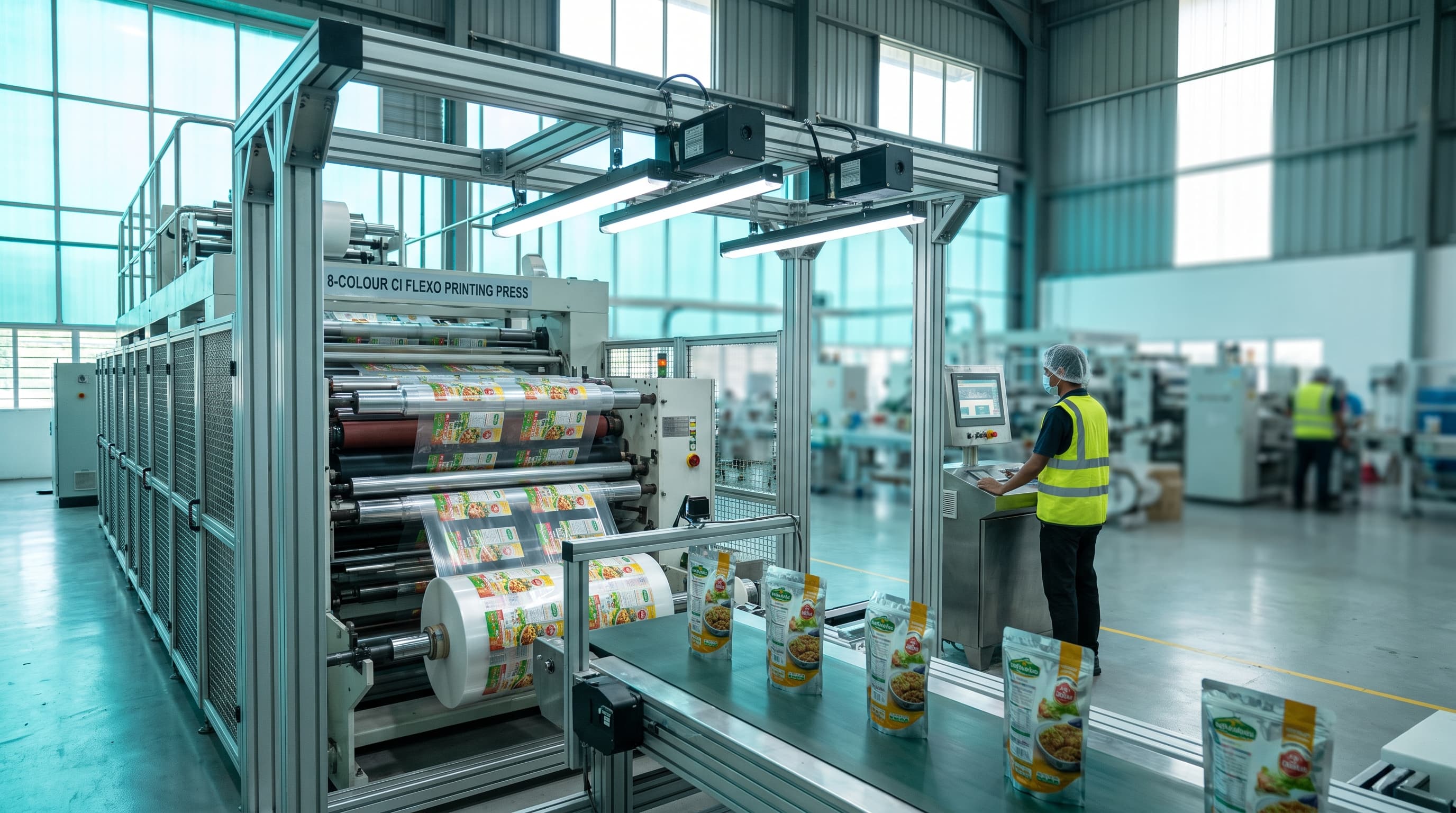
Case study: how a Kulim line cut mislabels 87% with AI vision
A 60-person Kulim Hi-Tech Park packaging line was scrapping 2% of finished output for mislabeled films. We spec'd a small AI vision checker. Scrap fell to 0.27% in 7 weeks.
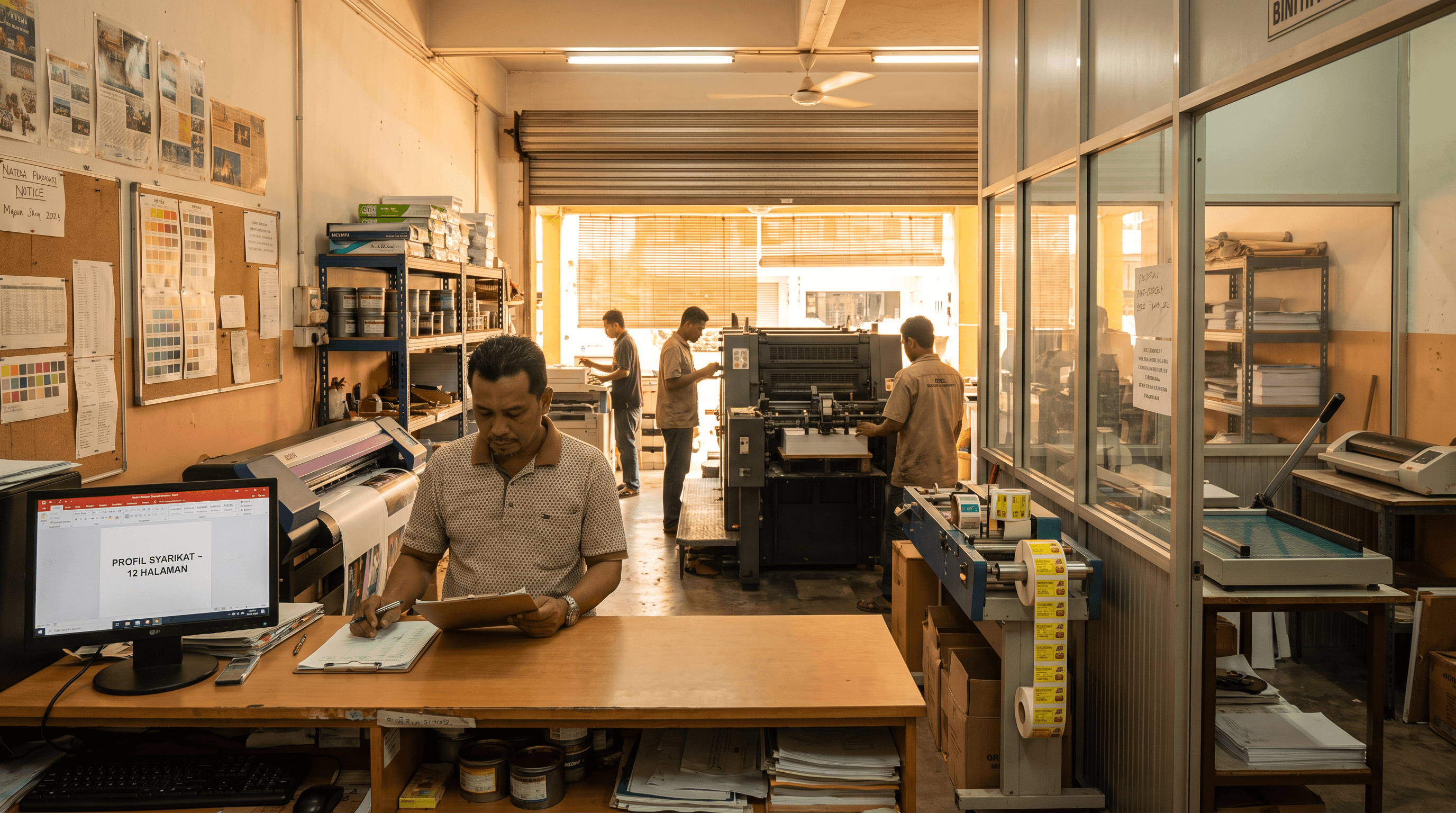
Case study: how an Alor Setar printing shop cut quote turnaround from 3 days to 4 hours with document-AI
A 22-year-old Alor Setar commercial printing shop was taking 2-3 days to turn a customer PDF into a firm quote. We built a document-AI pipeline. 5 weeks in, quotes land in 4 hours and the owner has stopped losing walk-in jobs to faster competitors in Penang.