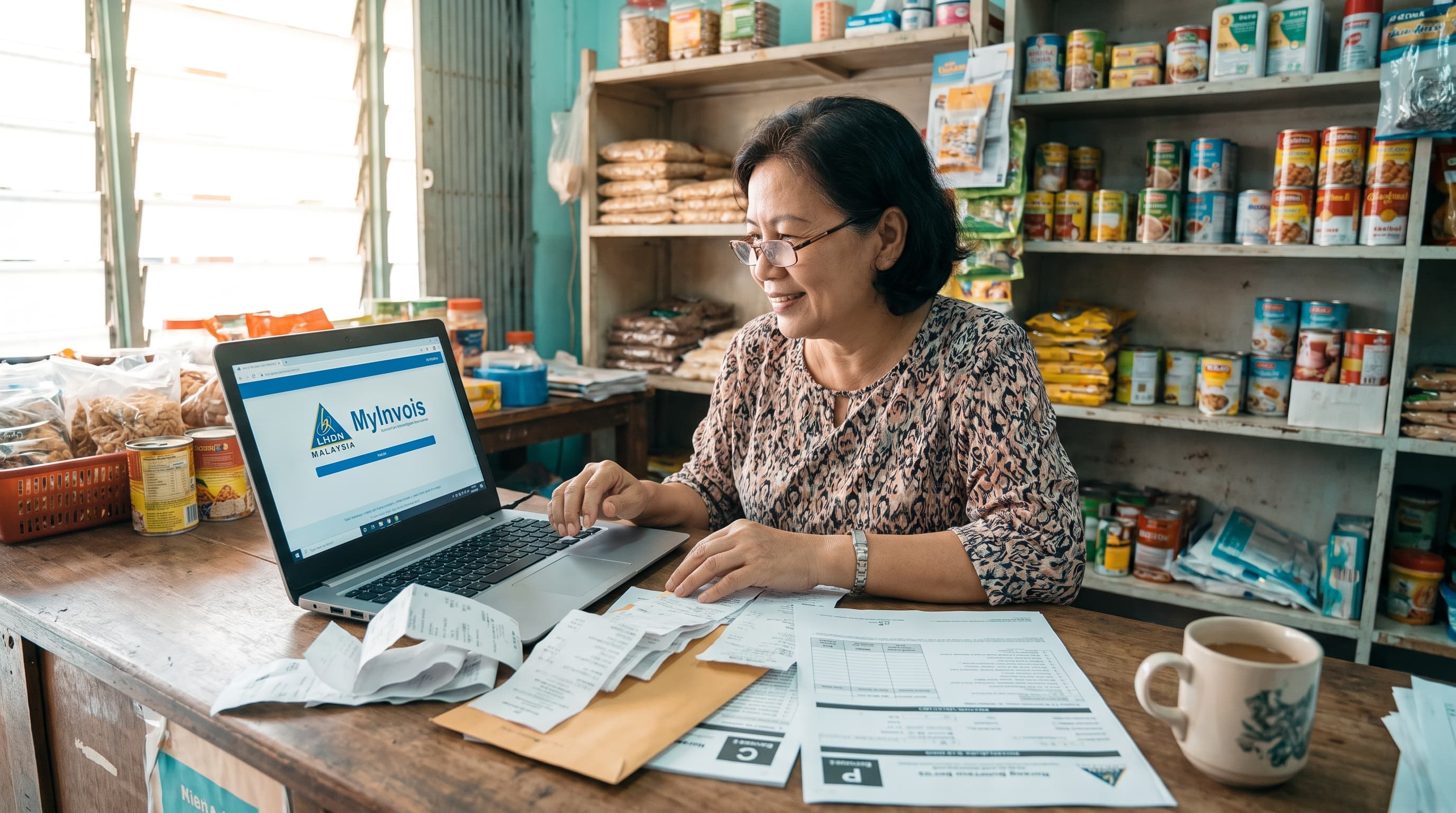
E-invoice readiness for Malaysian SMEs: the 2026 LHDN mandate in plain language
By The pitchdeck.my team
This is the pillar guide for LHDN e-invoice compliance. If you run a 5-person shop in Alor Setar, a 30-person F&B group in Ipoh, a seafood processor in Sitiawan, an auto-parts retailer in Sungai Petani, or a workshop anywhere in Malaysia — and you've heard that the LHDN e-invoicing mandate is coming and you don't know what to do about it — this is the one read.
We're going to walk through five things, honestly:
- What the LHDN e-invoicing mandate actually requires (in plain language — no jargon, no scary acronyms).
- The four compliance paths a Malaysian SME can take, with real RM costs and which one is right for which business.
- The cheapest path for a 5-person Kedah shop — specific recommendations, not generic advice.
- The hidden costs of the "free" e-invoice paths that nobody warns you about.
- The 3-month countdown playbook — what to do this week if your mandate is in 6 months.
No vendor pitch, no "transformation journey," no scare tactics. Just the framework we use when a Kedah business owner asks us: "do I need to spend RM 50,000 on e-invoice compliance, or can I do it for RM 200 a month?"
The honest answer for about 80% of Malaysian SMEs is the second one. RM 200 a month, an afternoon of setup, and you're done. The other 20% genuinely need a custom integration — usually because they have an unusual POS, an ERP that needs to talk to LHDN, or a volume that breaks the SaaS tools. This guide exists because most "e-invoice consultants" in Malaysia will quote the 20% answer to a business that needed the 80% answer, and pocket the difference.
If you want to skip the framework and go straight to the recommendations, jump to The cheapest path for a 5-person Kedah shop. The recommendations there are concrete — Xero for services, AutoCount for retail, SQL Account for manufacturing — and the 3-month playbook is in The 3-month countdown playbook.
If you'd rather book a 30-minute call to talk through your specific situation, contact us. We don't pitch either way. If the answer is "buy a RM 200/month Xero subscription and don't touch custom software," we'll tell you to do that.
And if you're on the other side of the table — a founder with a working business looking to raise capital, not deal with tax compliance — that's a different platform on this site. You can browse Malaysian businesses raising on pitchdeck.my, or submit your own listing if you've got a business that fits.
What the LHDN e-invoicing mandate actually requires (in plain language)
Let's start with what the mandate is, because most of the marketing material out there is either too vague ("be ready for e-invoicing!") or too dense (LHDN's own 80-page guideline document). Here's the plain-English version.
The mandate. Starting from a date that depends on your annual turnover, every business in Malaysia is required to issue and receive e-invoices in a specific format, validated by LHDN in near-real-time, instead of the paper receipts, PDFs, and manual tax invoices you use today. The e-invoice is submitted to LHDN through the MyInvois portal (or a connected accounting/e-invoicing system), LHDN returns a unique identification number (a "UUID"), and you store the validated invoice for 7 years.
The phases. LHDN has rolled the mandate out in turnover-based phases. As of 2026, the schedule looks roughly like this:
- Phase 1 (Aug 2024) — businesses with annual turnover above RM 100 million. Already required.
- Phase 2 (Jan 2025) — RM 25 million to RM 100 million. Already required.
- Phase 3 (Jul 2025) — RM 5 million to RM 25 million. Already required.
- Phase 4 (Jan 2026) — RM 1 million to RM 5 million. Required from January 2026.
- Phase 5 (Jul 2026) — all other businesses, regardless of turnover. Required from July 2026.
If your business is below RM 1 million in annual turnover — and a lot of the 5-person Kedah shops we talk to are — you're in Phase 5, which means your compliance deadline is July 2026. That sounds like a year away, but the 3-month playbook in this guide assumes you have 6 months, not 12, because the realistic window for "set up e-invoicing without panic" is 3 months of focused work. If you start in June 2026, you're late.
What "e-invoice" means under the LHDN definition. This is where most businesses get confused. An e-invoice under the LHDN mandate is NOT a PDF. It is NOT an email with a receipt attached. It is NOT a photo of a receipt. It is a structured electronic document with specific mandatory fields (seller details, buyer details, line items, amounts, tax codes), submitted to LHDN through the MyInvois portal or via an API, validated by LHDN, and stamped with a UUID.
The two flavours you'll see:
- MyInvois Portal — LHDN's free web portal. You log in, key in the invoice details, LHDN validates it, you get a UUID. Free. Suitable for low-volume businesses (under 50-100 invoices per month).
- API / ERP integration — your accounting software (Xero, AutoCount, SQL Account, etc.) or your POS system talks to LHDN's API directly. Suitable for higher volumes, for businesses that want automation, and for anyone who doesn't want to key in invoices by hand.
What's mandatory vs voluntary. For businesses inside the active phase, e-invoicing is mandatory for every B2B transaction (business-to-business) and every B2G transaction (business-to-government). B2C transactions (business-to-consumer, e.g. a retail shop selling to a walk-in customer) are also in scope from Phase 4 onwards for most businesses, with some exemptions for specific retail categories — but the practical read is "if you issue a tax invoice today, you need an e-invoice under the new rules." The penalties for non-compliance start at RM 200 per incorrect invoice and scale up to RM 30,000 or 30% of the invoice amount for repeated offences. LHDN has been clear that enforcement is real and not negotiable.
The two-step process for a typical B2B invoice. When you issue an invoice today, you'll:
- Issue and submit — within 72 hours of the transaction (or up to 7 days for B2B, with consolidation rules for high-volume businesses), submit the invoice to MyInvois. You get a UUID back.
- Share the validated invoice — give the validated invoice (with the UUID) to your buyer. This is typically a PDF copy of the validated e-invoice, or a link to the LHDN portal where the buyer can retrieve it.
The UUID is the proof that the invoice is LHDN-validated. Without the UUID, the invoice is not a valid e-invoice under the mandate.
What this is NOT. E-invoicing is not the same as:
- E-receipts (POS-printed receipts with QR codes). E-receipts are a different scheme and don't satisfy the e-invoice mandate.
- Paper receipts (the carbon-copy book you've been using). Paper receipts are not e-invoices.
- PDF invoices emailed to customers. PDFs are not e-invoices — they lack the structured data and the UUID.
- MyInvois is not e-filing. E-filing is the annual/quarterly tax return. E-invoicing is the per-transaction invoice submission. They're separate systems with separate deadlines.
That's the mandate in plain language. The next section covers the four ways a Malaysian SME can comply.
The 4 compliance paths for a Malaysian SME
There are four realistic compliance paths for a Malaysian SME in 2026, in order of how common they should be. About 80% of businesses should pick Path 1. About 15% should pick Path 2. About 4% should pick Path 3. About 1% should pick Path 4.
The order is intentional — if you can use Path 1, you should. The other paths exist for businesses where Path 1 genuinely doesn't fit, and where the cost of forcing Path 1 would be higher than the cost of a more sophisticated path.
Path 1: Existing accounting tool with built-in e-invoicing. RM 50 – RM 200/month.
This is the path for about 80% of Malaysian SMEs. You already pay for an accounting tool — or you should. The good ones in 2026 have e-invoicing built in, and they handle the MyInvois submission, the UUID, the validation, and the storage automatically.
The candidates:
- Xero — strong for services businesses (consultancies, agencies, professional services). RM 100 – RM 250/month. LHDN integration is direct, well-supported, and the user interface is clean enough for a non-accountant.
- AutoCount — strong for retail and F&B. RM 80 – RM 300/month. Malaysian-developed, deep local support, integrated POS modules. The LHDN integration is mature.
- SQL Account — strong for manufacturers, distributors, and businesses with multi-warehouse inventory. RM 150 – RM 600/month. The LHDN integration is via the SQL e-Invoice module, which is a paid add-on but is solid.
- MYOB — similar to Xero in scope, slightly less polished for Malaysian-specific compliance. RM 100 – RM 250/month.
- UBS Accounting — another Malaysian-developed option, popular with smaller Kedah/Perak businesses. RM 50 – RM 200/month.
The trade-off: these tools are SaaS subscriptions, so the cost is forever, but it's predictable. The compliance is automatic. The audit trail is built in. The invoice data is reconciled against your bank feed.
When to pick Path 1: any business below RM 5 million turnover, with a normal invoice volume (under 500-1000/month), with a single entity, and without a complex existing ERP. That covers most Malaysian SMEs.
Path 2: Paid e-invoicing SaaS (B2B specialist). RM 100 – RM 500/month.
This is the path for businesses that don't want a full accounting tool, but need to issue and receive e-invoices at higher volume, with better workflow than the MyInvois portal. The candidates:
- BillPlz — Malaysian-developed, focused on SMEs that need payment + e-invoice in one flow. RM 50 – RM 500/month depending on volume.
- StoreHub e-Invoice — built for retail/F&B using StoreHub POS. RM 100 – RM 300/month if you already use StoreHub.
- Qashier e-Invoice — same pattern as StoreHub, for Qashier POS users. RM 100 – RM 300/month.
- BigLedger — Malaysian-developed, focused on medium businesses with multiple entities. RM 200 – RM 1,000/month.
- e-Invoice solutions from banks — Maybank, CIMB, Public Bank, and others have all launched e-invoice modules for their business banking customers. Often free or very cheap if you're already a banking customer.
The trade-off: these are good for invoice issuance and receipt, but they don't replace your accounting system. You still need Xero/AutoCount/SQL for the books. In practice, most Path 2 deployments end up being "Path 1 accounting + Path 2 e-invoice connector," which gets messy.
When to pick Path 2: a business with a high invoice volume (1,000+/month) but a simple operation, or a business that already has a non-Malaysian-compliant accounting system and just needs the e-invoice layer.
Path 3: Custom ERP integration to MyInvois. RM 30,000 – RM 150,000.
This is the path for businesses with an existing ERP (SAP B1, Oracle Netsuite, Microsoft Dynamics, or a custom-built internal system) that needs to talk to LHDN's MyInvois API directly. The integration is custom code that bridges your ERP's invoice creation flow to LHDN's API, handles the validation responses, and stores the UUIDs alongside the invoices.
The candidates: any Malaysian or regional system integrator with experience in LHDN compliance. There are about 30-50 of them in the market as of 2026. The cost depends on the complexity of your ERP and the volume.
The trade-off: expensive upfront, but the ongoing cost is low (RM 1,000 – RM 5,000/month maintenance). The right call when you already have an ERP that does everything else, and the cost of switching ERPs is higher than the cost of integrating it to LHDN.
When to pick Path 3: a business with an existing mid-market or enterprise ERP, with a developer or vendor on retainer, with a clear scope for the integration. Most Malaysian SMEs are not in this category. If you're not sure whether you are, you're not.
Path 4: Full custom build (rebuild the invoice system around LHDN). RM 100,000 – RM 500,000.
This is the path for businesses that need a custom-built invoicing system for reasons beyond LHDN compliance — usually because they have a complex pricing model, multi-entity invoicing, intercompany flows, or a custom subscription/billing engine. The LHDN integration is part of the build, not the reason for the build.
When to pick Path 4: a business with genuinely complex invoicing needs, where the compliance work is bundled with a larger operational system rebuild. We're going to assume you don't need this guide if you're in this category.
The 80% should pick Path 1. The rest of this pillar is built around that assumption. If you're in the 20% that genuinely needs Path 2 or 3, contact us and we'll help you scope it. The pillar that covers the more complex cases — how to choose an AI agency in Malaysia without getting burned — has a parallel set of checklists for picking a system integrator.
The cheapest path for a 5-person Kedah shop
If you're a 5-person shop in Kedah — auto-parts retail, F&B, services, retail, a small workshop — the cheapest viable path is almost always Path 1. The question is which Path 1 tool. Here's the recommendation by business type, with real RM costs and the reasoning.
Services businesses (consultancy, agency, professional services). Xero.
If you sell hours — your invoices are 80% time, 20% expenses, no inventory — Xero is the right tool. RM 100 – RM 200/month for the Starter or Standard plan, LHDN e-invoicing built in, the reconciliation is automatic, and the dashboard is clean enough for a non-accountant to use.
The LHDN integration is via Xero's official Malaysian compliance add-on (RM 50/month for the Starter tier, included in Standard and above). The UUIDs are stored against each invoice. The validation errors are flagged in the dashboard. The audit trail is complete.
The honest alternative: if you're already using AutoCount, stay on AutoCount. Switching is a waste of effort for a 5-person shop.
Retail and F&B. AutoCount or SQL Account.
If you sell products — your invoices are 80% inventory line items, 20% service add-ons, daily transaction volume — AutoCount is the right tool. RM 80 – RM 300/month depending on the module set. The Malaysian-developed POS modules integrate with the LHDN e-invoicing flow without a separate connector.
For multi-outlet retail chains (3+ branches), SQL Account is the better fit. The multi-warehouse inventory, the consolidated invoicing across entities, and the LHDN e-invoice module are mature.
The honest alternative: if you're already on StoreHub or Qashier for POS, the e-invoice add-on is RM 100 – RM 300/month and integrates directly. Don't switch POS to satisfy e-invoicing — switch the e-invoice add-on to satisfy e-invoicing.
Manufacturing and distribution. SQL Account.
If you make or distribute things — your invoices have multi-line SKUs, batch numbers, expiry dates, multi-warehouse fulfilment — SQL Account is the right tool. RM 200 – RM 600/month for the modules you need. The LHDN e-invoice module is a paid add-on (RM 100 – RM 300/month) and is well-supported.
The honest alternative: if you have a custom-built inventory system, the LHDN integration is a custom build (Path 3) and the cost is RM 30,000 – RM 150,000. For a 5-person Kedah shop, the right move is to move off the custom inventory system and onto SQL Account, not to integrate the custom system to LHDN.
Mixed / not sure. AutoCount.
If your business is genuinely mixed (some services, some products, some inventory), AutoCount is the safest choice. It's Malaysian-developed, the support is in Bahasa Malaysia and English, the LHDN integration is mature, and the pricing is mid-range. The switching cost from a non-Malaysian-compliant tool is roughly 2-4 weeks of part-time effort for your accountant.
The 80% Kedah shop economics:
- Tool subscription: RM 100 – RM 300/month
- Bank feed / payment fees: RM 0 – RM 50/month
- LHDN e-invoice module (if separate): RM 0 – RM 100/month
- Accountant review (part-time): RM 500 – RM 1,500/quarter
Total realistic monthly cost: RM 200 – RM 600/month, or roughly RM 2,500 – RM 7,000/year for a 5-person shop. That's the cost of compliance for a Phase 5 Kedah business. It's not nothing, but it's a fraction of the RM 30,000 – RM 150,000 a custom integration would cost, and a fraction of the RM 10,000 – RM 50,000 in penalties you'd pay for non-compliance.
If you're in Kedah specifically, the state-level pages — custom software in Kedah and business automation in Kedah — give you the local market angle for when the SaaS path genuinely doesn't fit. If you're in another state, the same pages exist for Selangor, Kuala Lumpur, Penang, Perak, and Johor — the state-level cost ranges shift by ±20% depending on the local market, but the framework is identical. For the cross-state view of how Path 1 deployments are typically structured, the national custom software at pitchdeck.my page covers the SaaS-vs-custom trade-off across all of Malaysia.
The hidden costs of "free" e-invoice paths
The "free" path to LHDN e-invoice compliance is the MyInvois portal. It's free, it works, and for some businesses it's the right tool. For others, the hidden costs show up in month 3. Here are the four we see most often.
Hidden cost 1: Manual data entry at scale.
The MyInvois portal is a web form. You log in, key in the invoice details, submit, get a UUID, share with the buyer. For a business issuing 10-20 invoices per month, that's 2-3 hours of work per month. For a business issuing 200 invoices per month, that's 30-40 hours of work per month, which is a part-time job. The hidden cost is either the staff time (RM 1,500 – RM 2,500/month for a part-time admin) or the data entry errors that come with manual processing.
The break-even between "use the MyInvois portal" and "use an accounting tool with built-in e-invoicing" is usually around 50-100 invoices per month. Below that, the portal is fine. Above that, you're paying for manual work that automation would have done for free.
Hidden cost 2: API rate limits and batch size limits.
The MyInvois API has rate limits and batch size limits that aren't obvious until you hit them. As of 2026, the practical limits are roughly:
- 100 requests per minute per taxpayer
- 1,000 invoices per batch submission
- A 72-hour window for issuing invoices (with some consolidation flexibility for B2B)
For a 5-person Kedah shop, none of these limits matter. For a 30-person F&B group with 800 invoices per month, the batch size limit is fine but the rate limit can be a problem during month-end close (if you try to submit 200 invoices in 10 minutes, you'll get rate-limited).
The hidden cost: if you have a custom integration (Path 3), the developer has to build retry logic, queue management, and error handling around the rate limits. That's not a "free" integration — that's RM 5,000 – RM 20,000 of extra development work on top of the base integration.
Hidden cost 3: The "free tier" that breaks at 200 invoices/month.
Some of the bank-provided e-invoice modules and some of the e-invoice SaaS providers advertise "free for low volume" tiers. Read the fine print. The free tier usually caps at 100-200 invoices per month, after which the per-invoice fee kicks in at RM 0.20 – RM 1.00 per invoice. At 500 invoices per month, that's RM 100 – RM 500/month in hidden fees.
The honest read: "free tier" e-invoice modules are fine for the smallest Kedah shops, but the moment you cross 200 invoices per month, the math tips toward a paid accounting tool with built-in e-invoicing.
Hidden cost 4: What breaks when the LHDN portal goes down.
The MyInvois portal has had 3-4 significant outages since launch — usually 2-8 hours, always during business hours Malaysia time. During an outage, no one in Malaysia can issue or validate e-invoices. Your accounting tool's LHDN integration will queue the requests, but if the queue gets too long, you'll have a backlog of invoices to clear manually when the portal comes back up.
The hidden cost: if your business operates on tight invoice cycles (you issue an invoice, your customer pays on receipt), an LHDN outage is a 2-8 hour window of business disruption. Most businesses absorb this. If you can't, you need a backup process (a manual invoice ledger for the outage window) and a clear policy on when to issue the e-invoice after the portal comes back up. LHDN's official guidance is that you have 72 hours from the transaction, so most outages are well within the window.
The "free" path is honest, but it has costs. The right framing: MyInvois is a free, functional compliance tool, and for a 5-person shop with 50 invoices per month, it's the right choice. The hidden costs start showing up at higher volume, and the SaaS tools exist to absorb them. The decision isn't "free vs paid" — it's "do the hidden costs outweigh the SaaS subscription?" For 80% of Malaysian SMEs, the answer is no. The other 20% are usually businesses that should be on Path 2 or 3 anyway.
The 3-month countdown playbook
If your mandate is in 6 months (the typical case for a Phase 5 Kedah shop in 2026), you have a 3-month window of focused work to get compliant without panic. Here's the week-by-week playbook, in the order you should do it.
Weeks 1-2: The data audit.
Before you pick a tool, you need to know what you're actually issuing. The right first move is a 1-2 week audit of:
- How many invoices do you issue per month, on average? Count across the last 6 months. Get a real number, not an estimate.
- What are the line items on your typical invoice? Product codes? Service hours? Mixed? This determines the tool choice.
- Who are your top 20 customers by invoice volume? The bigger customers will care about receiving e-invoices from you. Talk to 3-5 of them now to ask if they're ready.
- What does your customer master look like? Names, addresses, TIN numbers, BRN numbers. E-invoices need buyer details — if your customer records are inconsistent, you have a data quality problem to fix first.
The output of weeks 1-2: a 1-page document with the invoice count, the line item structure, the top 20 customers, and a list of the data quality issues. If you can't produce this in 2 weeks, contact us — we can usually run this audit as a 1-week engagement.
Weeks 3-4: Tool selection and vendor sign-up.
Based on the data audit, pick a Path 1 tool from the recommendations above. Don't overthink this. The 4 tools (Xero, AutoCount, SQL Account, MYOB) are all LHDN-compliant, all have e-invoicing built in, and all have Malaysian support. Pick the one your accountant recommends, or the one your industry peers use, and move on.
The work in weeks 3-4:
- Sign up for the tool (most have 14-30 day free trials).
- Connect your bank feeds.
- Import your customer master and your chart of accounts.
- Configure the LHDN e-invoice module.
- Issue 3-5 test invoices to your own team and validate them through MyInvois.
The output of weeks 3-4: a working accounting system with the LHDN integration configured, validated against 3-5 test invoices, and ready for production use.
Weeks 5-8: Pilot.
Run a parallel pilot for 4 weeks. Continue issuing invoices the old way (paper, PDF, etc.) AND issue them through the new tool. Reconcile at the end of each week. The goal is to find the gaps before go-live, not after.
The work in weeks 5-8:
- Issue 100% of new invoices through the new tool.
- Reconcile the new tool's invoices against your old system.
- Resolve validation errors (wrong TIN, missing BRN, bad addresses — these will show up).
- Train your team on the new tool (1-2 hours per person).
- Update your invoice templates to include the UUID and the LHDN compliance language.
The output of weeks 5-8: a 4-week history of reconciled e-invoices, a team that's comfortable with the new tool, and a list of any remaining issues.
Weeks 9-12: Rollout and clean-up.
Switch to the new tool as the primary system. The old way becomes the fallback. Issue all new invoices through the new tool, and use the old way only if the new tool is down.
The work in weeks 9-12:
- Issue all new invoices through the new tool.
- Spot-check 10% of the issued invoices for accuracy.
- Resolve any remaining validation errors.
- Notify your top 20 customers that you're now issuing e-invoices and that they should expect the validated PDF with the UUID.
- File the validated e-invoices in your normal document storage (most accounting tools integrate with Google Drive, Dropbox, or OneDrive).
The output of weeks 9-12: a fully operational e-invoice system, a team that's using it daily, and a clean audit trail for the LHDN inspector if they ever come knocking.
What to do if you're behind the 3-month window.
If your mandate is in 3 months or less, compress the playbook. The data audit and tool selection can be done in 1-2 weeks if you're decisive. The pilot can be 2 weeks instead of 4. The rollout can be 2-3 weeks. The total compressed window is 5-7 weeks. Doable, but not comfortable. If you're in this position, skip the pilot and go straight to rollout — accept the higher error rate in the first month and fix issues as they come up.
If your mandate is in 1 month or less, you're late. The minimum viable compliance is: sign up for a Path 1 tool, configure the LHDN integration, issue invoices through it, accept the validation errors as they come up, and fix them after submission. You won't have a clean pilot. You will have compliance. The penalty for late compliance is higher than the penalty for imperfect compliance.
If your mandate is in 2 weeks, you should contact us or your accountant today, not tomorrow. The minimum viable window for "switch to a new tool and issue e-invoices" is about 2 weeks. Below that, you're issuing e-invoices by hand through the MyInvois portal until you can stand up a proper tool.
Real case studies from the field
The e-invoice mandate is new, but the underlying pattern — "the right tool for the right business" — is the same as every other compliance mandate we've worked through. Here are three case studies from the field, all from real Malaysian SMEs, that show how the framework applies in practice.
-
How a 14-year-old Alor Setar auto-parts shop cut weekly stock work from 8 hours to under 2 — A 4,200-SKU Alor Setar auto-parts shop with a custom-built stock + order system. The shop's e-invoice integration is a thin layer on top of the custom system, and the LHDN API call happens automatically when an invoice is issued. The shop is on Path 3 (custom ERP integration), and the e-invoice work was a 2-week add-on to a system they already had. Total e-invoice project cost: RM 8,000 – RM 15,000. The case study is the example of "if you have a custom system, the LHDN integration is a small project, not a transformation."
-
How a 3-outlet Ipoh kopitiam group added RM 18,000/month in recovered reorders with a WhatsApp-first AI agent — A 3-outlet Ipoh F&B group running on AutoCount. The e-invoice integration was a 1-week setup through AutoCount's built-in LHDN module, no custom code required. Total e-invoice project cost: RM 0 (the LHDN module was already included in their AutoCount subscription). The case study is the example of "if you're already on the right SaaS, the e-invoice work is a 1-week setup, not a project."
-
How a Sitiawan seafood processor passed its first major buyer audit with a custom batch-traceability system — A 60-person Sitiawan seafood processor with a custom batch-traceability + invoicing system. The LHDN integration was part of the original build (the system was being designed for a buyer audit that happened to coincide with the e-invoice mandate). The case study is the example of "if you're building a new operational system anyway, design LHDN compliance in from day 1 — the marginal cost is small."
These three case studies aren't a complete picture of e-invoice compliance for Malaysian SMEs. They're the ones we have public permission to share, and they're the ones whose numbers we can stand behind. The other 5 case studies on the site — Kulim vision inspection, Langkawi WhatsApp concierge, Sungai Petani business automation, Ipoh boutique hotel web design, Perak AI maintenance — don't have a direct e-invoice angle, but they show the same pattern: the right tool for the right business, the right scope for the right budget.
If you want to see a build for a business like yours, contact us — we can usually show you a more relevant example in the first call.
About the author
The pitchdeck.my team
I run pitchdeck.my — fifteen years building custom software, automation, and AI tooling for Malaysian SMEs, from Alor Setar family businesses to KL fintech desks. Most weeks I’m scoping a new build, writing the spec, and shipping the first version with the founder.
- AI for SMEs
- Custom software
- Malaysian markets
- Business automation
Related builds
Get custom software in Kedah
Frequently asked questions
Every business in Malaysia, in turnover-based phases between 2024 and 2026, is required to issue and receive electronic invoices in a specific structured format, validated by LHDN's MyInvois portal, instead of paper receipts and PDFs.
It depends on your annual turnover. Phase 1 (above RM 100M) was Aug 2024. Phase 2 (RM 25-100M) was Jan 2025. Phase 3 (RM 5-25M) was Jul 2025. Phase 4 (RM 1-5M) is Jan 2026. Phase 5 (all other businesses) is Jul 2026. If you're below RM 1 million turnover, your deadline is July 2026.
For about 80% of 5-person shops, the cost is RM 100 – RM 300/month for a Path 1 accounting tool (Xero, AutoCount, SQL Account) with the LHDN e-invoice module included. The 3-month setup window absorbs RM 0 – RM 2,000 of one-time effort (mostly staff time). The annual cost is RM 1,200 – RM 5,000/year — a fraction of the RM 10,000 – RM 50,000 in penalties for non-compliance.
The MyInvois portal is free. It works for businesses with low invoice volume (under 50-100/month). The hidden costs are the staff time for manual data entry, the API rate limits, and the fact that most accounting tools that integrate with MyInvois are cheaper than the staff time saved. For a 5-person Kedah shop with 30 invoices per month, the portal is fine. For a 30-person F&B group with 800 invoices per month, a SaaS tool is cheaper.
No. The mandate is a compliance requirement, not an AI opportunity. The cheapest paths are accounting tools with built-in LHDN integration, and AI doesn't make compliance faster, easier, or cheaper. If an agency is pitching you "AI-powered e-invoice compliance," find another agency. Our AI for small business in Kedah guide covers the cases where AI is genuinely the right call — and LHDN compliance is not one of them.
E-filing is the annual/quarterly tax return submission through LHDN's e-Filing portal. E-invoicing is the per-transaction invoice submission through LHDN's MyInvois portal. They are separate systems with separate deadlines. You still need to do both. The e-invoice data feeds into the e-filing return automatically if your accounting tool is configured correctly, but the systems are independent.
Waiting until the last minute. About half the SMEs we talk to are planning to "deal with e-invoicing in the last month before the deadline." That's a mistake because the 3-month countdown playbook assumes you have 6 months of runway, and the compressed 5-7 week playbook assumes you have 3 months. Below 3 months, the right move is to pick a tool today and accept the imperfect compliance, not to spend 3 weeks evaluating options. The 12-point checklist from our custom software guide applies to tool selection here too — fixed price, clear scope, references, the people in the pitch are the people doing the work.
For Path 1 (the SaaS path), you don't need a partner. You need an accountant who knows Xero, AutoCount, or SQL Account, and the tool vendor's Malaysian support team. For Path 2 or 3 (the integration paths), you need a system integrator with LHDN experience. The vetting checklist is the same as the one in how to choose an AI agency in Malaysia without getting burned — tell you when not to build, study your business first, fixed price with clear scope, named senior person, references in your industry. The 5% of cases that genuinely need a custom integration are the ones where this checklist matters. The 80% on Path 1 don't need a partner at all.
Yes, if the sale is a B2B transaction or a B2G transaction. For pure B2C (retail sales to walk-in customers, e-commerce sales to individuals), the rules are different — most retail categories are exempt from e-invoice issuance below specific turnover thresholds, but the practical read is that if you issue a tax invoice today, you need an e-invoice under the new rules. The exception for retail B2C was being expanded through 2025, so check the latest LHDN guideline. If your e-commerce platform supports it (most Malaysian e-commerce platforms — Shopify, EasyStore, BillPlz — have LHDN integrations), the e-invoice generation is automatic. If it doesn't, you have a 1-2 week integration project on your hands. Our WhatsApp automation pillar covers the order-management side; the e-invoice integration is a separate layer on top of that. If you want to go further than a self-serve read, the next step is a 1-2 week discovery engagement where we audit your invoicing, recommend the right Path 1 tool, and write a 90-day rollout plan. RM 3,000 – RM 8,000, credited against any build or integration work if you proceed. That's where the 3-month playbook becomes a calendar instead of a framework. We're pitchdeck.my's AI Your Business arm — the architect, AI is the builder, priced like a hire not a project. For about 80% of Malaysian SMEs, the right answer to "do I need a custom e-invoice integration?" is "no, buy a RM 200/month accounting tool with built-in LHDN and move on." We're the right partner for the 20% that genuinely need the custom work. We're also the right partner for the 80% that need a 1-2 week audit and a clean 3-month rollout plan — because sometimes the most valuable thing an agency can do is tell you the answer is "buy the SaaS and don't touch custom software." For the broader framework on what custom software is, when it's the right call, and when it isn't, our custom software pillar covers the full picture.
Tell us what you run.
We’ll spec the fix in a week.
Priced like a hire, not a project — around the cost of one admin a month. Most builds pay back in 30 days or less.
Get a build specMore for Kedah

Case study: how a Bukit Kayu Hitam cross-border trading business replaced a 7-tab Excel with a custom inventory system
A 14-year Bukit Kayu Hitam cross-border trading business was running 2,300 SKUs and 3 currencies across 7 Excel tabs. We spec'd a custom inventory system with HS codes, dual-pricing, and a Kastam 2 export. The spreadsheet mess ended in week 2.

Case study: how a 3-branch Sungai Petani workshop chain ended the lost-job-card problem with a custom system
A 3-branch Sungai Petani workshop chain was losing 8-12 job cards a week out of ~80. We didn't sell them a SaaS — we spec'd a custom job-card system. The lost-paperwork problem ended in the first fortnight.