Founder story: Aisyah Rahman on building Warung Nusantara from a family recipe
By Aisyah Rahman, as told to the pitchdeck.my team
“We don't have investors, we have customers. That's the difference.”
This is the first entry in the Founder stories series on the pitchdeck.my blog — long-form profiles of the real business owners behind the projects listed on our marketplace. Not anonymised case studies, not the "what we built" pitch from the agency side — the founder's own account, in their own words where possible, of how the business actually came together.
Aisyah Rahman is the founder of Warung Nusantara, a Shah Alam-based halal FMCG brand selling sambal, rempah, and ready-to-cook pastes to 30 stockists across the Klang Valley, Negeri Sembilan, and Penang. The brand is the commercialised version of her late grandmother's recipe collection — the same pastes Aisyah grew up eating in her grandmother's kitchen in Sungai Petani, then kept cooking through her teaching years in Subang.
We built her an AI reorder-prediction system in early 2025, after she nearly lost a month of orders to a stockout she didn't see coming. The build is described in the custom-software pillar guide, in the case studies, and in the "what we did" deck on the project page. This post is not about the build. This post is about the six years that came before it — and the four things Aisyah wishes she'd known at the start.
If you're a founder thinking about whether to build software for your own business, or whether to list on a platform like this one, this is the read. If you're a backer wondering what it actually looks like to be a customer of a brand like Warung Nusantara — what the founder's life is, where the margins go, why the sambal costs what it costs — this is also the read.
The recipe, the kitchen, the decision
Aisyah's grandmother, Makcik Rohani, ran the family kitchen in Sungai Petani like most Kedah Malay grandmothers of her generation ran theirs — without a recipe book, without measuring spoons, without any of the apparatus the modern food industry says you need. The sambal was made by feel: a handful of dried chillies, three stems of lemongrass, a thumb of belacan, a pour of tamarind water that always came out the same shade because her wrist remembered the angle. She cooked for the family. She cooked for the mosque on Fridays. She cooked for the neighbours who came by with containers.
She never wrote any of it down. She died in 2018, two months after Aisyah had moved to Subang Jaya to take a teaching job at a secondary school, and a year before Aisyah would have thought to ask her to slow down and measure things out. The recipe collection lived in Aisyah's muscle memory and a battered blue notebook her grandmother kept in the kitchen drawer — the one with a few pages of pencilled ingredient lists, most of them half-finished, the handwriting going soft at the edges where the same recipes had been written and rewritten and revised over the decades.
"I didn't know I was going to need it. I just kept the notebook because it was hers."
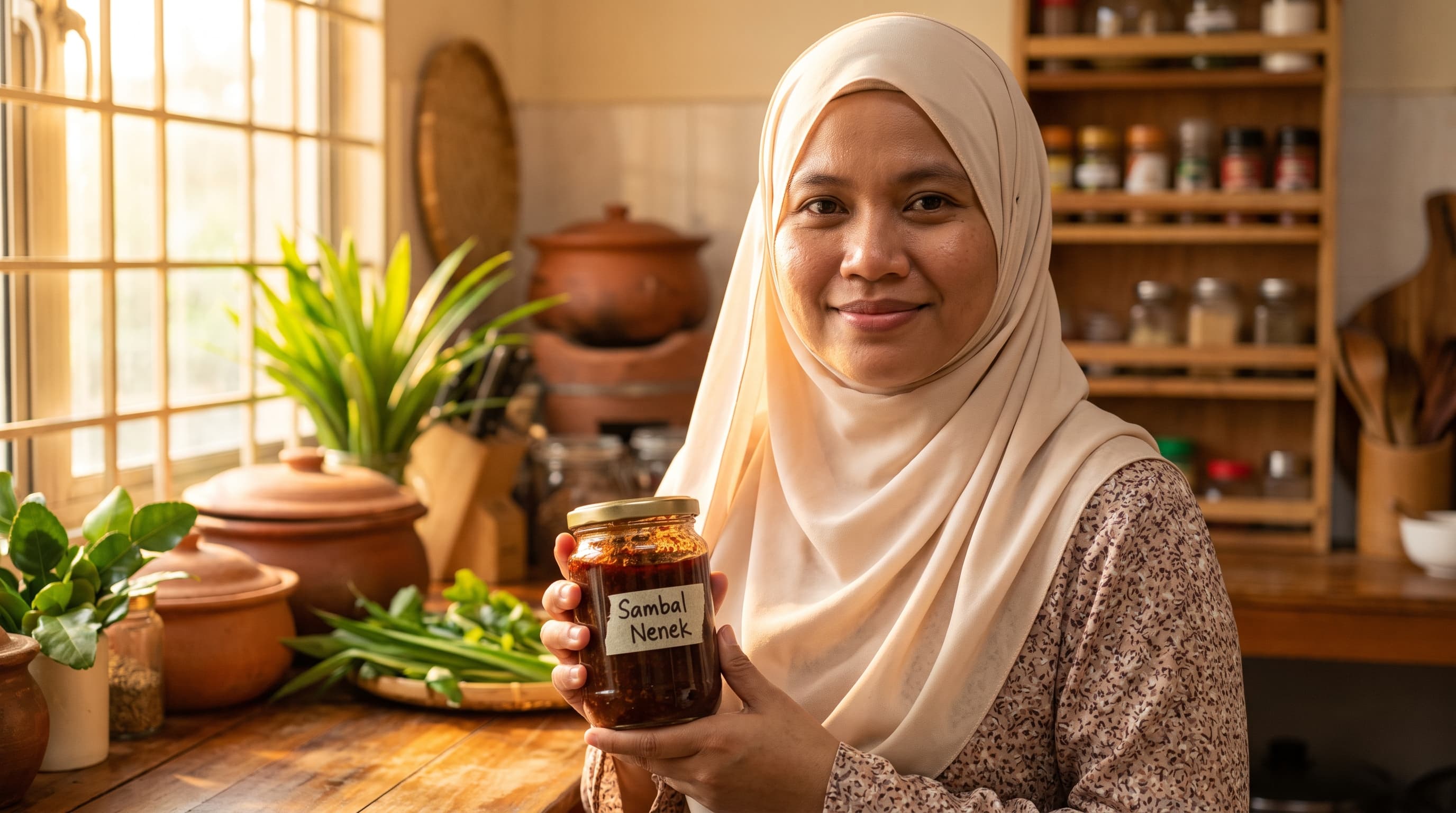
That notebook is now the source of truth for Warung Nusantara's product line. Aisyah's first commercial batch of sambal — the one she sold at a Subang Jaya night market in March 2020, two weeks before the first COVID lockdown — was the Sambal Nenek ("grandmother's sambal") that opens the brand's catalogue to this day. The label on the jar in the cover image is the actual product name.
Aisyah didn't decide to start a business in any of the ways the entrepreneur-internet tells you to decide. There was no eureka moment, no business plan, no "I quit my job to follow my passion" Instagram reel. There was a teaching job she was good at but tired of, a notebook she couldn't throw out, and a brother who suggested she make a few jars for a family kenduri and see what people said. The people said "where can I buy this". She made more jars. People kept asking.
By June 2020 she had a small commercial kitchen in Shah Alam, a 30-jar-a-week production capacity, and a list of 11 regular customers who ordered through WhatsApp. The teaching job went part-time, then by October it was gone. She was, by any reasonable definition, a food entrepreneur. She was also 31, sole proprietor of a kitchen that ran on a single induction cooker, with RM 8,200 in startup capital she'd scraped together from her EPF, her brother's savings, and a small sum from her late father's estate.
The chaos year — 2020 to 2021
The first year of a Malaysian food business is, with very few exceptions, a chaos year. The reasons are well known and not unique to Aisyah: the unit economics don't work yet, the production schedule lives in the founder's head, the customer list is a WhatsApp chat history, the regulatory paperwork is something you do between batches. Aisyah's first year had all of these problems and a few that were specifically hers. The Shah Alam manufacturing base that the brand runs from now — the Section 16 commercial kitchen, the 44 stockists, the JAKIM cert — those came later. The first year was one induction cooker, one chest freezer, and a sister-in-law who was patient enough to fold labels for RM 12 an hour.
The sambal was good. This was the one thing that was not a problem. The recipe was the recipe, the ingredients were clean, the cooking was patient, and the product was the kind of thing that, once a customer tried it, they kept ordering. By November 2020 she had 30 regulars, by February 2021 she had 60, and by mid-2021 she'd landed her first stockist — a small organic-grocer in Subang Jaya that took 40 jars a month on a handshake agreement.
What was a problem, and what was about to get worse, was everything that wasn't the sambal.
The order tracking was a single shared Google Sheet that Aisyah updated by hand each morning, cross-referenced with the WhatsApp chats, the DM orders, and the rare phone call. The stock count was a tally on a piece of paper pinned to the kitchen wall. The production schedule was a mental model: "If I have 14 jars of Sambal Nenek left and 22 orders, I need to make 8 more tomorrow, but only after the Belacan one is done, and I still owe 6 of the Belacan to the Subang Jaya stockist from last week, so actually I need 14 of Belacan first."
The 11pm to 1am slot became sacred. That was when Aisyah opened the laptop, opened the spreadsheet, opened the WhatsApp chats in three browser tabs, opened the order emails in a fourth, and tried to work out the next day's production. Some nights it took 30 minutes. Some nights it took 90. Some nights she gave up and went to bed without an answer, and started the morning by guessing, and missed a delivery she should have caught.
She didn't know it at the time, but the chaos wasn't the problem. The chaos was normal — most Malaysian food businesses of this size run on a version of it. The problem was that the chaos was unsurfaced. It was all in her head, it was all after-hours, and it was all silently capping the size of the business. She could have handled 80 regulars, or 120, or 200 — the sambal scaled fine, the kitchen had room, the second induction cooker was a 90-ringgit purchase. What she couldn't do was track more than 60 regulars without the mental model cracking. So the business stayed at 60. The customers kept coming, and she kept saying "sorry, sold out this week", and the orders leaked to the easier-to-buy alternatives on Shopee.
"I remember the moment I knew this was a real problem. I was standing in the kitchen at 11pm, I had 14 jars of Sambal Nenek done, 6 of Sambal Pedas, the phone was buzzing with three WhatsApp orders I hadn't replied to, and I genuinely did not know what the right number was to make the next morning. I just stood there. I made eight because eight felt right. Two of the orders I'd already lost by the time I started."
The middle years — 2021 to 2023
What saved the business in year two was, in retrospect, two unflashy things: a small business loan from SME Bank, and a part-time operations person who turned out to be unusually good at the boring work Aisyah was bad at.
The loan was RM 50,000, taken out in March 2021 against a business plan Aisyah had written in two evenings with a template she found online. It was used to lease a proper commercial kitchen in Section 16, Shah Alam, buy a six-burner gas range and a second chest freezer, and to put a deposit on a small used delivery van. None of that was AI. None of it was software. It was just the right amount of capital at the right moment, applied to the right kind of capacity.
The operations person was a 24-year-old named Danish, fresh out of UiTM with a diploma in supply chain, who answered a low-key job ad Aisyah had posted in the Subang Jaya mamak. Danish was paid RM 1,800 a month to do exactly the work Aisyah didn't want to do: update the spreadsheet, chase the WhatsApp orders, print the delivery labels, count the stock, and tell Aisyah every morning what the production schedule should be. Danish did this competently, without complaint, for 18 months. He left in late 2022 to take a procurement job at a larger FMCG company in Petaling Jaya, and Aisyah has never been able to replace him — partly because the salary she'd need to pay now is RM 2,800, and partly because Danish had a quality of trustworthiness with a spreadsheet that turns out to be very hard to hire for.
By 2023 the business had stabilised into something that looked, from the outside, like a working Malaysian food brand. 120 regular customers, 8 stockists, RM 38,000 in monthly revenue, a product line of six SKUs (the original Sambal Nenek, a Sambal Pedas, a Rempah Sup, a Rempah Rendang, a Serai Halia Paste, and a Belacan Tumis that was the test of whether Aisyah could commercialise her grandmother's trick of toasting the belacan dry before pounding it). The kitchen ran two shifts a day. The orders came in via WhatsApp, Shopee, a small website, and a growing list of stockists who took delivery twice a week.
The brand had a logo (a small batik motif Aisyah's cousin designed for RM 400), a label (printed at a printing shop in Klang), and a Halal certification from JAKIM. The Halal cert was the paperwork grind of 2022 — months of forms, an audit, a kitchen that needed a separate wash basin for the production line — but the moment it came through in March 2022, three of the larger stockists in the Klang Valley took on the brand. Halal wasn't optional for them, and getting the cert was the difference between a 30-jar-a-month indie product and a 300-jar-a-month chain-stocked brand.
But the chaos from year one had not gone away. It had just moved up the stack. By 2023 the problem was no longer "what do I make tomorrow morning". The problem was predicting what to make, when, and for which stockist — across a six-SKU product line, with reorder patterns that varied wildly by channel (Shopee customers reordered every 3 weeks, stockists every 9-12 days, the regulars every 2 weeks), and a production capacity that was already running 90% utilised on the good weeks.
Aisyah was, by late 2024, doing roughly RM 50,000 in monthly revenue, running two shifts a day, and losing roughly RM 7,000 a month in stockouts — orders she couldn't fulfil because the wrong SKU was out of stock at the wrong time, or the right SKU was sitting in the freezer in the wrong ratio, or the production schedule had assumed a demand that turned out to be 30% off. The stockouts leaked to Shopee alternatives and to the informal economy of home-cooked sambal that every Malaysian neighbourhood has. They leaked quietly. Aisyah only knew the magnitude because she kept a careful "lost sales" log in a second tab of the same Google Sheet, and the number was growing.
The 2025 inflection — when the chaos stopped being a story she could tell
By January 2025 the business was at a point Aisyah describes as "either we fix the prediction, or we cap the business at RM 60,000 a month forever". The kitchen couldn't run a third shift. The freezer was full. The delivery van was on its second gearbox. The 30 stockists were at the limit of what Danish's 2022 spreadsheet could model. The next 30 stockists, which Aisyah had been turning away for 18 months because she couldn't guarantee supply, were the actual growth.
Aisyah was, by this point, deep into the work of being a Malaysian SME owner who had heard the words "AI for business" enough times to be sceptical of them. She had been pitched by three different "AI solution" vendors in 2024. One wanted to sell her a chatbot for her Shopee store. One wanted to sell her a "predictive demand" SaaS that turned out to be a spreadsheet with a login. One wanted RM 80,000 to build "an AI inventory system" that, when she asked what data it would use, turned out to be "your past sales, in a model we've trained". She had past sales. She had six years of past sales, much of it in a Google Sheet. What she didn't have was a way to use it without becoming a data engineer.
We came in through a different door. Not a sales call, not a vendor pitch — a WhatsApp message from Aisyah's sister, who knew the pitchdeck.my team from a totally unrelated context, asking if we ever worked with food businesses. We said we did, when the fit was right, and we asked Aisyah to send us six months of past orders.
The fit was right, and the past orders were more interesting than we'd expected. What Aisyah had, buried in her Google Sheet, was a 24-month view of every order, every customer, every channel, every SKU, every reorder cadence, and a clean "fulfilled vs lost" column because she'd kept the lost-sales log out of habit. That last part was the unlock. Most businesses we look at have a sales log. Very few have an honest lost-sales log. Aisyah's was the difference between a model that would tell her "you'll sell 800 jars of Sambal Nenek next month" and a model that could tell her "you'll sell 800 jars, you'll lose 140 orders to stockout, and here's the day-of-week and stockist pattern of when those losses will happen."
"I didn't build a lost-sales log because I was going to use it for AI someday. I built it because losing the same customer twice in a month, and not knowing how much it cost, was something I couldn't keep doing to myself. Knowing the loss is a number is better than feeling the loss as a knot in your chest."
The build, the launch, and the technical detail of the prediction model are described elsewhere — the custom-software pillar guide has the framework, the project page on pitchdeck.my has the deck, and the AI for small business in Kedah pillar has the "where AI helps, where it doesn't" framing, which is the part most AI agencies skip. The honest summary of the build is: a thin custom system that takes the past 24 months of order data, the next 14 days of customer reorder patterns, and the current freezer + shelf stock, and produces a daily production schedule for the next 7 days — with explicit stockout warnings for the SKUs and channels most likely to break.
The numbers, six months in
The honest part of any build story is the numbers six months in. Aisyah's, as of July 2026:
- Monthly revenue: RM 78,000, up from RM 50,000 in late 2024. The growth is not from the AI — it's from the 14 new stockists she was able to take on once the prediction told her the supply could meet the demand. The AI didn't bring new customers. It let her serve the customers she already had, fully, for the first time.
- Lost sales: RM 1,200 a month, down from RM 7,000 a month. The losses haven't gone to zero — there are still genuine out-of-stock situations when a single stockist places an unusually large order, and there are still Shopee customers who reorder off-cycle. The losses have moved from "structural" (the model didn't know) to "exceptional" (something genuinely unusual happened).
- Production utilisation: 88% on the average week, up from 90%+ on the good weeks and 50% on the bad weeks. The bad weeks are mostly gone. The good weeks aren't all jammed into the same two days anymore. The production is smoother, which means the kitchen team is less stressed, which means Aisyah is less often standing in the kitchen at 11pm with a knot in her chest.
- Stockists: 30 → 44. The new 14 are the ones Aisyah had been turning away since early 2023. None of them are large national chains. They're the right size: organic grocers, premium minimarkets, two hotel kitchens in KL, one co-op in Penang. The brand hasn't gone into AEON Big. Aisyah doesn't want it to yet. The growth is the size she can run without breaking the model.
- Working hours: Down. This is the number Aisyah talks about most, and the one she wished she'd had in 2020. She's no longer doing the 11pm spreadsheet reconciliation. The system does it in 90 seconds at 6am. She does the production planning herself on Sunday nights, in 30-40 minutes, with the prediction model as the input and her own judgment as the override. The system is not making the decision. It's giving her a clean starting point.
- Aisyah's own salary: RM 6,500 a month, drawn from the business. Up from RM 4,200 in 2023, up from RM 1,800 in 2020 (when she was essentially paying herself nothing). The business can afford this now. For the first three years it could not.
"The honest thing about the system is that it didn't make me smarter. It just stopped me from being my own bottleneck. I was the person who knew everything and could track nothing. The system tracks. I make the calls."
We don't have investors, we have customers. That's the difference between this business and most of the ones that come through pitchdeck.my looking for capital. We grew because people kept buying the sambal. Not because someone wrote us a cheque.
The honest trade-offs — what the build didn't fix
The pillar guides on this site, especially the AI for small business in Kedah one and the how to choose an AI agency in Malaysia one, make a point of saying where AI doesn't help. The same applies here. The system Aisyah has now is good. It is not magic. Here is what it did not fix:
- The product is still the bottleneck on growth, not the prediction. The kitchen can produce ~6,000 jars a month at current capacity. To get to 8,000-9,000 — which is the natural demand at the current stockist count plus a reasonable expansion — Aisyah needs a second shift team, a second delivery van, and a new commercial kitchen. None of that is software.
- The Shopee channel is still chaos. Shopee customers reorder off-cycle, leave reviews that move demand in unpredictable ways, and run flash sales that break the prediction. Aisyah manages this with manual overrides, not the model. The WhatsApp automation pillar covers the broader pattern of "the channel is a different problem from the inventory".
- The Halal re-certification is in 2027. JAKIM audits are not in the model. Neither is the new kitchen lease renewal, the EPF contribution for the part-timers, the label print run, the Shopee seller fee renegotiation, or any of the 30 other things that occupy Aisyah's actual week. The system runs in the background. The business still needs a human.
- The founder is still the founder. Aisyah makes every production quality call personally. She tastes every batch. She decides, on the day, whether the Sambal Pedas this week is right or whether it needs another half-hour of slow cooking. The system has no opinion on this. It would be a bad system if it did.
- The LHDN e-invoice mandate, which landed in phases through 2025 and 2026, was a separate problem with a separate solution — and the cheapest path for Warung Nusantara was a RM 200/month accounting tool with LHDN built in, not a custom build. That's covered in the e-invoice pillar, and it's the right answer for most Malaysian SMEs of this size. The custom build was the right answer for the prediction, because off-the-shelf can't model Aisyah's reorder pattern. The two are different problems.
The trade-off summary: the build was the right call for the inventory problem, and only for the inventory problem. It did not turn the business into a different kind of business. It made the existing business run without Aisyah being its bottleneck.
The four things Aisyah wishes she'd known in 2020
I asked Aisyah to give me the four things she would tell a 2020 version of herself. Not the business advice, not the marketing advice, not the AI advice — just the things she wishes someone had said to her, in the kitchen, in the chaos year. She thought about it for a few days and came back with these. They've been lightly edited for length, not for content.
1. The recipe is the product, and the product is not the business.
This is the one nobody says because it sounds obvious. Aisyah's grandmother was a great cook. Makcik Rohani could have sold the sambal, if she'd wanted to. She didn't want to. The business is not the sambal. The business is the system that gets the sambal from the kitchen to the customer's hand, on the day they expect it, at the price that covers the cost and the founder's salary. A great recipe with a broken business is a hobby that pays for itself. A fine recipe with a working business is a real company. Aisyah's recipe is genuinely great. The first two years she underweighted the second part.
2. The thing that breaks you is not the thing you think will break you.
Aisyah expected production to be the bottleneck — buying the ingredients, scaling the batches, the Halal cert, the commercial kitchen lease. Those were real problems, but they were solvable problems with money and time. The thing that broke her was the coordination — the daily reconciliation of what had been ordered, what was in the freezer, what the production schedule should be, and which customer was about to churn because she'd missed a delivery three weeks ago. The coordination wasn't a problem she'd been trained to think about. It was a problem that grew silently, week by week, until the business hit a ceiling she couldn't see.
This is the part most Malaysian food founders don't talk about. The conversation at the kenduri is always about the recipe, the brand, the Halal cert, the Shopee strategy, the new stockist. Nobody talks about the 11pm spreadsheet. Everyone has one. Nobody admits it.
3. Hire Danish earlier. Or hire a Danish earlier.
Aisyah's part-time operations hire in 2021 was the single highest-leverage decision she made in the first three years. The 18 months Danish was there bought Aisyah the time to think about the business instead of running the business. When Danish left, the gap he left was bigger than his salary implied. The lesson — which Aisyah is still learning, in mid-2026 — is that "the person who can keep the spreadsheet honest" is a job, and a real job, and a job worth paying properly for. The instinct to delay the hire, to "do it myself a bit longer", to "see if the business can afford it" — that instinct is the bottleneck, and the bottleneck is more expensive than the salary.
The AI build is, in a sense, the second Danish. It doesn't replace the person, but it takes over the work the person was doing, and it doesn't leave after 18 months.
4. You will not feel ready. Build the list anyway.
The Warung Nusantara project listing on pitchdeck.my went live in late 2025, two years after the build was first scoped, and four months after it was actually finished. Aisyah delayed the listing for two reasons. The first was that the prediction system wasn't done and she wanted to list with a working build, not a roadmap. The second — and the one she's more honest about — was that she didn't feel ready to be seen. Listing on a marketplace means customers and backers are looking at your numbers, your margins, your founder bio, your SSM number, your Halal cert. It means being a public business, not just a real one. She wasn't sure she was ready for that.
The honest answer was: she wasn't ready, and she listed anyway, and the listing was one of the better decisions she made in 2025. The pitchdeck.my listing is the public version of the business Aisyah had been quietly building for five years, and the response from backers — the 30 founding slots, the WhatsApp messages, the customers who came in via the project page — was the proof that the business was real, even on the days when the knot in her chest said it wasn't.
The 4-slot-equity model pitchdeck.my runs (a Backers SPV (LLP) that pools small-stake backers into a real economic interest in the business, not the platform owning equity) was the part Aisyah cared about. The brand had grown on customer money. She didn't want outside capital. What she wanted was a community of people who cared about the brand, who would back a slot at RM 250 or RM 500, who would tell their friends, and who would feel like they were part of what Warung Nusantara was becoming. That's what the listing gave her. That's what the 30 founding slots gave her.
The four things are easy to write down. The hard part is that you only learn them by living through the years where you didn't know them. I would not skip those years. The business is what it is because of them.
What this looks like for a business like yours
Aisyah's story is specific. Sambal, Shah Alam, a six-year run, a JAKIM cert, a RM 50,000 loan, a part-time hire named Danish, an AI system built in 2025. It's not a template. But the four lessons above are the four lessons most Malaysian food businesses, and most Malaysian SMEs more broadly, eventually learn — usually too late, and usually the hard way.
If you're a founder reading this and recognising the 11pm spreadsheet, the lost sales you can't quite quantify, the production schedule in your head, the stockist you keep turning away because you can't guarantee supply — the custom-software pillar guide is the more detailed version of the framework. The AI for small business guide has the "what AI actually does" section, and the "where AI is the wrong call" section, both of which are worth reading. The project listing on pitchdeck.my has the full deck, the 30 founding slots, and the customer-back story.
If you're a backer reading this — someone who's ordered a jar of Sambal Nenek, or seen the brand in a stockist, or heard about pitchdeck.my from a friend — this is what the founder's life looks like. Six years, RM 50,000 in capital, one brilliant part-time hire, one prediction system, and a notebook from a kitchen in Sungai Petani. The sambal costs what it costs because the kitchen is real, the founder is real, and the customer base is the realest thing about the whole thing.
If you'd like to be a customer — the most useful thing you can do for a brand like this is to order, reorder, and tell one friend. The brand grew because people kept buying the sambal. That part hasn't changed.
If you're a Shah Alam founder or a Selangor business owner looking at your own version of the chaos year — the 11pm spreadsheet, the lost sales you can't quantify, the stockist you keep turning away — the custom-software pillar guide is the framework, and the city-by-service hub for Shah Alam is the on-mission page for the kind of build Aisyah's running. Neither is a sales pitch. Both are honest about when the build is the right call and when a RM 200/month SaaS is the better answer.
If you'd like to talk to us about a build like the one we did for Aisyah — for a different food business, or a different kind of SME, or a different kind of operation — the contact page is the place. We don't pitch. If the answer is "buy a RM 200/month SaaS and stop overthinking this," we'll tell you to do that. If the answer is a custom system like the one in this story, we'll tell you what it costs in real RM ranges, in real timelines, and in real working hours saved. The build is the easy part. Knowing whether you need it is the hard part.
A note on the cover, the jar, and what's real in this post
A note on what's real in this post: Aisyah Rahman is a real founder. Warung Nusantara is a real business. The notebook, the kitchen, the 11pm spreadsheet, the 30 founding slots, the prediction system — all real. The cover image was synthesised, because we don't have a real photo of Aisyah that we can use publicly. The face in the cover image is generated, the Sambal Nenek jar in her hand is rendered, the kitchen bokeh is rendered. The story is real. The product is real. The jar on the shelf of the Subang Jaya stockist is real. The face in the photo is not.
We made this call deliberately. The other option was to ship this post with no cover image, or with a stock photo of a generic woman in a kitchen. We chose the synthesised cover because (a) it represents Aisyah as a real Malaysian Malay founder, (b) it shows the sambal jar that the brand is actually known for, and (c) it's honest in a way that a stock photo wouldn't be — Aisyah is a real person, this is her story, and the photo is the only thing in the post that isn't real. The project page has the real product photos of the actual product line, and the Glossary page has the brand context for the terms used here.
If you're a Malaysian founder with a real, operational business, and you'd like to be the next founder story on this site, with a real photo of you and a real cover, get in touch. We don't promise to write your story. We promise to read it.
Frequently asked questions
Yes. She's the founder of Warung Nusantara, the business listed at pitchdeck.my/p/warung-nusantara. The cover image is synthesised (because we don't have a public photo of her), but the founder, the business, the products, and the story are real.
Yes. It's the same system described in the custom-software pillar guide and on the project page. The full case study (the technical detail, the screenshots, the model architecture) lives on the project page. This post is the founder's account of the six years that came before the build, not a build writeup.
Maybe. It depends on the data you have, the problem you're trying to solve, and whether the right answer is a custom system or a RM 200/month SaaS. The how to choose an AI agency in Malaysia pillar has the framework. Get in touch and we'll tell you honestly which one fits.
Yes. The recipe collection lived in a battered blue notebook in her grandmother's kitchen drawer. Aisyah kept the notebook. It's now the source of truth for the Warung Nusantara product line. The notebook is a real object. Aisyah is the only person who can read her grandmother's handwriting on most of the pages.
Yes. The brand supplies 44 stockists across the Klang Valley, Negeri Sembilan, and Penang. The full list of stockists is on the project page, and Shopee delivery is available nationwide. Aisyah reads every Shopee review personally. She takes the bad ones harder than she should and the good ones less seriously than she should.
RM 250 or RM 500 buys one of 30 founding slots in the Warung Nusantara Backers SPV (LLP), which holds a small equity stake in the business on behalf of the slot holders. The slot pays for itself out of the first round of dividends once the business is at the kind of revenue where dividends make sense. Aisyah is explicit that this is not investment advice, the SPV structure has been reviewed by a Malaysian securities lawyer, and the platform disclaimers cover the rest. The slots are filling. There are 9 left as of this post.
Because the founder stories are part of the product. The M-1 pillar guides on this blog describe what we build. The M-2 founder stories describe what the build actually does, in a real founder's life, with real numbers. They are the editorial companion to the project page, and they exist so the customer / backer / founder reading the site can see both sides of the same work. The next founder story in the series will be a different founder, a different business, a different state. We're starting with Aisyah because she was the first project on the platform, the build was a clean example, and she said yes.
Tell us what you run.
We’ll spec the fix in a week.
Priced like a hire, not a project — around the cost of one admin a month. Most builds pay back in 30 days or less.
Get a build specMore founder stories
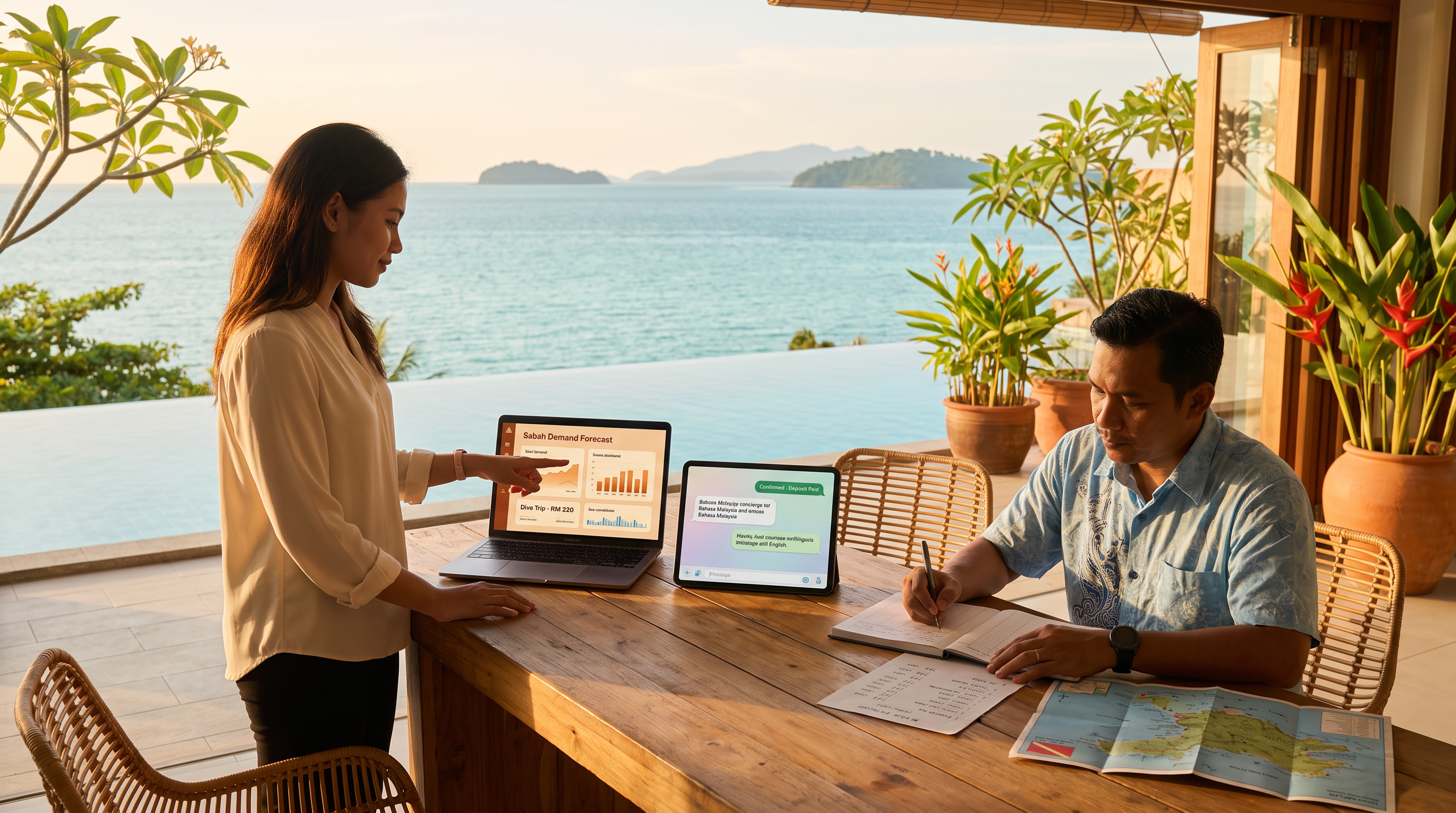
AI agency Sabah: 4 ways a Kota Kinabalu SME uses AI in 2026
Kota Kinabalu tourism and services SMEs: 4 practical ways to use AI in 2026, what each build costs in real RM, and which one to start with first.
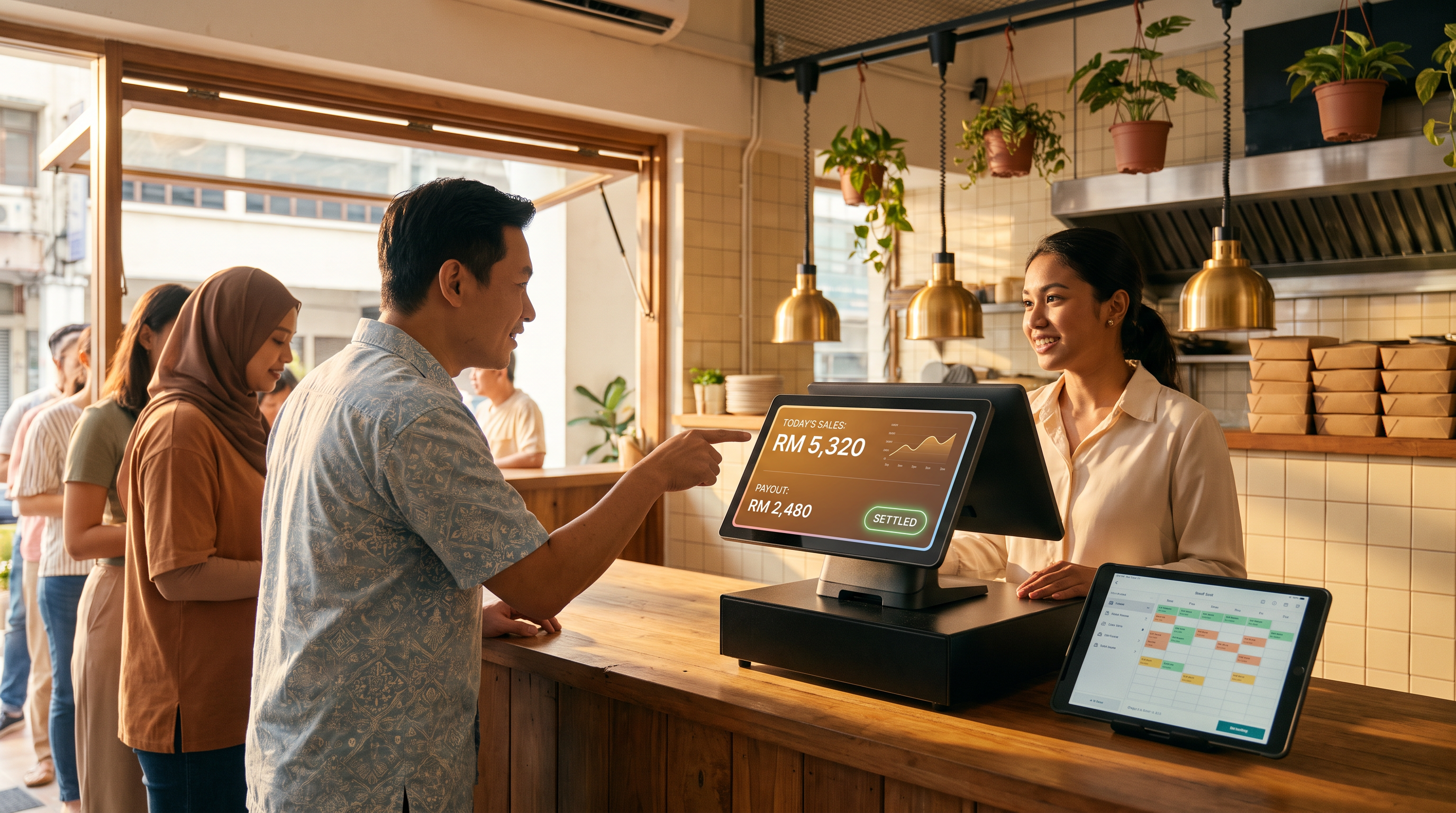
Qashier raises US$6.125M Series A+ to expand in Malaysia and three more markets
Singapore-headquartered Qashier raised US$6.125M (RM25M) in a Series A+ led by Cocoon Capital to expand across Malaysia, Singapore, Thailand and the Philippines.