Case study: how a Pokok Sena agri office handled 1,200 labour enquiries
Pokok Sena agri office: 1,200 seasonal labour enquiries cleared by an AI WhatsApp bot. 9 weeks in: 22-second replies, 340 workers placed, zero missed calls.
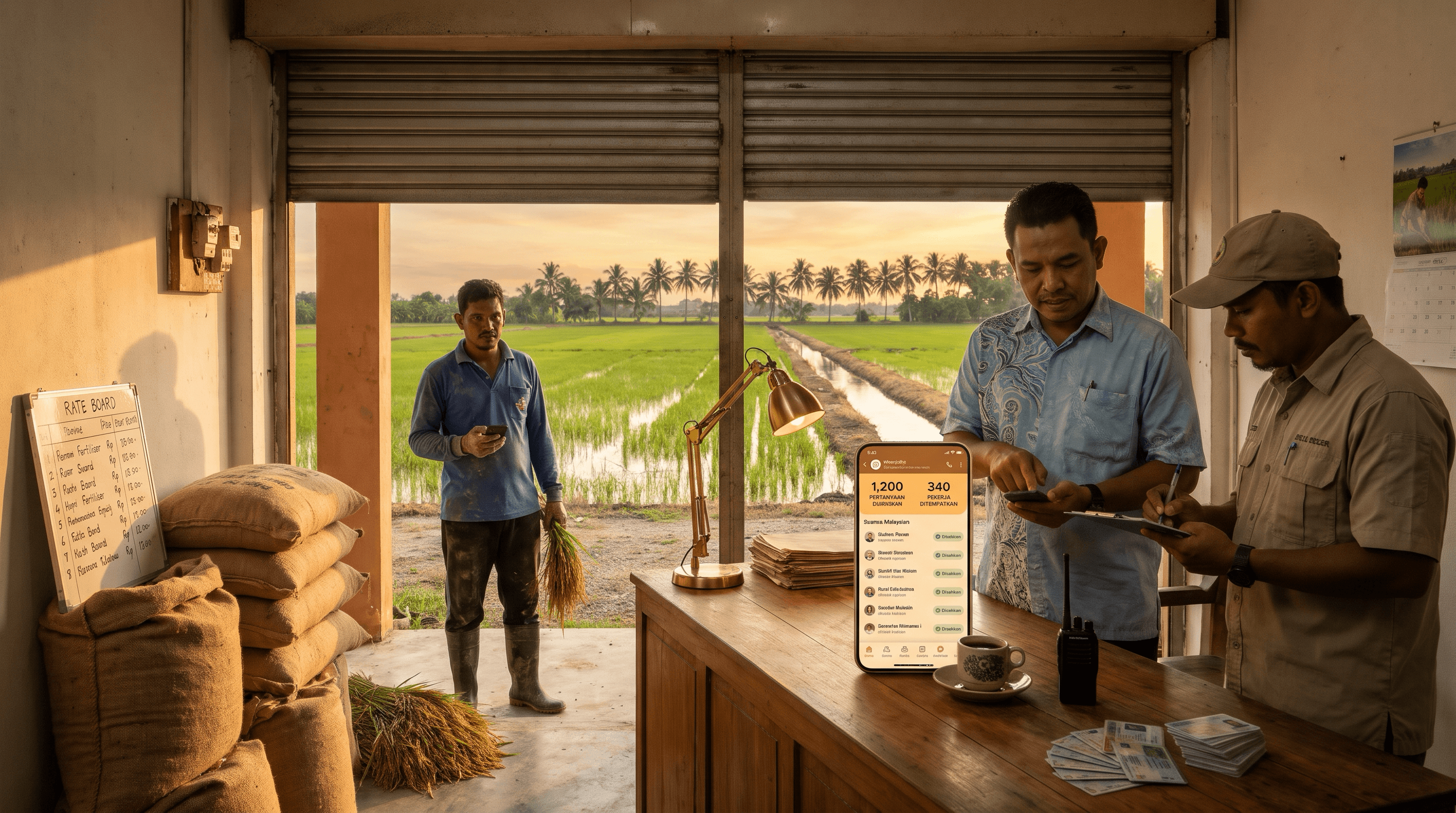
This is a case study. For the category-level read, see when a WhatsApp chatbot works.
A family-run agronomy and labour-support office in Pokok Sena, Kedah was losing an entire planting month to WhatsApp messages it could not answer. Farmers asked for a transplanting crew, workers asked where to report on Monday, and both were told to call back later — by which time the crop window had moved. We built the office a WhatsApp chatbot for seasonal labour enquiries: it answers in Bahasa Malaysia, matches workers to jobs against a live roster, and writes every placement down. In the planting month after launch it handled 1,200 enquiries end to end, and missed zero calls.
The business
The office has run in Pokok Sena since 2004, in a two-storey shopfront on the road between Alor Setar and Jitra, about 12 km north of the state capital. It started as a fertiliser and seed counter; the agronomy advice came later, and then the labour-matching side — for RM 45 a placement, they put workers onto farms across the Pokok Sena and Jitra tenure.
Nine people work there: the founder, his two sons, four field officers, two admin staff and a driver. Around 400 farmer clients come through the door, most working four to eight hectares of paddy.
The geography makes the business seasonal. Pokok Sena sits inside the Muda irrigation command area, where the double-cropping calendar runs two cycles a year — cool-season and dry-season — each with a narrow transplanting window and a narrow harvest window. The office calls the 31 days around the big transplanting push "musim tanam" — everything stacks up in those 31 days.
The problem they were actually trying to solve
Before the build, a typical enquiry was a WhatsApp message at 6:40am from a worker asking where to report, which gate to meet at, whether the wage was daily or per hectare, and when the lorry leaves. The office had two landlines and one family mobile — whoever picked up answered, everybody else kept working. In the last planting month before the build, 1,180 enquiries came in and 512 were answered. The other 668 sat unanswered until the following morning, by which point the worker had taken another job and the farmer had called someone else.
Three problems ran underneath the missed calls:
- The peak was the whole problem. Enquiries tripled in the fortnight either side of transplanting, and capacity to answer was flat. The people answering the phones were the same people who needed to be out in the field checking a crew had actually turned up.
- Confirmations were the expensive part. Every placement needed a reporting point, a start date, and confirmation the worker knew where to go. 41 of 212 workers arrived late or never arrived last season, because the confirmation call never happened — the officer was already driving to another plot.
- The records were paper. Muster sheets lived in the boot of the pickup, signed in pencil, and the office could not tell a farmer on a Friday how many workers had turned up on Wednesday.
The owner said on the first call: "We don't have a marketing problem. We have a phone problem, and it only shows up for four weeks a year. If a worker messages at six in the morning and gets an answer, he comes. If he calls and gets nothing, he goes to the next shop in Jitra. I want the message answered, not a brochure."
What we built — and why this approach
We built an AI WhatsApp chatbot on the office's existing WhatsApp Business number, so nobody had to learn a new app or a new number. It runs in Bahasa Malaysia, English and the Manglish mix that field labour actually uses, and it handles voice notes — a third of the messages, because typing on a phone with dusty hands is slow.
Four parts:
- A six-way intake flow — land preparation, transplanting, weeding, harvesting, machine and transport work, and direct-hire requests. Each branch captures the same core fields: skill, number of workers, plot location, start date, reporting point.
- A live worker roster — 214 workers on file with skill, mukim, phone number and how many days a week they can work, so the bot stops offering a slot to someone already standing in another field that morning.
- A plot and reporting-point matcher. Workers send a photo of the field; the bot pins the reporting point — nine across the tenure — and re-sends that pin at 5am on the working day. This is the single change that moved the late-arrival number.
- Handover to the four field officers. Wage disputes, injuries, anything about a named farmer's account, and any request to speak to a person go into a queue with the transcript attached. The bot never negotiates a wage.
The build took 14 days from kickoff to live. We chose this over hiring a fifth field officer at RM 1,700 a month — the hire would not have been available in the two weeks that mattered — and over a generic SaaS bot, which could handle FAQs but not read the roster or write a placement into the ledger.
We architected it; AI built it — the operating model on our Kedah page: fifteen-plus years of software practice deciding what the system must do, AI doing the heavy lifting. Total build RM 13,400, plus RM 950 a month for maintenance, language tuning and uptime.
How the operation changed
The overnight queue is now the morning brief. Enquiries arriving after 9pm are answered before 6am — 34% of traffic now lands before 7am, against 6% before the build. The four officers open the list at 7am and deal with the exceptions, not the volume.
- The 7am muster became the only human step in the chain. Before, an officer confirmed each placement by phone. Now the bot sends the reporting point, the field officer's name and the start time, and answers the follow-up questions in the meantime.
- The paper disappeared. Every confirmed placement writes to the office ledger as it is booked, so the office can tell a farmer on a Friday exactly how many workers turned up on Wednesday.
- One officer moved off the phone entirely. He now manages the roster — adding workers, keeping availability current, chasing the few who fall out of touch.
The numbers, nine weeks in
We don't do client testimonials. We do the office's own figures, nine weeks after launch — the planting month plus the five weeks after:
- Enquiries answered: 512 of 1,180 → 1,200 of 1,200. Zero missed calls in the planting month.
- Handled end-to-end by the bot: 78.6% (943 of 1,200). With a field officer following up: 15.2% (182). Escalated to a person immediately: 6.2% (75).
- Median first reply: 7 hours → 22 seconds. After-hours replies went from "sometime tomorrow" to under 40 seconds.
- Worker placements: 212 → 340 in the planting month. Most of the increase was small work — two people for a morning of weeding.
- Late arrivals and no-shows on the reporting day: 41 → 9.
- Field-officer phone time: 56 hours a week → 11 hours a week, across four officers.
- Total program cost: RM 13,400 build + RM 950/month retainer.
- Payback: 9 weeks, on RM 8,320 of avoided late-arrival costs and RM 5,760 of additional placements in the planting month alone.
What it would cost for your business
We don't publish a price sheet, because the price depends on how messy your intake is. Three honest bands for a Kedah or Perak business on WhatsApp:
- RM 7,800 – RM 11,800 build + RM 700 – RM 900 / month. One number, one intake flow, 10 to 15 enquiry types, a knowledge base from your own FAQ sheet. 2-3 week build. Fits a single-location business taking 300 to 600 enquiries a month.
- RM 13,400 – RM 24,000 build + RM 950 – RM 1,800 / month. A live roster or booking feed behind the bot, multilingual intake with voice notes, escalation to a person, and placements written into your own ledger. 4-6 week build. Fits a business with a seasonal peak — agri, construction, logistics, harvest crews.
- RM 28,000+ build + RM 2,000 / month. Multi-branch, a CRM layer on top, campaign messaging, voice ordering over the phone, and a model trained on your own transcripts.
The same bands run on the Kedah AI chatbot page. Perak equivalents are the same, adjusted for field conditions.
What this looks like for your business
If you run a seasonal operation in Kedah or Perak — agri, construction, logistics, harvest crews — and the phone is what sits between you and the work, the fix is not a bigger team. It is an answer that arrives in 22 seconds at 6am, in the language your worker actually writes in. This office's problem was not demand and it was not price. It was 668 enquiries a month with nobody free to pick them up, inside a 31-day window that does not wait for anyone.
We have built the same shape for an Alor Setar vet clinic and for WhatsApp automation more broadly. The agri version is the most seasonal of them — the demand is real, it all lands in one channel, and it arrives at 5am. For the wider Kedah read, see AI for small business in Kedah.
If you want to talk it through, book a 30-minute call. We will look at your enquiry volume, your peak week and your existing number, then come back with a number and a build week. We don't pitch you either way — about a third of the offices we talk to end up hiring the extra person instead, which for an office in its second year is often the right answer.
About the author
The pitchdeck.my team
I run pitchdeck.my — fifteen years building custom software, automation, and AI tooling for Malaysian SMEs, from Alor Setar family businesses to KL fintech desks. Most weeks I’m scoping a new build, writing the spec, and shipping the first version with the founder.
- AI for SMEs
- Custom software
- Malaysian markets
- Business automation
Related builds
Get ai chatbot in Kedah
Frequently asked questions
In this office's case the volume settles it: 1,200 enquiries a month, and before the build 668 went unanswered and those workers went elsewhere. The behaviour is not app-shopping — it is "I already have the app on the phone I use for everything, and the number I saved is the number from the last harvest." A web form is not a substitute here.
It handles all three, and that decides whether the build works in the field. About a third of the workers' messages here were voice notes sent from the field, and roughly half the rest were Manglish. The bot is trained on the office's own past transcripts, answers in the register the worker wrote in, and asks nobody to switch language. A bot that only speaks standard Bahasa loses the conversation in the first message.
It hands off. Wage negotiations, injury reports, anything about a named farmer's account, and any request to speak to a human go to a field officer with the full transcript attached. The bot never quotes a rate it was not given and never handles an injury report — 6.2% of conversations were escalated to a person in the first nine weeks, and those were exactly the ones that needed one.
It has to, so we built for that. The whole conversation runs inside WhatsApp — no app, no login, no portal for a tired worker to fight — and the bot replies from a hosted model, so someone on 3G in a field still gets an answer in seconds. The only thing that needs a good signal is the voice note, and the bot asks for text when one comes through badly.
Tell us what you run.
We’ll spec the fix in a week.
Priced like a hire, not a project — around the cost of one admin a month. Most builds pay back in 30 days or less.
Get a build specMore for Kedah
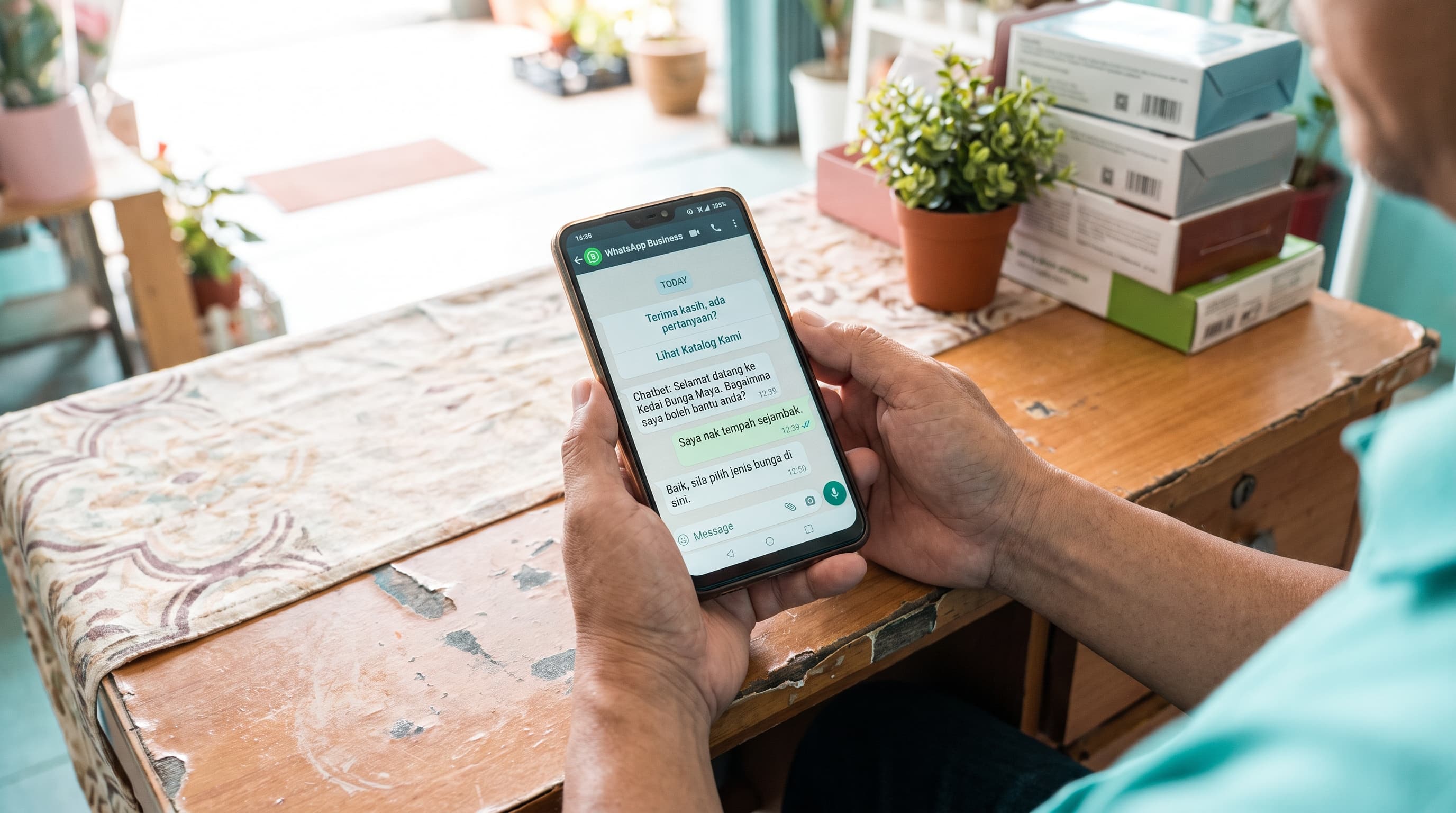
WhatsApp automation for Malaysian businesses
When WhatsApp automation is the right call, when it's overkill, the cost of doing it properly, and the PDPA compliance checklist. Built for Malaysian SMEs who already know WhatsApp is the channel.
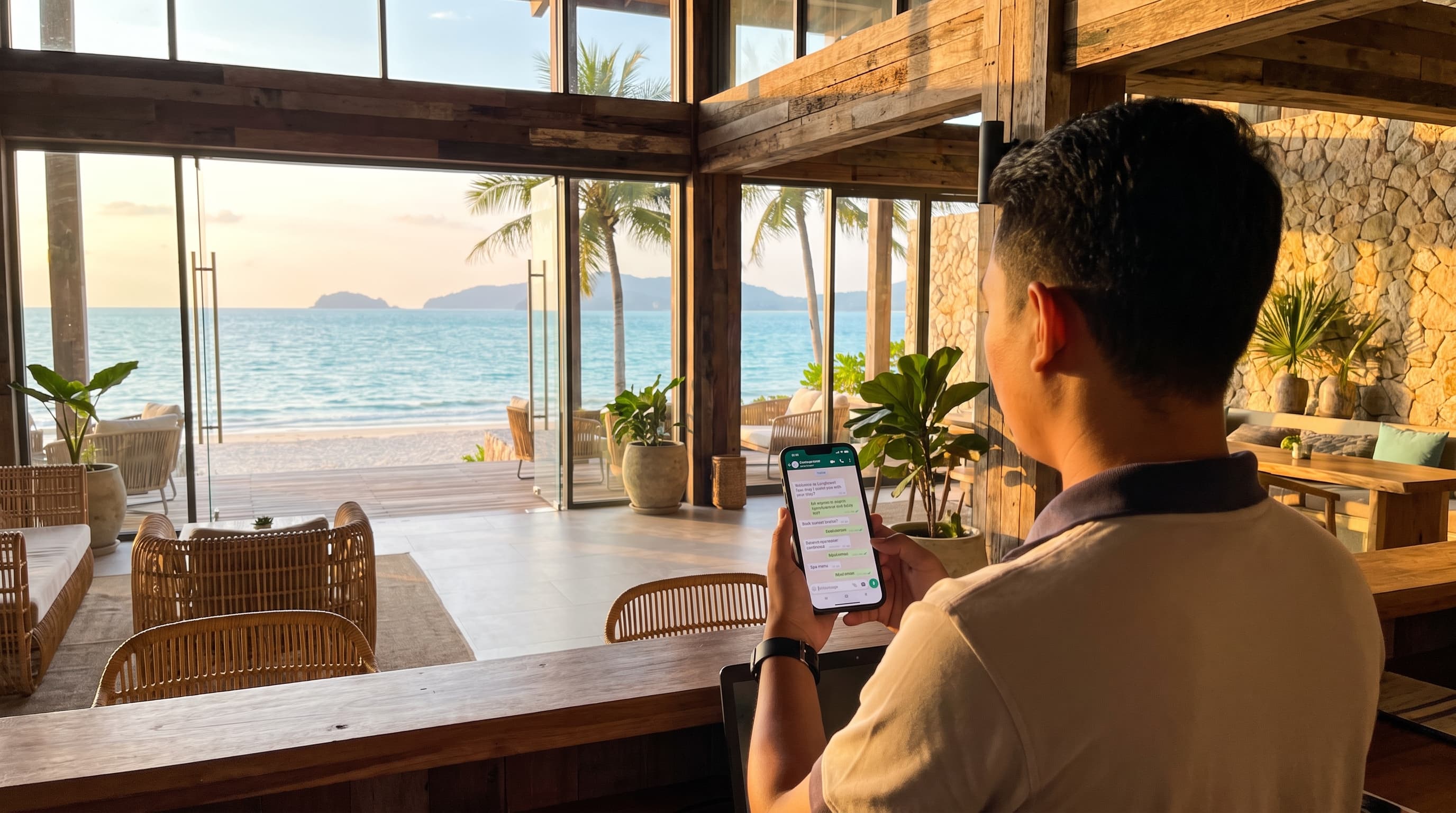
Case study: how a Langkawi beach resort handled 2x booking volume with an AI WhatsApp concierge
A 32-room Langkawi resort was missing half their WhatsApp enquiries during peak season. We didn't replace their staff — we built them an AI concierge that handles 80% of messages and books 24/7. Here's what it did in 8 weeks.