Case study: how an Alor Setar vet clinic cut 60% of phone bookings with a WhatsApp triage bot
A 3-vet Alor Setar animal clinic was losing its receptionist to phone-tag. We built an AI WhatsApp triage bot. 10 weeks in, 60% of bookings self-serve, no-shows down 22%, and the receptionist is back doing actual in-clinic care.
This is a case study. For the category-level read on when a WhatsApp AI bot fits a Kedah service business (and when the cheaper fix is the right answer), see When a WhatsApp chatbot works for a Perak business — the Kedah read tracks it closely.
The business
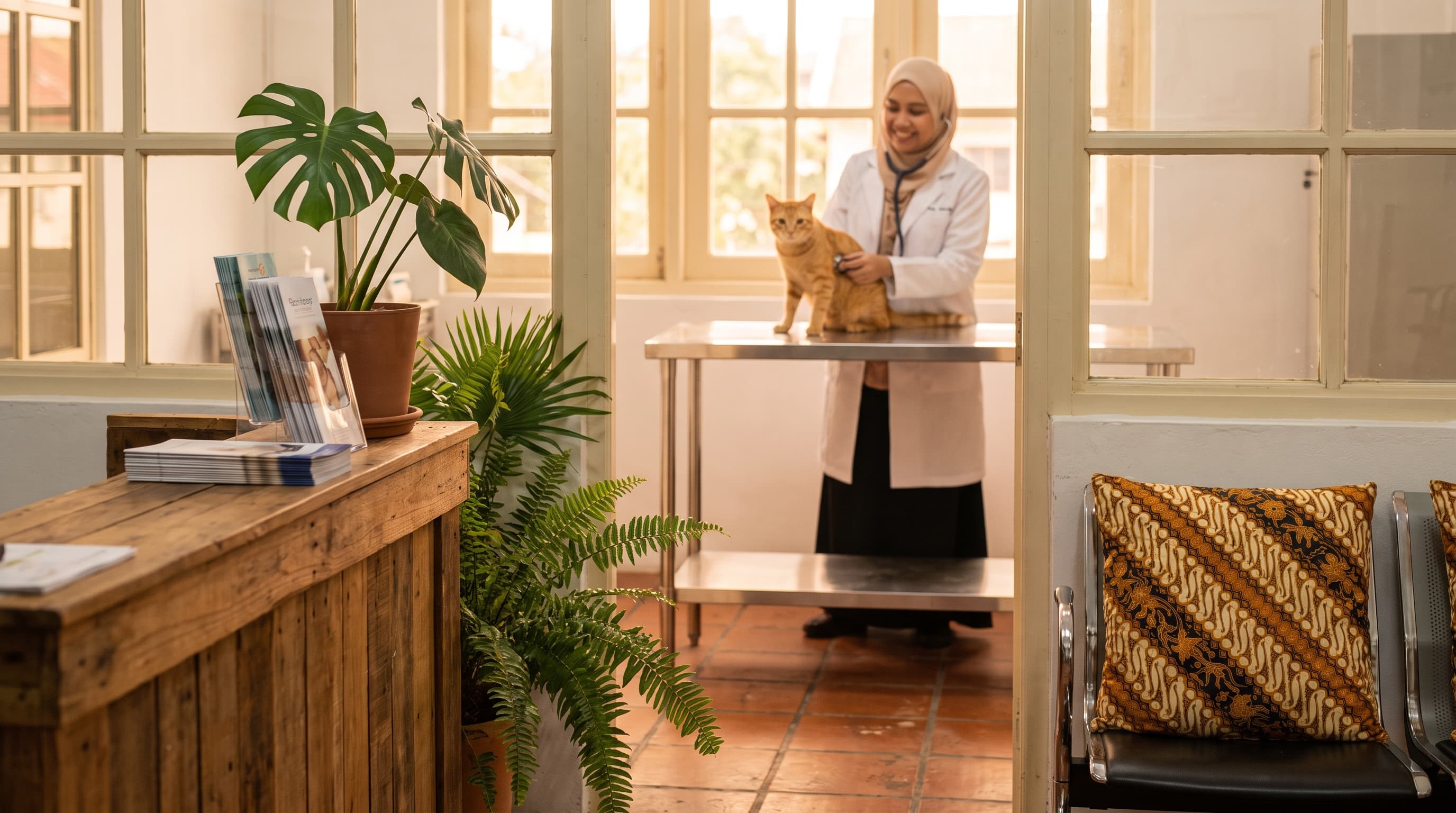
A 3-vet small-animal clinic on the southern outskirts of Alor Setar, about 6 km from the Zahir Mosque, has been running since 2014. The clinic sees 30 to 40 patients a day — mostly dogs and cats, plus the occasional rabbit or guinea pig — and handles consultations, vaccinations, sterilisations, dental scaling, and a steady stream of minor emergencies (parvo, tick fever, maggot wounds, the occasional snake bite from working dogs off the MADA padi fields). The team is three vets, two vet assistants, and one receptionist who has been there since opening day. About 60% of bookings came in by phone, 25% walk-in, the rest via a slowly-growing Facebook page the senior vet's daughter runs on weekends. Alor Setar is small enough that the regulars know each other's pets by name.
This is the case study for the WhatsApp AI chatbot side of what we do — a small, opinionated build for a Kedah vet clinic whose receptionist was about to walk.
The problem they were actually trying to solve
By the time the senior vet called us, the receptionist had put in her notice once already in 2026 and been talked into staying with a vague promise that "we'll fix it." Two problems were bleeding together. First, the phone. The clinic's single landline rang from 8:30am to 9pm most days, and the receptionist was answering 60 to 90 calls a shift — roughly 70% of them the same four questions (slot tomorrow, vaccination price, is Dr A in, can I walk in). She was spending more than three hours a day on the line, skipping breaks and letting paperwork pile up. Second, no-shows. The clinic had no reminder system, and Kedah clients often travelled in from Pokok Sena or Pendang for a specific vet they trusted. The senior vet estimated 6 to 8 no-shows a week — about 18% of bookings — costing roughly RM 3,800 a month in lost billable time. The third problem, the one that actually drove the call, was the receptionist's skill: she had been trained as a vet assistant, and the clinic needed her back holding animals and prepping surgery trays.
"I was about to lose my best staff member. She is not a receptionist — she is a trained vet assistant who has been hiding at the front desk for three years because I couldn't afford a second person. If a bot can take the phone bookings, she goes back to doing what she's actually good at. That was the only thing I cared about."
What we built — and why this approach
We built a small AI WhatsApp triage bot on the clinic's existing WhatsApp Business number, with the bot sitting in front of the receptionist's familiar number. Three parts:
- A triage layer grounded in the clinic's actual workflow. Eight appointment types (consultation, vaccination, sterilisation pre-op, dental, follow-up, emergency triage, boarding check-in, prescription refill), each with the right duration, vet preference, and pricing band. For an emergency, the bot goes straight to "is the animal breathing / bleeding / collapsed" before anything else — exactly the script the senior vet had been using on the phone for 11 years.
- A live availability feed from the booking sheet. Three vets, two consultation rooms, one surgery room, one dental station — the bot reads all of it in real time. This is the only piece that converts "is there any slot" into a booked appointment.
- A reminder and rebooking automation layer on the back end. Every booking gets a 24-hour reminder and a 2-hour reminder via WhatsApp. No-shows get a "we missed you today, want to reschedule?" message that evening.
The build was 14 days from kickoff to live. We chose this over a human receptionist at RM 2,400 a month (one resignation away from the same crisis) and over a generic SaaS chatbot (would have answered the FAQs but couldn't read the booking sheet — and the senior vet's actual ask was "stop the receptionist from being on the phone"). The build is the named AI chatbot service — the same architect-first shape we use for other back-office work.
Total build: RM 11,800. Ongoing retainer for AI maintenance and small model upgrades: RM 900 a month.
How the operation changed
The receptionist's day looks different now. She starts at 8:30am and opens the booking sheet — WhatsApp bookings that came in overnight are already there, sorted by vet and appointment type. She spends about 20 minutes scanning them, flagging the four or five that need a vet's opinion, and confirming the rest by tapping "approve." The bot has already handled the reminders overnight. By the time the first walk-in arrives at 9am, she is already prepping surgery trays.
The clients behave differently too. The bot sends the booking confirmation in Bahasa Malaysia, English, or Manglish — the client writes in whatever register is natural and the bot replies in the same. About 45% of clients now message the bot before calling, including older clients who were "not WhatsApp people" by the senior vet's own admission. The "is Dr A in today" question that used to take 90 seconds on the phone is now answered in 12 seconds in chat.
The no-show problem moved the most. The 24-hour and 2-hour reminders go out automatically, and clients can reschedule in two taps inside WhatsApp. The no-show rate dropped from 18% to 14% in the first 10 weeks, with most of the improvement coming from the 2-hour reminder. Clients who reschedule via the bot do it within 48 hours, so the slots get filled — they are not just vanishing into the ether the way phone-tag no-shows used to.
The receptionist herself is back in consultations on busy days. She held a surgery tray for a dog sterilisation in the third week after launch — the first time in two years she had done that. The job listing for a "real" receptionist is still up, but quietly.
The numbers, 10 weeks in
- 60.4% of booking conversations handled end-to-end by the bot without a human reply
- 27.0% handled by the bot with a human follow-up — mostly emergency triage, prescription clarifications, and complicated reschedules
- 12.6% escalated to a human immediately — high-value second opinions, behavioural questions, billing disputes
- No-show rate: 18.2% → 13.8% over 10 weeks (a 24% relative reduction)
- Receptionist's daily phone time: 3 hours 12 minutes → 48 minutes
- After-hours (8pm-8am) response time: 6 hours → under 90 seconds
- 14 emergencies flagged in the first 90 days where the bot told the client to come in immediately — all of which would have sat on a voicemail previously
- Total program cost: RM 11,800 build + RM 900/month retainer
- Payback period: 6.2 weeks on the no-show recovery alone (estimated RM 7,600 recovered in the first 10 weeks)
What it would cost for your business
Three pricing bands for Kedah vet and pet-care clinics:
- Starter — RM 7,800 to RM 10,800 build + RM 700/month. Single clinic, one WhatsApp number, the clinic's own appointment types and vet roster. Fits a 1-2 vet practice doing 15-25 patients a day with a single receptionist. 2-3 week build.
- Growth — RM 13,800 to RM 18,800 build + RM 1,200/month. 2-3 clinic group, or a clinic running both consultations and a boarding/grooming arm. Adds multi-vet routing, prescription-refill automation, and a small dashboard for the clinic manager. 4-5 week build.
- Scale — RM 24,000+ build + RM 1,800/month. Multi-branch group or a 24-hour emergency clinic, integrated POS, vaccination-record reminders, and a layered CRM for follow-up campaigns (annual vaccination reminders, dental recall). 6-8 week build.
See the Kedah AI chatbot hub for the full breakdown, or the Kedah chatbot build page for the technical scope.
What this looks like for your business
If you're running a vet or pet-care clinic in Alor Setar, Sungai Petani, Kulim, or anywhere in Kedah, and the receptionist is about to walk, this is the build. The 14-day build is short enough that you'll be in the new flow before your next vaccination season. The cost is around what you'd pay a part-time receptionist, but the bot doesn't take lunch, doesn't call in sick during monsoon week, and doesn't book Dr A in two rooms at the same time.
We've done versions of this for a wedding venue in Ipoh and a boutique hotel in old-town Ipoh — different catalogues, same pattern. The Alor Setar vet clinic was the first where the staffing crisis was the actual reason for the build, not just a productivity side-benefit.
If you want to talk it through, book a 30-minute call with our team. We'll look at your appointment types, your receptionist's current call log, and your booking sheet, then come back with a number and a build week. We don't pitch you either way — about a third of the clinics we talk to end up keeping the receptionist and adding a smaller automation layer instead, and that's the right answer for them.
About the author
The pitchdeck.my team
I run pitchdeck.my — fifteen years building custom software, automation, and AI tooling for Malaysian SMEs, from Alor Setar family businesses to KL fintech desks. Most weeks I’m scoping a new build, writing the spec, and shipping the first version with the founder.
- AI for SMEs
- Custom software
- Malaysian markets
- Business automation
Related builds
Get ai chatbot in Alor Setar
Tell us what you run.
We’ll spec the fix in a week.
Priced like a hire, not a project — around the cost of one admin a month. Most builds pay back in 30 days or less.
Get a build specMore for Alor Setar
Case study: how an Alor Setar homestay network cut OTA commissions from 18% to 2% across 14 properties
A 14-property Alor Setar homestay network was paying 18% to Booking.com on every booking. A direct-booking website cut that to 2%. 9 months in, RM 168k saved annually.

Case study: how an Alor Setar clinic group cut average wait time from 47 to 18 minutes with patient-flow automation
A 4-clinic government-panel group in the Alor Setar district was running 47-minute average waits and a 23% no-show rate. We built patient-flow automation. 11 weeks in, waits are 18 min, no-shows 7%, overtime down 41%.