Custom software vs SaaS subscription: which should a Malaysian SME pick?
SaaS is faster, cheaper upfront, and easier to walk away from. Custom software fits when the workflow is specific enough that no off-the-shelf tool will do it without a fight. The honest answer is rarely one or the other — it is which parts of the operation get which treatment.

The short answer
If a SaaS does 80% of what you need and the remaining 20% is tolerable, buy the SaaS. If 80% of the workflow is unique to your business and the SaaS forces your team to fight the tool every day, commission a small custom build. The trap is buying the SaaS anyway and then spending a year trying to bend it.
Which one is right for you?
Custom software fits
You're operational, you want to keep 100% of equity, and the bottleneck is finding the next 200 customers — not building a product.
SaaS subscription fits
You genuinely need RM300k+ of risk capital, you're ready to give up 10-20% equity, and the validation of a regulated round matters.
Neither fits yet
You're pre-revenue, pre-product, or pre-customer. The honest answer is: build or get operational first, then come back to this page.
At a glance
Custom software
- Upfront cost
- RM30-80k for a small build, depending on scope. Sometimes more, sometimes less.
- Monthly cost
- Low. Hosting, minor maintenance, and the occasional extension. Often under RM500/month.
- Time to live
- 6-12 weeks for a focused build. Long for a full enterprise system.
- Fit to your workflow
- Exact. Built around how your business actually runs.
- Lock-in
- Low. You own the code and the data. Walk away any time.
- Customisation
- Total. Anything your business needs is in scope, including the parts no SaaS would bother to build.
- Maintenance burden
- Yours. We hand over, but you own updates, security patches, and hosting.
SaaS subscription
- Upfront cost
- RM0 to start. Subscription fee from day one (RM100-RM3,000+/month typical).
- Monthly cost
- RM200-RM5,000/month once you are on the right tier, scaling with users and features.
- Time to live
- Same day. Sign up, configure, onboard the team.
- Fit to your workflow
- Approximate. Your team adapts to the SaaS's assumptions about how work should flow.
- Lock-in
- High. Migrating off a deeply integrated SaaS is one of the most expensive projects a business will ever run.
- Customisation
- Capped at what the vendor's API and config screens allow. Workarounds are usually the team's problem.
- Maintenance burden
- Vendor's. Patches, uptime, and feature updates are on someone else's roadmap.
When custom software makes sense
Example
A Sitiawan seafood processor with 60 staff needed batch traceability to pass a major retail buyer's audit. The off-the-shelf traceability SaaS quoted was RM1,200/month, locked the batch data on the vendor's Australian servers, and required the team to re-key every batch on a desktop terminal. The custom build was RM48k, completed in 9 weeks, and runs on the processor's own server. Passed the audit, kept the data on-site, and paid back the build cost in 3.5 years of avoided subscription fees — with the added benefit of a tool that actually fits the line.
When SaaS makes sense
Example
A new SS15 cafe with no in-house IT hires a SaaS POS at RM220/month. The POS handles orders, KDS, stock counts, and end-of-day reconciliation. It does everything the cafe needs, the team learns it in an afternoon, and the owner spends zero time on infrastructure. Custom-building a POS for a single cafe would be the wrong call — the cafe does not have workflow unique enough to justify the build, and the team is too small to absorb the operational burden. The right time to revisit custom is when the cafe opens its 4th outlet and the SaaS starts to feel expensive and inflexible.
When custom software makes sense — full notes
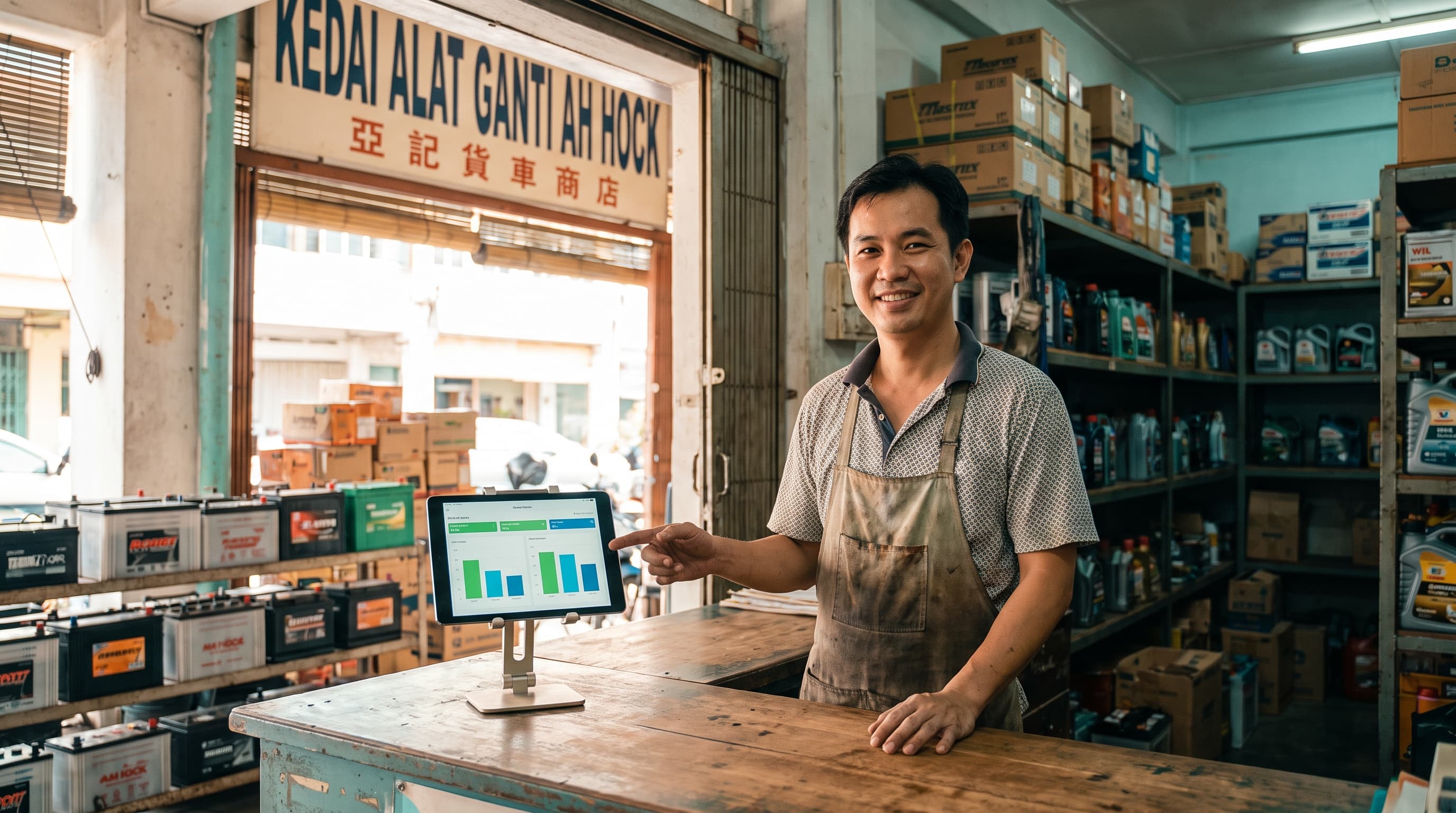
Custom software is the right call when the workflow is specific enough that no SaaS will fit it without a fight. The auto-parts shop in Alor Setar with 4,000 SKUs, manual reorders, and a paper ledger is the canonical case: an off-the-shelf inventory tool would force the team to change how they count, how they reorder, and how they track returns, and the saving in subscription fees would be eaten by the lost productivity in the first month.
It is also right when the data is sensitive or the regulatory burden is heavy. A Sitiawan seafood processor that needs batch traceability to pass a buyer's audit cannot store its batch data on a third-party SaaS that does not commit to a specific data-residency policy or that can change its terms on a 30-day notice. Custom code lives on your infrastructure, on your terms, and you decide what the audit log shows.
And it is right when the SaaS alternative is more expensive than the build over a 2-3 year horizon. RM800/month for 3 years is RM28,800 — and a focused RM40k build, owned outright, often pays for itself inside 18 months while leaving you with a tool that fits the workflow. The math is not always this clean, but it is more often in custom's favour than SME owners expect.
When SaaS makes sense — full notes
SaaS is the right call when the workflow is standard and the team is small. A PJ cafe that needs a POS, a Melaka boutique hotel that needs a property management system, a KL services firm that needs a CRM — these are solved problems, and the SaaS vendors in those categories have spent years tuning their tools to the median use case. Pay the subscription, onboard the team, and the business gets a working tool this afternoon, not this quarter.
It is also right when speed is the constraint. A new business that needs to take orders next week, before it has the cash to commission a build, should absolutely use a SaaS POS, a SaaS booking system, or a SaaS accounting tool. The downside of SaaS is its assumptions; the downside of custom software is its lead time. If the business cannot afford the lead time, the SaaS is the correct answer for now.
And it is right when the team is non-technical and does not want to operate the tool themselves. A custom build means the SME is now in the business of running infrastructure — even if we hand it over cleanly, somebody on the team has to think about backups, updates, and uptime. A SaaS eliminates that responsibility, and for many small teams that is worth the monthly fee on its own.
What pitchdeck.my does
We are the AI Your Business arm
The same team that ships the pitchdeck.my platform. We study your business first, find where it can be optimised, and code a custom solution.
Custom software, from RM 1,500
Lightweight systems built around how your business actually runs. No bloated ERP, no off-the-shelf template you'll fight for a year.
AI agents, automation, websites
WhatsApp concierge, AI-ization of existing workflows, direct-booking websites. From around the cost of one admin a month.
We are the AI Your Business arm for the case where custom is the right answer. Our custom software, business automation, and AI tooling are built around how your business actually runs — a small, focused build from around the cost of one admin a month, instead of a RM200k enterprise project. We spec it tightly, AI does the heavy building, and you own the code and the data outright. Listing on pitchdeck.my after is optional, not a condition of the build.
And — equally important — we tell you when custom is the wrong answer. If a SaaS does 80% of what you need for RM300/month, we will say so before the first invoice. The honest line: we have sent more than one prospect to StoreHub, Qashier, or a hospitality PMS instead of taking the build. If you'd rather talk to a human about your specific case, WhatsApp us or read the case studies below.
What this looks like in practice
An 18-room Ipoh boutique hotel was on a SaaS PMS that did 70% of what it needed. The remaining 30% — the direct-booking engine, the channel-manager integration, the local payment methods — the team worked around with a parallel set of spreadsheets and manual reconciliations, costing 3 hours a day. The honest answer was not to replace the PMS; it was to commission a small web design + booking engine build that integrated with the existing PMS. The PMS stayed (and the team kept what it liked), and the new website took direct revenue from 0% to 40% in 7 months. The SaaS was not the problem. The SaaS plus the missing piece was the right answer.
The honest trade-off
Custom software is not free, and the first 6 months are the most expensive part. The build costs RM30-80k before you see a single workflow improvement, and you carry that cost while your team is still learning the new tool. We mitigate this with short, focused builds rather than big-bang systems, and we hand over within 6-12 weeks, not 6-12 months — but the cost is real. If your business cannot absorb a RM50k build cost on top of the SaaS subscriptions you are already paying, custom is not the right move yet, and we will tell you so directly.
Frequently asked questions
A focused build for a single workflow typically runs RM30-80k. A full enterprise system (POS + inventory + production tracking + reporting) is RM100-250k, phased over 3-6 months. We start with the smallest version worth building, then extend as the business earns the next piece. From around the cost of one admin a month once live.
When the workflow is standard, when the team is too small to operate the tool, or when the lead time would put the business at risk. A new cafe opening next week should not commission a custom POS — it should use StoreHub or Qashier. The right time to revisit custom is when the SaaS starts to actively cost the business money or slow it down.
Yes, but the migration is one of the most expensive projects a business will run. Most teams underestimate the data-export, training, and parallel-running costs. We have done a few migrations and they are doable, but if you suspect the SaaS will be temporary, it is usually cheaper to start with a custom build from the outset.
Only when replacing them is the right call. Most of our builds integrate with the SaaS the business already runs — the SaaS keeps doing what it does well, and the custom build handles the missing 20-30%. Rip-and-replace is a last resort, not a default.
See the build services in action.
AI Your BusinessThe pitchdeck.my build pages that cover each side of this comparison — services and regions.
Read the case studies.
Real Malaysian businesses, the build we shipped, and the numbers 4 months in.
How a 14-year-old Kedah auto-parts shop cut weekly stock work from 8 hours to under 2
A family-run auto-parts trader in Alor Setar was losing hours to a paper ledger and missed reorders. We built a small custom stock + order system.
ReadHow a Sitiawan seafood processor passed its first major buyer audit with a custom batch-traceability system
A 60-person Sitiawan seafood processor was weeks from losing a major retail-buyer audit. We built them a small batch-tracking system in 9 weeks.
Read