Case study: how a Sitiawan fishing cooperative cut fleet fuel costs by 8% with a thin custom tracking app
A 22-boat Sitiawan fishing cooperative was burning RM 38,000 a month on diesel. We didn't sell them fleet AI. We built them a simple live-tracking app. Six months in, fuel is down 8% and boat utilisation is up 14%.
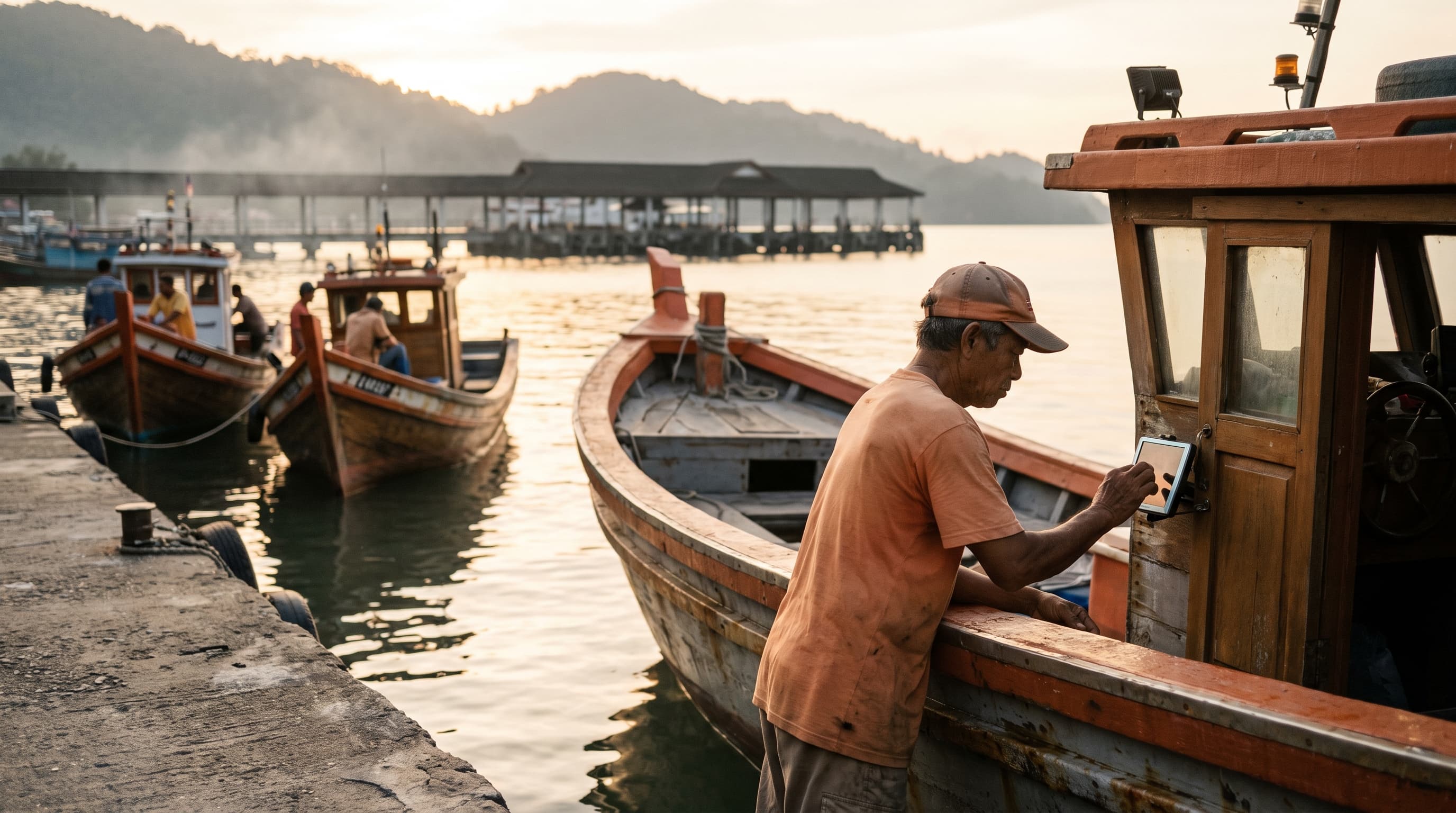
A 22-boat purse-seine cooperative in Sitiawan, Perak, on the Manjung coast roughly 25 kilometres from Lumut naval base and the Pangkor Island ferry jetty. The fleet runs squid, mackerel, and small pelagic catches through the year, sells at the morning auction at the Sitiawan fish landing complex, and was burning RM 38,000 of diesel a month. Forty-eight registered fishermen, twelve boat owners, one operations manager.
This is the case study for the custom software side of what we do — a small, opinionated build for a Perak fishing cooperative that did not need a fleet-AI platform, did not need a six-figure telematics contract, and did not need a transformation programme. It needed to see where the boats were and how much fuel they were burning, so the operations manager could stop paying for the fleet's bad habits.
The business
A purse-seine cooperative registered in 2003, fishing off Sitiawan, Lekir, and the Pangkor Strait. Twenty-two boats — fifteen under 30 gross tonnes, seven in the 30 to 70 GT range. Twelve boat owners, the rest share-fishermen. The cooperative does its own fuel procurement through a bulk-diesel arrangement with a Manjung-area supplier and resells at cost-plus on a tab.
Day to day, the operations manager sits in a small office behind the ice plant in Kampung Sitiawan. He settles the morning's catch with the auction buyers, allocates ice, signs off on the next fuel draw, and tries to keep twelve owners reasonably happy. The fleet had no shared visibility on position, fuel use, or trip duration. Each owner knew his own boat. Nobody had a fleet view.
The problem they were actually trying to solve
Diesel was eating the cooperative. Fuel was running around RM 38,000 a month — about 22% of gross catch revenue, well above the 13 to 15% the operations manager remembered from five years earlier. The cooperative had no shortage of theories: boats idling at the jetty for hours after the catch was sold, longer trips than necessary, two particular boats allegedly making unauthorised detours for night squid off Pangkor, and a fuel-draw tab that bore a passing resemblance to fiction.
The operations manager had tried two things in the previous 18 months:
- A fleet-management SaaS pitch from a Singapore telematics vendor. The demo looked slick. The quote was RM 72,000 for the first year, with a per-boat monthly fee and a 6-month onboarding. The manager asked one question — "does it work on a boat with no power at the jetty for 14 hours?" — and the sales engineer had nothing.
- A spreadsheet he had built himself in 2019, where each boat owner was supposed to text in start fuel, end fuel, and trip hours every morning. It worked for three months. Then four owners stopped sending the numbers. Then three more. The data died.
What the operations manager said on the first call: "I don't need a fleet AI. I need to know which boat is burning 4.2 litres a nautical mile and which is burning 2.8, so I can have a conversation with the owner." That sentence is the brief.
The other thing he wanted, said almost as an afterthought, was a way for the boat owners to see what they were spending too. Most owners trusted him. Two or three did not, and the lack of visibility was quietly eroding trust. That is worth fixing on its own.
What we built — and why this approach
A small custom fleet-tracking app with three parts, sitting on equipment the boats could get cheaply:
- A telematics box on each boat. Twenty-two units — a small industrial GPS tracker with a fuel-level probe wired into each tank. The boxes are 12-volt, draw less than a cabin light, and back up their data on a local SD card when there is no signal. Boats that run toward the Pangkor Strait can be out of cellular for stretches — the boxes handle the gap and upload the buffered data when they come back into range.
- A simple web app the operations manager opens in a browser. Live position of all 22 boats on a chart, colour-coded by trip status (fishing, transiting, idle). Each boat has a card showing today's fuel burn, trip hours, nautical miles, and litres per nautical mile. A daily summary email lands in his inbox at 5:30am.
- A boat-owner view. Each of the twelve owners gets a login. He sees his own boat only — position, fuel, today's trip, last 30 days' litres-per-nautical-mile trend. That is the entire boat-owner view. It is the most important screen in the system.
The data sits in a Postgres database on a single modest cloud instance; the app is a small Next.js frontend. The intelligence is a trip-status rules engine — five rules that look at GPS speed, fuel rate, and time at the jetty to label each boat as fishing, transiting, or idle. The manager can override a label and the override feeds back into the rules.
Why not the Singapore telematics SaaS? Because the cooperative does not have an IT team, does not have a transformation budget, and does not want to pay RM 72,000 a year for software that will not upload from the Pangkor Strait. The build matches the fleet, not the other way around. That is the line on the Perak custom-software work — the architect decides what is worth building, AI helps build it fast, and the result is owned by the people using it.
How the operation changed
Three concrete changes inside the first 12 weeks:
- The morning settlement is faster and quieter. Before, the manager spent the first hour of every morning asking each owner how the trip went. Now the trip summary lands in his inbox at 5:30am and the settlement conversation starts from the data. He is at home by 7:30pm on most nights instead of 9.
- The owners who were burning too much changed their behaviour, not their boats. Two boats were running 4.1 to 4.3 litres per nautical mile — well above the fleet median of 3.1. One had an ageing engine and a blocked keel cooler. The other had a fuel-siphon problem. Both got fixed inside a month. The numbers did the persuading.
- The cooperative trust is back. Before, three of the twelve owners were quietly convinced they were being short-changed on fuel. The boat-owner view let each owner audit his own draw without going through the manager. By month three, the fuel-settlement disputes had effectively stopped. That is worth more than the 8%.
The build is now in a second phase — a catch-vs-effort module that overlays fuel cost onto the morning's catch revenue per boat, so the manager can have a quarterly conversation with each owner about profitability, not just fuel. That is the business automation layer.
The numbers, 6 months in
- Fuel cost per nautical mile down from a fleet median of 3.1 L/nm to 2.85 L/nm — an 8.1% reduction, holding the same boats, same gear, same fishing grounds. Two problem boats were the bulk of the gain.
- Total monthly fuel spend down from RM 38,200 to RM 35,000 — RM 3,200 a month, about RM 38,400 a year. The cooperative used part of the saving to bulk-buy ice for monsoon months.
- Boat utilisation up 14% — productive trip hours per boat per week, after the manager used the trip-status data to find four boats idling at the jetty for 90 minutes before the catch was sold. Three re-sequenced their morning; the fourth did not and is now down to a 70-hour week to match.
- Fuel-settlement disputes effectively zero — informal complaints down from roughly three a month. The annual general meeting passed without a question on fuel accounting, for the first time in five years.
- Total build cost: RM 38,500, including the 22 telematics boxes, installation, the web app, and 12 months of hosting. Payback: 13 months on fuel savings alone — 6 months if you count the elimination of one fuel siphon.
What it would cost for your business
Three pricing bands, anchored to fleet size:
- Small fleet (5-10 boats, single site) — RM 14,000 to RM 22,000, including hardware, install, and the same web app. Suits a single-owner operation, a young cooperative, or a small long-line or trawl outfit in Lumut, Kuala Selinsing, or Bagan Datuk.
- Mid fleet (15-30 boats, multi-site operations) — RM 32,000 to RM 55,000, which is roughly what the Sitiawan cooperative paid. Add a per-boat monthly hosting and SIM fee of RM 25 to RM 40. For broader pricing context, see our honest 2026 pricing guide for Alor Setar custom-software work — the band logic transfers.
- Larger fleet (40+ boats, or fleet with cold-chain or processing downstream) — RM 80,000 to RM 140,000, with integration into a landing complex or auction system. The same app is the foundation for the batch-traceability system we built for the seafood processor down the road.
For a 22-boat fleet on the Manjung coast, expect 12 to 18 months payback on fuel savings alone, 6 to 8 months once you count dispute resolution and utilisation gains. The 30-day payback line is for business-automation plays — fleet tracking is honest 12-to-18-month work.
What this looks like for your business
If you run a fishing cooperative, a small aquaculture outfit, or any diesel-dependent fleet — tugs, supply boats, palm-oil transporters, the small commercial fleets that move around Manjung, Bagan Datuk, Selama, and the rest of Perak — the pattern is the same. You do not need a fleet AI. You need to see, per vehicle or boat, what the fuel bill looks like, and a way for each owner or driver to see the same number without asking.
The custom route makes sense if you want to own the data, you want the per-driver view in the system, and you do not want to pay a Singapore SaaS a per-boat fee forever. If you are happy with a hosted fleet platform and you only need the manager's view, the SaaS route is fine. We will tell you that on the call. We do not pitch you either way — that is the one promise we keep.
If this looks like your shape of problem — small fleet, fuel cost creeping up, trust between owners and the office eroding — get in touch. We will spend 30 minutes on a call to figure out whether a custom build, a thin automation, or a vendor recommendation is the right answer.
About the author
The pitchdeck.my team
I run pitchdeck.my — fifteen years building custom software, automation, and AI tooling for Malaysian SMEs, from Alor Setar family businesses to KL fintech desks. Most weeks I’m scoping a new build, writing the spec, and shipping the first version with the founder.
- AI for SMEs
- Custom software
- Malaysian markets
- Business automation
Related builds
Get custom software in Perak
Tell us what you run.
We’ll spec the fix in a week.
Priced like a hire, not a project — around the cost of one admin a month. Most builds pay back in 30 days or less.
Get a build specMore for Perak

Case study: how an Ipoh dental clinic group cut no-shows from 22% to 6% with a custom patient-communication system
A 14-year Ipoh dental clinic group was losing 22% of booked slots to no-shows. We built a custom WhatsApp-first patient-communication system. By week 8, no-shows were 6%. The full build, the cost, the real numbers.
Case study: how a Sitiawan seafood processor passed its first major buyer audit with a custom batch-traceability system
A 60-person Sitiawan seafood processor was weeks away from losing a major retail-buyer audit. We didn't sell them a traceability SaaS — we built them a small batch-tracking system in 9 weeks. Here's what it did.