Off-the-shelf POS vs custom POS: which fits a Malaysian F&B or retail business?
Off-the-shelf POS systems (StoreHub, Qashier, Touché) are fast, cheap, and good enough for most Malaysian F&B and retail. Custom POS fits when the workflow is specific enough that the SaaS forces the team to fight it. The middle path — keep the SaaS, build the missing pieces — is usually the right call.

The short answer
If you run 1-3 outlets with a standard menu and standard payments, an off-the-shelf POS (RM200-500/month) is the right call and a custom build is overkill. If you run 5+ outlets with a non-standard workflow — multi-kitchen routing, complex stock rules, custom commission structures — the SaaS starts to cost you more in lost productivity than the build would. Most businesses are somewhere in the middle, and the honest answer is usually: keep the SaaS, build the missing 20%.
Which one is right for you?
Custom POS fits
You're operational, you want to keep 100% of equity, and the bottleneck is finding the next 200 customers — not building a product.
Off-the-shelf POS (StoreHub, Qashier, Touché) fits
You genuinely need RM300k+ of risk capital, you're ready to give up 10-20% equity, and the validation of a regulated round matters.
Neither fits yet
You're pre-revenue, pre-product, or pre-customer. The honest answer is: build or get operational first, then come back to this page.
At a glance
Custom POS
- Upfront cost
- RM40-100k for a focused build. Phased over 6-12 weeks.
- Monthly cost
- RM500-2,000/month. Hosting, minor maintenance, occasional extensions.
- Time to live
- 8-16 weeks for a focused build. Long for a full enterprise system.
- Fit to your operation
- Exact. Multi-kitchen routing, custom modifiers, complex stock rules — whatever the business needs.
- Multi-outlet reporting
- Built-in. Single dashboard across all outlets, custom KPIs, live data.
- Integration with your other systems
- Direct. We connect the POS to your accounting, inventory, e-commerce, and e-invoice system as part of the build.
- Vendor lock-in
- None. You own the code, the data, and the integrations. Walk away any time.
Off-the-shelf POS (StoreHub, Qashier, Touché)
- Upfront cost
- RM0-RM3,000. Most charge a small onboarding fee or none at all.
- Monthly cost
- RM180-600/month per outlet. Scales with users and features.
- Time to live
- Same day. Configure terminals, onboard staff, take orders.
- Fit to your operation
- Approximate. The POS vendors optimise for the median Malaysian outlet. Edge cases are the staff's problem.
- Multi-outlet reporting
- Standard. Most vendors have a multi-outlet dashboard, but custom KPIs require workarounds or the enterprise tier.
- Integration with your other systems
- Via the vendor's API or Zapier. Usually works for common flows; anything custom is a vendor dependency.
- Vendor lock-in
- High. Migrating stock, sales history, and customer data off a POS is one of the most painful projects a retail business can run.
When a custom POS makes sense
Example
A Shah Alam halal FMCG maker with 4 distribution channels (wholesale, retail, modern trade, export) needed a POS that could route orders to the right warehouse, apply the right price book per channel, and update the batch-traceability system in real time. StoreHub handled the till; the rest was a parallel set of spreadsheets that one admin kept updated by hand, costing 4 hours a day. The custom POS replaced both, integrated with the existing traceability system, and paid for itself in 8 months of admin time recovered.
When an off-the-shelf POS makes sense
Example
A new SS19 cafe with a 30-item menu and a single counter runs StoreHub at RM250/month. The POS handles orders, payments, end-of-day reconciliation, and the basic sales reports. It does everything the cafe needs, the team learned it in an afternoon, and the owner spends zero time on infrastructure. The right time to revisit custom is when the cafe opens its 4th outlet and the StoreHub dashboard stops being sufficient — not before.
When a custom POS makes sense — full notes
A custom POS is the right call when the workflow is specific enough that the SaaS vendors cannot fit it. A Shah Alam factory outlet running a halal FMCG line with batch-level stock tracking, multi-warehouse fulfilment, and consignment customers cannot operate on a StoreHub-tier POS without a parallel set of spreadsheets. The off-the-shelf tool handles the till; the spreadsheets handle the actual business. That is a custom build waiting to happen.
It is also right when the business is 5+ outlets and the SaaS's multi-outlet reporting has started to fail. Once a retail or F&B group crosses 4-5 outlets on the same SaaS, the dashboard typically becomes the bottleneck — the KPIs the owner actually needs (food cost per outlet, staff productivity, average ticket time by shift) are not on the standard report. A custom POS bakes those KPIs in, and the owner stops running parallel Excel.
And it is right when the business has a hard integration requirement. A KL cafe group that needs its POS to talk to a custom loyalty system, a custom kitchen display, and a custom e-invoice pipeline is going to spend more on the integration glue than on the POS itself. Building a focused POS around the integration requirement is usually cheaper and faster than wiring 4 vendors together.
When an off-the-shelf POS makes sense — full notes
An off-the-shelf POS is the right call when the business is 1-3 outlets with a standard operation. A PJ cafe, a Melaka boutique, a KL services firm — these do not need a custom POS. They need a tool that takes orders, takes payment, and reconciles at end of day. StoreHub, Qashier, Touché, and the rest of the Malaysian POS market are mature, well-priced, and good at exactly this. The custom build is overkill and a bad use of capital.
It is also right when the team is non-technical and the founder does not want to be in the business of running infrastructure. A custom POS means the SME is now running servers, doing security updates, and fielding 'why is the till down' calls. A SaaS POS eliminates that responsibility, and for many small teams that is worth the monthly fee on its own.
And it is right when the business is still pre-PMF. A new F&B concept trying to figure out the menu, the pricing, the customer flow — should not be investing in a custom POS. The menu will change, the workflow will change, and the custom build becomes a sunk cost before it earns its keep. The right time to revisit custom is when 3 outlets are running the same proven operation and the SaaS is starting to actively cost the business money.
What pitchdeck.my does
We are the AI Your Business arm
The same team that ships the pitchdeck.my platform. We study your business first, find where it can be optimised, and code a custom solution.
Custom software, from RM 1,500
Lightweight systems built around how your business actually runs. No bloated ERP, no off-the-shelf template you'll fight for a year.
AI agents, automation, websites
WhatsApp concierge, AI-ization of existing workflows, direct-booking websites. From around the cost of one admin a month.
We are the AI Your Business arm for the case where a custom POS is the right answer. Our custom software work covers POS, inventory, and the integrations around them — built around how your multi-outlet operation actually runs, from around the cost of one admin a month, with full code ownership at hand-over. We have also built the web design + direct-booking engine for F&B groups that need their website and their POS talking to each other.
And we are honest about the limit. If a StoreHub or a Qashier does 80% of what you need, we will say so. The honest line: we have sent more than one prospect to the SaaS POS vendors instead of taking the build, because that was the right answer. If you'd rather talk to a human about your specific case, WhatsApp us or read the case studies below.
What this looks like in practice
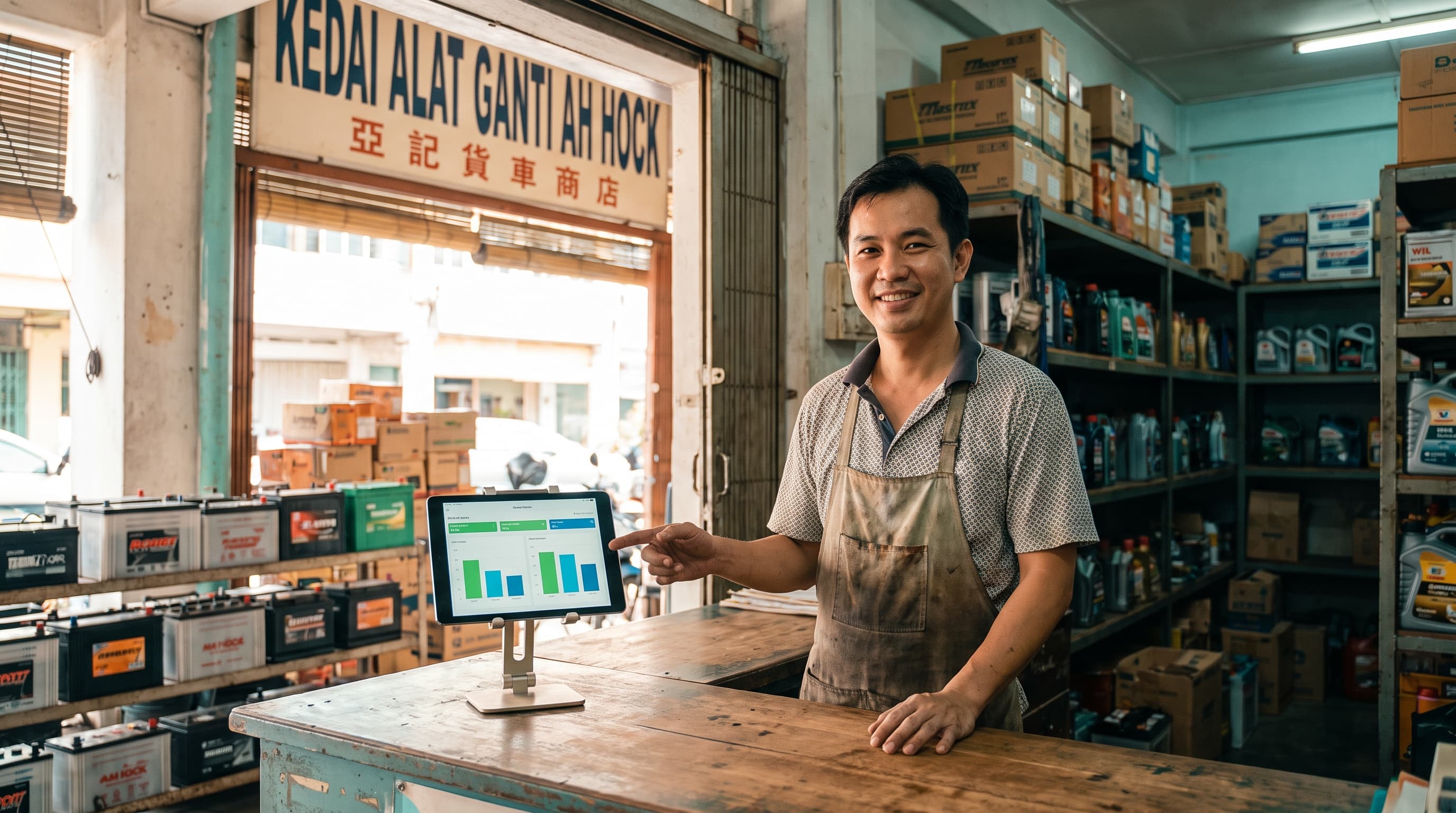
A 3-branch Sungai Petani electrical goods retailer was running StoreHub at the till and a parallel stocktake process that took 6 days a month. The off-the-shelf POS handled the sales, the stocktake was a manual reconciliation that the owner did over a weekend. The honest answer was not to replace the POS. The honest answer was a small business automation build that wired the barcode scanner to the POS and ran the reconciliation script. The StoreHub stayed (and the team kept what they liked), the stocktake dropped from 2 days to 4 hours, and the build cost was RM22k — paid back in 6 months of recovered owner time.
The honest trade-off
A custom POS is the right call only for businesses whose workflow has stopped fitting the SaaS. The honest limit: the build costs RM40-100k before you see a workflow improvement, and you carry that cost while the team is still learning the new system. We mitigate this with phased builds and tight scoping, but the cost is real. If your business can still operate on a StoreHub or a Qashier, the custom POS is the wrong call, and we will say so before the first invoice — even if it means we do not get the build.
Frequently asked questions
For a single-outlet cafe or restaurant, StoreHub and Qashier are the strongest general-purpose picks. Touché is well-suited for full-service restaurants. For retail, Lightspeed and Vend (now Lightspeed Retail) are solid, and a few smaller local players cover niche cases. The best way to choose is a 2-week trial at one outlet, not a feature-comparison spreadsheet.
A focused build for a multi-outlet operation with custom stock rules and a real dashboard typically runs RM50-120k, completed in 10-16 weeks. A full enterprise POS with multi-warehouse, advanced reporting, and a customer-facing ordering app is RM150-300k, phased over 4-8 months. We start with the smallest version that solves the actual bottleneck, then extend as the business earns the next piece.
Yes, and that is the more common path. We have built custom reporting, custom stock rules, custom e-invoice pipelines, and custom loyalty systems on top of StoreHub, Qashier, and a few other Malaysian POS systems via their APIs. The POS keeps doing what it does well, and the custom layer handles the missing 20-30%. This is usually cheaper and faster than a full rip-and-replace.
Yes. The LHDN e-invoice mandate is rolling out through 2026, and the major Malaysian POS vendors (StoreHub, Qashier, Touché) have either shipped or are shipping e-invoice support. If your POS does not have it by the time your turnover band triggers the mandate, we can build the e-invoice layer on top of the existing POS via its API. This is a common project for us in 2026.
See the build services in action.
AI Your BusinessThe pitchdeck.my build pages that cover each side of this comparison — services and regions.
Read the case studies.
Real Malaysian businesses, the build we shipped, and the numbers 4 months in.
How a 3-branch Sungai Petani electrical goods retailer cut stocktake from 2 days to 4 hours with a simple automation
We didn't sell them an ERP — we wired their barcode scanner to their POS and built a reconciliation script. Here's what it did.
ReadHow a Sitiawan seafood processor passed its first major buyer audit with a custom batch-traceability system
A 60-person Sitiawan seafood processor was weeks from losing a major retail-buyer audit. We built them a small batch-tracking system in 9 weeks.
Read