Case study: how an Ipoh school cut parent admin hours 60% with a custom parent portal
An Ipoh independent school with four WhatsApp parent groups was burning 22 admin hours a week on parent messages. A custom parent portal cut that 60% by week 10.
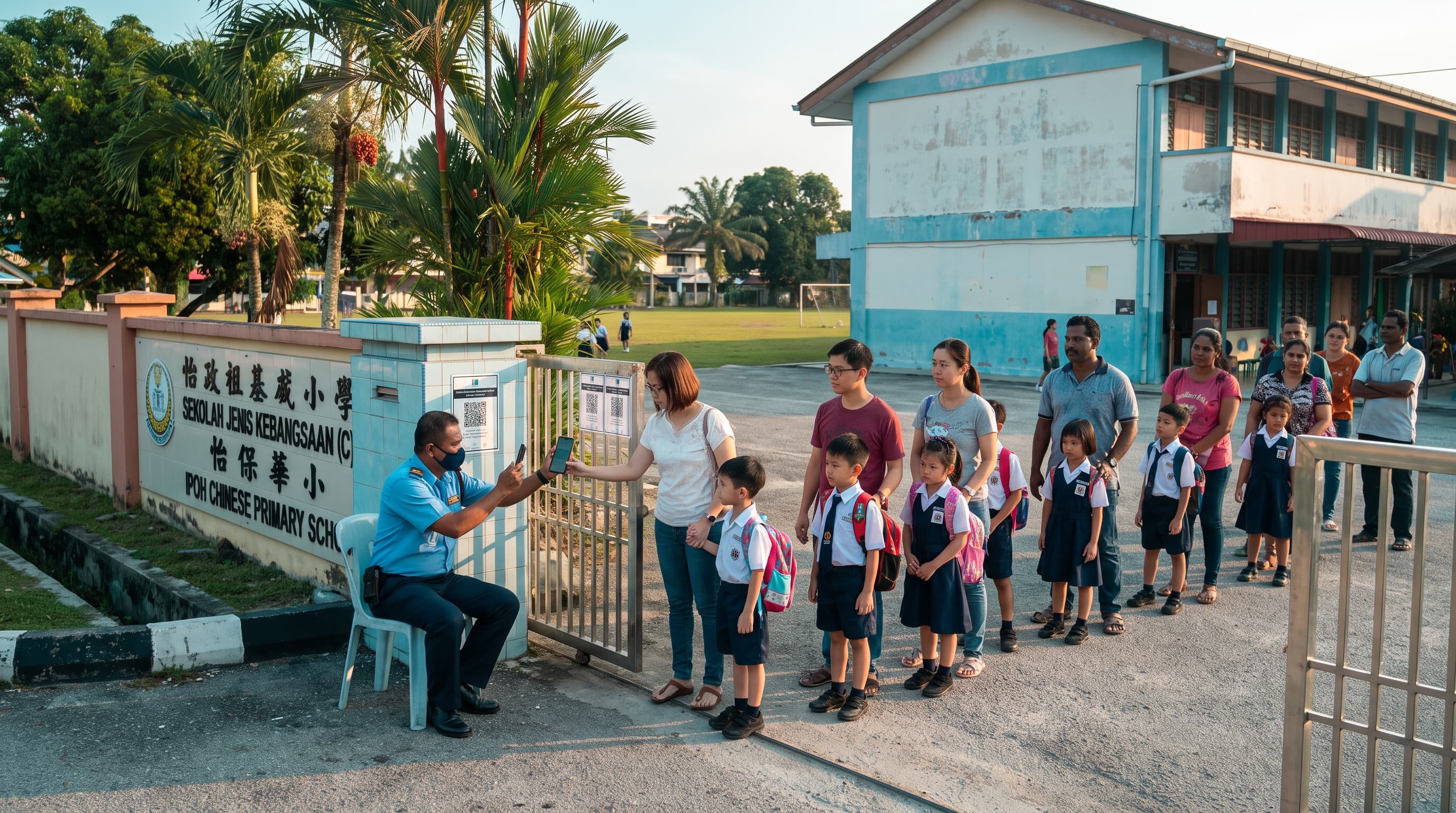
A 22-year-old independent Chinese-medium school in the southern Ipoh suburbs was running four WhatsApp groups to talk to 380 parents, two admin staff losing 22 hours a week to message triage and fee queries, and a paper sign-out book at the school gate. By week 10 of the build, the WhatsApp groups were archived, parent-facing admin hours were down 60%, and the front-gate sign-out was a one-tap flow that took 4 seconds instead of 90. Here is the build, the cost, and what your school would pay.
The business
A 22-year-old independent Chinese-medium school on the southern edge of Ipoh, Perak, with primary and lower-secondary sections totalling 380 students. The school is run by a board of directors from the founding association, with day-to-day operations handled by a principal, two vice-principals, and 11 admin and operations staff. About 70% of the cohort is Chinese-Malaysian, the rest a mix of Malay, Indian and a small expatriate slice; the language of instruction is Chinese, with Bahasa Malaysia and English tracked alongside. Fees sit at the mid-band for Ipoh independent schools — around RM 480 a month for primary and RM 560 for secondary — with roughly 12% of students on the school bursary scheme. The school draws from the Kinta Valley catchment: Taman Ipoh Jaya, Bercham, Taman Cempaka and the southern residential estates. The principal — a former government school headteacher who took over six years ago — is on the third parent-communication tool the school has tried in five years.
This is a case study for the custom software arm of what we do — a tightly scoped parent-portal build around how an Ipoh independent school actually communicates, not a generic school SaaS template.
The problem
Three leaks, all the same shape — the school had a system, but the system was four WhatsApp groups:
- Four parallel WhatsApp groups, each leaking into the next. One for the school office (urgent notices, fee reminders, absence notes), one for the parent-teacher association, one per class level for primary, and one for secondary. About 92% of parents were in at least one. About 41% were in all four. The principal was fielding the same absence note three times — once to the class teacher, once to the office group, once to the PTA group. The school secretary was forwarding messages from the office group to the principal's personal phone at 10pm because parents had started using the groups for anything urgent.
- 22 admin hours a week, gone. Two admin staff (the school secretary and a part-time front-desk clerk) spent the bulk of their week on WhatsApp: answering the same five questions (term dates, fee amounts, uniform shop hours, exam timetables, school holiday closure), forwarding absence notes to class teachers, and reconciling fee payments against a paper receipt book. That worked out to roughly 22 hours a week, or about 1.2 FTE of admin capacity — not a small number for a school of this size.
- The paper sign-out book at the gate was a safety and a workflow problem. Every pickup required a parent to sign a paper book with a name, time, car plate and student ID. The book was checked against a class list at dismissal. The school had two near-misses in 12 months where a parent picked up a child using a name they had heard in the group, not their own. The office knew about the issue. The board had asked twice for a fix. Nothing had moved.
The principal said on the first call: "I am running a school, not four WhatsApp groups. I need parents to be able to find the term dates, see their kid's absence record, pay the fee, sign the gate book, and tell me a sick note — all in one place, in two minutes, without my secretary being the relay station. I do not need another app that does three of those four." That sentence is the brief.
What we built — and why this approach
A small custom parent-communication portal — web-first, with WhatsApp as the message bus — in five parts, anchored to the school office, not the parents' phones:
- A single parent portal, web and mobile-friendly, with one login per family. Each family has a single account that shows every child they have at the school. No app download, no new username for each class. Login is by phone number with a one-tap OTP, which matters because roughly 30% of the parent body are 50-plus and resistant to a second app.
- A notice board and FAQ that absorbs the top 10 parent questions. Term dates, fee structure, uniform shop hours, exam timetables, school holidays, bus routes, the bursary application form, the absence reporting form, the pickup procedure, and the contact list. Each entry is editable by the school office from a simple CMS. New entries get pushed to parents as a single weekly digest on WhatsApp, with a deep link into the portal entry.
- An absence and sick-note flow that replaces the group message. A parent reports an absence in the portal; it lands in the class teacher's queue with the student name, class, date and reason pre-filled. The class teacher confirms in one tap. The school office sees the roll-call auto-update. A WhatsApp confirmation goes back to the parent. Total parent-side time: about 40 seconds. The class teacher-side time: about 12 seconds.
- A fee and receipt module, integrated with the school's Maybank account. Each family's outstanding fees, payment history and upcoming-due reminders, with a one-tap FPX link. A receipt is generated automatically on payment and is downloadable from the portal. The school office's reconciliation drops from a paper-book-and-spreadsheet dance to a daily 10-minute check.
- A QR-based gate sign-out that kills the paper book. Each family gets a unique QR code in the portal. At the gate, the guard scans the code with a shared phone, the system records the pickup against the student record, and the parent is on their way. Total time at the gate: about 4 seconds. The sign-out log is live, the office gets a daily pickup report, and the principal can audit any individual pickup.
Why custom and not a school SaaS? Three reasons. Every school SaaS we evaluated assumed either a national-school workflow (which the independent school system does not run on) or a fee-only billing model (which the school's board does not want exposed to a third party). None handled the WhatsApp-first, web-portal-second mix the parents actually use. And the QR gate sign-out plus the absence flow plus the fee reconciliation — the three highest-ROI parts of the build — is not a feature in any off-the-shelf product we found at the Ipoh school's price band. For the wider regional pattern, see our Perak services hub and the custom-software track. The same architecture — small, WhatsApp-anchored, office-first, no vendor lock-in — is what we used in the Ipoh dental clinic patient-communication build and the Sungai Petani workshop job-card case study.
How the operation changed
The school secretary stopped being the relay station. By week 6, the four WhatsApp groups had been archived, with a pinned message redirecting parents to the portal. The same five questions parents used to ask all week were now answered in 40 seconds by the FAQ. The secretary's call volume dropped by roughly 73%. She said in week 7: "I can finish my actual job — the fees reconciliation, the enrolment forms, the teacher-on-duty roster — instead of forwarding the same Term 3 holiday notice four times a day."
Absence reporting became a one-tap flow, not a chat thread. A parent who used to WhatsApp the class teacher, then the office group, then the PTA group, now logs the absence in the portal once. The class teacher sees it, confirms it, the roll auto-updates, and the school office gets a daily roll summary at 8.30am. The principal stopped getting the "did you see the absence note" messages from three different teachers by 8.45am.
The gate sign-out stopped being a paper-and-pen bottleneck. Pickup at 1pm — the primary dismissal — used to take 18 to 25 minutes because of the paper book. By week 8, the same pickup took 9 to 12 minutes. The two near-miss incidents the board had flagged the year before have not recurred. The guard said: "I am a guard, not a clerk. Now I am a guard."
The numbers, 10 weeks in
After the fee and gate-sign-out modules went live (week 10), the school ran on the new portal for 6 weeks before we took these numbers:
- Admin hours on parent communication down 60%, from 22 hours a week to 8.7 hours a week, measured by a one-page weekly time log the two admin staff kept. The savings split roughly 55/45 between the school secretary and the front-desk clerk.
- Parent WhatsApp call volume to the office down 73%, from roughly 38 calls and messages a day to 10. The school secretary's morning call backlog — the 8.30am crush — is now a non-event.
- Absence reporting time per parent down from about 6 minutes to 40 seconds (WhatsApp thread to portal flow). The class teachers' morning roll-check time down from 18 minutes to 6 minutes across the school.
- Fee reconciliation time down from 4 hours a week to 35 minutes. The paper receipt book is gone. Roughly 81% of parents now pay via FPX through the portal in the first 5 days of the billing cycle, up from 31% who paid by bank transfer or cash before.
- Gate sign-out time per pickup down from about 90 seconds to 4 seconds. Pickup-window total time down 47% (18-25 min to 9-12 min). Two of the three afternoons of the week now finish the full primary dismissal in under 10 minutes.
- Zero safety incidents at the gate in the 6 weeks since go-live. The two near-misses in the prior 12 months were the original trigger for the build; the system has held the line.
Total program cost: RM 24,500 for the 10-week build, including the portal, the WhatsApp message bus, the fee module with FPX integration, the QR gate sign-out, and a 90-day post-launch support window. Payback period: roughly 4 months on admin time saved alone, ignoring the safety improvement, the parent-satisfaction uplift, and the time the principal reclaimed from WhatsApp forwarding.
What it would cost for your business
Pricing bands, sized to the kind of Malaysian school that would actually buy this:
- Small independent school, single campus, 150 to 250 students. RM 12,000 to RM 18,000. Single-campus portal, the FAQ and notice board, the absence and sick-note flow, the fee module, and a basic QR gate sign-out. Payback inside 4 months for a school with one admin staff over-stretched on parent WhatsApp.
- Mid-sized independent school, single campus, 250 to 500 students. RM 22,000 to RM 38,000. The build we did here — full portal, WhatsApp message bus, fee reconciliation with FPX, QR gate sign-out, multi-class absence reporting, and weekly digest automation. This is the band where the build pays for itself fastest.
- Multi-campus school group, 500+ students across 2 to 4 campuses. RM 38,000 to RM 78,000. The full build plus a campus-admin dashboard, a board-level reporting layer, and cross-campus absence roll-up. Board-level reporting is the part that usually moves the needle for a multi-campus board.
For Perak-specific cost benchmarks, see our Perak services page. For the build-arm's overall scope, the custom-software overview is the cleanest summary of what we ship and what we don't.
What this looks like for your business
If you run a Malaysian independent or private school — Chinese-medium, mission, international or national-private — and your school office is the relay station for four WhatsApp groups, the build pattern is the same: a single web portal, a WhatsApp message bus, the absence and sick-note flow, the fee module, and a QR gate sign-out. The cost is a small fraction of a year of admin salary, the build is 8 to 10 weeks.
If you are comparing this against an off-the-shelf school SaaS, the honest summary is: most school SaaS handles the calendar and the fees. Almost none handle the WhatsApp-first Malaysian parent mix, the QR-based gate sign-out, the office-side fee reconciliation, and the parent-side portal that does not require an app download. If you can find a SaaS that does all four at a price that beats a small custom build, take it.
If you want to talk through what this would look like for your school, book a 30-minute scoping call — we don't pitch you either way. Two more case studies in the same build pattern: the Ipoh dental clinic patient-communication build and the Alor Setar printing shop document-AI build.
About the author
The pitchdeck.my team
I run pitchdeck.my — fifteen years building custom software, automation, and AI tooling for Malaysian SMEs, from Alor Setar family businesses to KL fintech desks. Most weeks I’m scoping a new build, writing the spec, and shipping the first version with the founder.
- AI for SMEs
- Custom software
- Malaysian markets
- Business automation
Related builds
Get custom software in Ipoh
Tell us what you run.
We’ll spec the fix in a week.
Priced like a hire, not a project — around the cost of one admin a month. Most builds pay back in 30 days or less.
Get a build specMore for Ipoh

Case study: how an Ipoh wholesaler cut stock reconciliation to 11 min
A 19-year Ipoh wholesale distributor ran 90-min nightly stock counts. A business automation build got it to 11 min by week 4. Cost, payback, what it would take for your Perak operation.

Case study: how an Ipoh wedding venue cut 70% of booking-enquiry work with an AI concierge
A 9-year-old Ipoh garden wedding venue was losing its owner to WhatsApp — 1,400 messages a month, 70% asking the same three questions. We built an AI concierge. 12 weeks in, 70% of chats handle themselves, site-visit conversion is up 16 points, and she's planning weddings again.