AI vision on a Johor Bahru factory line: 5 things that go wrong (and the cheaper fix)
JB factories get pitched AI vision QC at RM 200k+ every month. Here's what actually goes wrong on a real Pasir Gudang or Senai production line — and the cheaper fix that usually pays back faster.
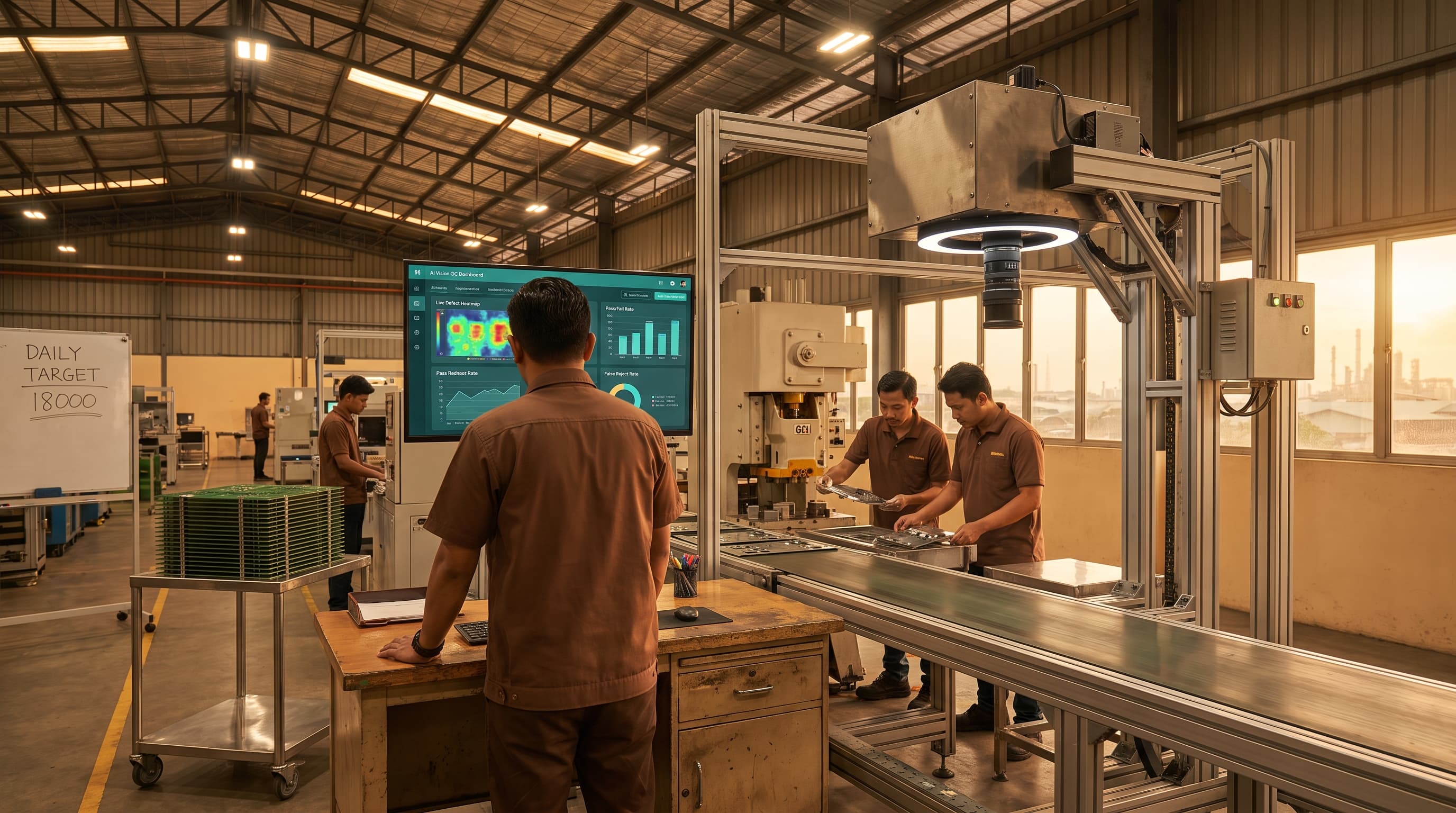
Every Johor Bahru factory owner we talk to has the same story. Someone pitched them an "AI vision" system to catch defects on the line, quoted RM 200,000 to RM 600,000, promised 99% accuracy, and 6 months later the system is either gathering dust, generating 200 false rejects an hour, or quietly being paid for and never switched on. This post is for the Pasir Gudang, Senai, Kulai and JB factory owner who wants the honest read on why most AI vision installs fail on Malaysian production lines — and the cheaper fix that usually works better.
What this is and why it matters
AI vision on a Johor Bahru production line, the honest version, is a camera plus a model that watches the line, classifies what's passing, and either flags a defect, counts output, or triggers a reject. It's sold as a magic upgrade. The real version is a small custom model trained on YOUR defects, deployed with the right lighting, integrated with your line PLC, and babysat for the first 90 days. Johor has the country's densest manufacturing cluster after Selangor — Pasir Gudang heavy industry, Senai and Kulai electronics, Iskandar logistics, Muar furniture — and the highest density of "AI vision" pitches per square kilometre after KL. Knowing the 5 failure modes below saves a JB factory owner from a RM 200k+ write-off. The framework sits inside the broader AI agency Malaysia approach; what follows is the Johor line-floor view.
The 5 things that go wrong when a JB factory installs AI vision
1. You started with the wrong use case. Defect detection is the most pitched, the most expensive, and the hardest. A camera watching a Pasir Gudang stamping line for hairline cracks needs thousands of labelled defect images, controlled lighting, and a model that's wrong 1% of the time — which is still 30 false rejects an hour on a fast line. The cheaper fix: start with presence/absence (is the part there or not), counting (how many left the line), or barcode reading. These are 90%+ accurate with off-the-shelf models, RM 8k-25k to deploy, and they pay back in weeks. Add defect detection only after the easier wins are running. For the full Johor AI agency services overview, see the state page.
2. The lighting and environment weren't controlled. A vision model trained in a Senai electronics plant under fluorescent lighting will fail when the sun hits the line at 4pm, or when the factory shutters are open for ventilation. Industrial vision needs diffuse, consistent lighting — backlights, ring lights, enclosed hoods — at a fixed distance and angle. Skipping this is the single biggest reason JB vision systems underperform in production. The fix is boring: a 2-day lighting audit before any model training, and a 3-week shading study. Budget RM 5k-15k for the lighting retrofit. It's the cheapest line item and the highest-ROI one. This is what we mean when we say the Johor AI agency build starts with studying the floor, not pitching the model.
3. You bought a black-box vendor product. A JB factory paid RM 380k for a "vision QC platform" in 2024. The vendor owns the model, the data, the training pipeline, and the deployment. Two years in, the vendor raised the annual fee 40%, and the factory can't move to a cheaper option because their defect library lives behind the vendor's login. The fix: any AI build we do for a Johor manufacturer hands you the model weights, the training data, the code, and the deployment — you can move to a different vendor or in-house after the build. If a vendor says the model is "proprietary," that's a hostage clause. Walk.
4. You're targeting 100% accuracy and you don't need it. Vision systems don't need to be perfect. They need to catch the bad parts and not slow the line. A 95% accurate model that the line trusts beats a 99.5% accurate model that the line overrides. The cheaper fix: design the system to err on the side of "send to human review" for anything below 90% confidence. The 10% that goes to review is cheaper than the 5% false rejects you'd otherwise eat. The line keeps moving, the QC staff review the borderline cases, and the 90% the model is sure about gets through unblocked. This is the actual production-grade pattern. Vendors who promise 99.9% are either lying or quoting a system that runs at one-tenth line speed.
5. The integration with the line was an afterthought. A Kulai electronics plant had a beautiful vision system that flagged defects with 96% accuracy. It sat unused for 4 months because nobody had wired it into the line PLC, so the reject signal didn't actually trigger a reject — it just showed a red box on a screen. Integration is 30-50% of the total build cost for a production-grade system: the PLC handshake, the conveyor trigger, the rejection arm, the supervisor dashboard, the shift-end report. The cheaper fix: spec the integration as a first-class deliverable, not a "phase 2." Budget RM 30k-80k of the build for the integration, not RM 5k. For a representative Johor Bahru AI vision build, see the city page.
Where it goes wrong
This won't work if your line runs fewer than 200 parts an hour, or if your defect rate is below 0.5% — at that volume the model doesn't have enough defects to learn from, and the ROI doesn't beat a senior QC operator at RM 2,500 a month. It won't work if your line has frequent product changeovers (more than 3 SKUs a day) — every changeover means retraining, and you don't have time. It also won't work if you're not willing to spend 3 months bedding the system in — first 30 days for installation, next 60 for tuning against real production. The honest version: vision works for high-volume, low-mix, defect-rate-between-1%-and-8% lines. Outside that, a barcode + rule-based reject is cheaper, faster, and just as effective. About a third of the JB factories that ask us for vision, the right answer is "no, not yet" — we tell them on the first call.
What to do next
If you're a Johor Bahru factory owner considering AI vision, start with a 2-week discovery engagement — RM 5,000 to RM 12,000, credited against the build. The deliverable is a use-case fit report, a lighting audit, and a fixed-price build spec, not a sales deck. About a third of the time the answer is "no, not yet" — the volume is too low, the defect rate is too low, or a simpler system does the job. The other two-thirds we ship. For the Johor Bahru AI agency guide and a representative build, see the city page.
Frequently asked questions
A presence/absence or counting system: RM 8,000-25,000 setup plus RM 300-800 a month. A defect-detection system on one line: RM 60,000-180,000. A multi-line defect platform: RM 200,000-600,000. Add 15-20% for line integration (PLC, conveyor, reject arm). Ongoing retraining retainer: RM 1,500-4,000 a month per line. The cheap pitches at trade shows are usually demo-ware, not production systems.
A presence/absence system: 2-4 weeks. A defect-detection system on one line: 8-14 weeks including the lighting retrofit and the integration. Add 60-90 days of bedding-in for tuning. The "ROI in 30 days" pitch is for the demo, not the production system. Plan for 4-6 months from kickoff to a line that trusts the system.
It depends on three numbers: line speed (above 200 parts an hour), defect rate (1%-8%), and SKU mix (under 5 changeovers a day). Outside those windows, vision either can't learn from the data or doesn't pay back. We'll tell you on the first call if it's a fit. If we say no, the cheaper fix is usually a barcode plus rule-based reject or a senior QC operator.
Yes. We hand over model weights, training data, deployment scripts, documentation, and the supervisor dashboard code. You can move to a different vendor or run it in-house after 6 months. If a vision vendor says the model is "proprietary" or "licensed," that's a hostage clause — your defect library is your moat, not theirs. Walk away.
Tell us what you run.
We’ll spec the fix in a week.
Priced like a hire, not a project — around the cost of one admin a month. Most builds pay back in 30 days or less.
Get a build specMore AI Agency insights
AI chatbot Selangor: 5 questions to ask before a WhatsApp bot build
Shah Alam, PJ, Klang, Subang — Selangor SMEs ask us every week if a WhatsApp bot is worth the build. These 5 questions save you RM 8k-30k and 8 weeks of regret.
Business automation in Johor 2026: what the build actually costs a JB manufacturer
Johor manufacturers ask the same question every week: what does a real business automation build cost in 2026? Here are the 6 RM bands a JB factory or warehouse should expect, with the hidden line items.