
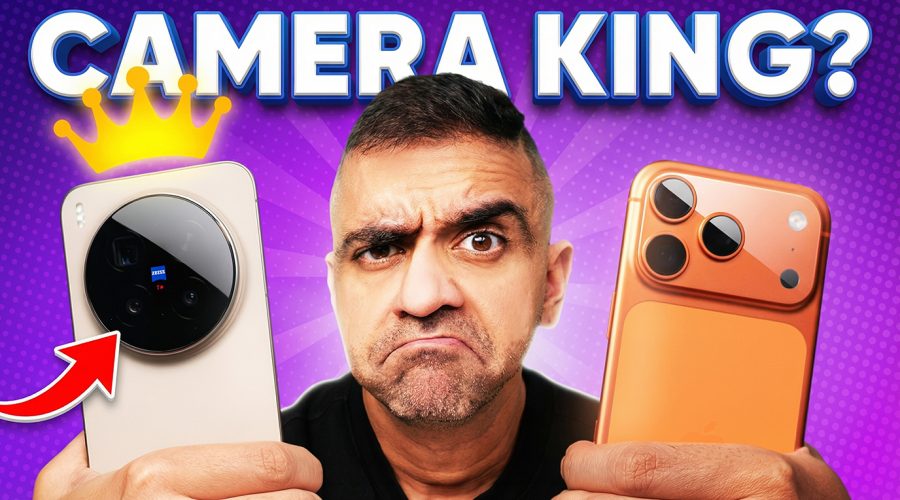
vivo X300 Pro vs iPhone 17 Pro: In-Depth Camera Comparison
So, you all really seem to love my last comparison review. Thank you so much and I’m really glad to hear that. Here is another one. This time around is between the vivo X300 Pro against the iPhone 17 Pro to find out if the more money you pay for this phone will give you more or not. So, watch first and buy smart.

Camera Specs Overview
Just as a recap, the iPhone 17 Pro comes in a triple 48 MP lens:


- the main camera is an f/1.8 aperture at 24 mm wide lens,
- an f/2.8 4x optical periscope telephoto lens,
- the ultrawide lens is an f/2.2 13 mm wide lens,
- with an 18 MP f/1.9 20 mm square sensor selfie lens.
As for the vivo X300 Pro, it comes with a ZEISS lens setup:


- a main 50 MP f/1.6 24 mm ZEISS wide lens,
- a massive 200 MP ZEISS APO telephoto f/2.7 85 mm periscope telephoto lens with a 3.5x optical zoom,
- a 50 MP f/2.0 15 mm ultrawide lens with autofocus,
- and a 50 MP f/2.0 20 mm selfie lens with autofocus.
Yes, this is the only time I’ll be talking about the specs because the rest of the video will be a head-to-head comparison purely on the image and a video perspective.
Ultrawide
Starting from the ultrawide lenses, there are only two differences that you can see. Firstly, the iPhone’s image is wider because it has a 13 mm focal length compared to 15 mm on the vivo. And secondly, are the colors, where it was more vibrant on the vivo, making it a bit more appealing to share on social media or just to show your friend. Other than that, the dynamic range is the same with no barrel distortion at the edges.

Even looking at this second picture, the overall shadows at the bottom coming from the leaves above were very well pronounced, and the dynamic range in the middle far ahead was also nice and visible without being blown out.

But what’s interesting is this particular third image, because this was taken around 6 p.m., where things were starting to get a little darker. And here’s where vivo was the clear winner with a brighter overall image in the darker parts, even with a similar aperture value.

And it was the similar case for the nighttime with better highlights shown on the vivo.

Main & Zoom
For the main lens though, just so you know that both phones are using the same 24 mm as mentioned earlier, but the iPhone has a slightly bigger aperture at f/1.78 instead of f/1.57 on the vivo. So, besides the more vibrant colors on the vivo, you’ll see a difference in the highlights and the shadows because of the better aperture value on the vivo.

And the results were the same on the 2x mode, where the vivo is at 48 mm, but the iPhone chooses to crop from the 24 mm main lens instead, which was weird, but true.


Then comparing the telephoto lenses, the 85 mm on the vivo is at 3.5x zoom, where the iPhone was on the 4x zoom. But because the aperture value is higher on the vivo at f/2.6 instead of f/2.8, once again, you’re getting a brighter photo on the vivo. There’s also a difference once again in the optical focal length, where the vivo is at 10x and the iPhone is at 8x instead. But looking at the image quality, once again, the vivo is just a bit more brighter, but the details are great on both.


While the image starts to look a little degraded on the iPhone’s 20x zoom, the vivo maintained the sharpness, giving a more consistent color and the detail of the building. And since the iPhone’s max zoom is at 40x zoom, even comparing that with vivo’s 50x zoom, the quality was way much better on the vivo. And the details were still crisp at 100x zoom on this vivo X300 Pro.


The reason for that is because vivo’s 200 MP ZEISS APO telephoto has a much larger 1/1.4 inch sensor, which is four times the resolution of iPhone’s 48 MP telephoto. This means that when you zoom in, vivo is giving you real pixel data, while the iPhone starts to rely on sharpening a bit more. So that is why vivo stays crisp even at 20x and all the way 200x.
Then the story was the same for this batch of comparison photos, with a more vibrant color and brighter photos for the main on the vivo, and similar results for the punched-in 2x zoom on the iPhone as mentioned earlier. It was the same throughout all of the focal lengths as well, with vivo being the clear winner in terms of the overall details and of course, the ability to zoom beyond 40x yet giving amazing details on the photos.


Just like the ultrawide lenses earlier, the images were brighter on the vivo for the main lenses during the evening. Then the 2x zoom also saw less details on the building, where you could argue that it is a bit more stylistic, but that’s not how the eyes were perceiving it. And it was like that throughout the 4x zoom on the iPhone compared to the 3.5x zoom on the vivo. And it had a similar look for the 8x on the iPhone versus vivo’s 10x.


But the iPhone tries to bring back some of the details on the buildings on the 20x zoom, which was very similar to the vivo, where the only difference would be the warmer temperature on the colors for the iPhone, with the vivo being a little more cooler. And of course, the iPhone gives up on the Max 40x, where the details were never nowhere as good as vivo’s 50x or even 100x.


So, this shows that while the overall quality is very comparable during the day, you’ll start to see where vivo really shines, literally, during low-light situations. Not only when there are lesser light, but also against the sun as well, but the obvious better zooming clarity and capabilities is also shown on the vivo X300 Pro.
Macro
Ever since the iPhone introduced their macro photography, which uses the ultrawide lenses to convert into macro shots, it was one of the best since the minimum focus distance can be really close. But with that, there’s a huge caveat, which is trying to get the focus easily.
Based on this first shot, the edges were a bit more blurred out on the iPhone, as seen on each of the corners, compared to the vivo being nicely detailed and sharp from edge to edge.

And while this second macro photo has a little blur at the top of the photo on the vivo, the iPhone not only had the similar edge for every corners being blurred out, but the colors were not as accurate when taking the shot in real life.

But the biggest weakness is actually the iPhone’s very close minimum focal distance. Because while I could easily take this particular picture on the vivo while the bee was being on the flower by enabling the macro mode in the camera app and then using the 10x zoom or the 240 mm focal length, when I went closer with the iPhone to get a good shot, the bee said, “What the?” and ran away and just got a shot of a flower instead.

This means that the versatility of the vivo’s macro capabilities makes this a better option when it comes to macro photography compared to the iPhone.
Portrait
While vivo is always known for its portrait photo capabilities on humans, I decided to first test portrait mode for objects first.
Based on this first 24 mm portrait shot, while the bird on top was nicely focused on top, the bottom area is where vivo did a better job on recognizing the thin gold frames below. Even when I literally adjust the aperture value on the iPhone in the camera app at the same f/2.0 aperture value, for some strange reason, it shows as f/1.78 instead.


The results were the same for the 2x portrait mode, where the edge detection at the circular object below the bird was better on the vivo.

But while the third and the final portrait mode focal length on the iPhone looks more like an 85 mm equivalent, the meta data of the iPhone still shows that it is 24 mm still, even for the 2x portrait mode as well. So, does this mean that it’s using 24 mm digital zoom all the way?


Besides that, vivo is once again more versatile with having focal modes of 50 mm before the 85 mm and the 135 mm to go up close better.


As for humans as a subject, besides the warmer color temperature on the iPhone, both did very well on the first 1x portrait mode. But the bokeh on the 2x portrait on the iPhone looks not as natural compared to the vivo.


But, you know what? What’s with the iPhone making everything warmer? Because honestly, this video light over here in the studio is controlled at 5600 Kelvin, which is a neutral or a daylight white set during the whole entire shot here in the studio. And that is exactly how you see it in the vivos photo. And yes, I did make sure that the iPhone’s photography style was maintained at standard or default.

Here’s where I feel that probably it’s because of vivo’s Pro imaging chip VS1 handles multi-frame fusion more intelligently, especially when it comes to switching the zoom modes. And since the iPhone doesn’t have a 50 mm equivalent focal length look, when comparing the 85 mm, the phone got side hair completely wrong on the edges, compared to the vivo of getting every strand of the hair very well.

Then as for the portrait mode at night, once again, the quality of the edge detection was the same, but the iPhone suddenly decided to be a little more cooler in the temperature, probably taking cues from the Lee Meridian signage at the back.

And once again, looking at the iPhone’s 2x zoom against vivo’s 85 mm, the vivo did better in terms of the color accuracy. But the iPhone got it right in terms of the more balanced contrast on how it looked in real life.

But the vivo regained its throne on the 135 mm shot with better edge detection and a sharper image than the iPhone. But only if you zoom in close on the iPhone’s picture is where you would see it being a little more blurred, and that is because vivo is using ZEISS natural portrait mode which avoids any weird smoothening or extra sharpening as well. So with all of that being seen, is the vivo still the King of Portraits? Well, you tell me, guys.

Front Camera
As for the selfie cameras, while Apple has been talking about its square sensor and how wide the selfies can be, the caveat is that it doesn’t work with portrait mode. This means that a typical selfie with your background being blurred is only available in portrait mode, but not this new square sensor, probably not yet.

However, on the vivo, it has three different focal lengths, even on the portrait selfie, which is at 20 mm wide, a regular 24 mm, and also a super close 50mm too. Even though I’m not sure who would take a 50mm selfie because you need to stretch out your hand like that to take a shot to fit your head in the frame. But yeah, at least there’s an option.

All of the focal length maintains the same color accuracy. So it’s good that there’s no difference in color when using different focal lengths, even though it is using a digital zoom using the front cameras.

Comparing it at just 24mm of the focal length, once again, the iPhone was warmer, but the details of the skin and the subject-to-background blur was really good on both.

But if you’re taking selfie photos against the light at 24mm, here’s where the vivo becomes a bit more warmer, and the iPhone takes the prize for being a little more color accurate over here.

Then, as for taking selfies at night, while I totally forgot to turn on the portrait mode on the vivo, you can see the results being the same as the daytime shots, with the iPhone being warmer as usual at 24mm focal length.

But if you’re taking a selfie photo against a bunch of lights at the back with less light shining at your face, the vivo does surprisingly better at lighting the face.

I wanted to show you how each does in a more indoor mixed lighting situation, as I feel that it is important to know how each phone handles the white balance better. The good news is that both handle it well in the ultrawide lenses. The story was the same, with the iPhone being just a little warmer. The color consistency on both was perfect, with no color shift just like the day shifting between all of the zooms. But of course, you’ll get better zoom in detail with the 20x zoom on the vivo.


Ultrawide, Main & Zoom (Night)
Taking photos outdoors at night, the results were similar on the ultrawide lenses, where it was brighter on the vivo with more details on the darker shadows on the buildings towards the left. The lens flare on the iPhone on the lamp post, while it is really improved, but vivo handled it just a little better.

What’s interesting is that on the 2x mode, both phones had the lens reflection towards the side of the photo as seen.

But once again, it was more prominent on the iPhone as seen side by side. Both of them also looked almost the same for the 4x zoom on the iPhone and the 3.5x zoom on the vivo.

And the darker areas are not much of a difference compared to the main lenses. But the way vivo handled the “St. Giles” signage was better as seen in the 10x zoom on the vivo against the 8x zoom on the iPhone. And the quality continues to degrade on the iPhone on the 20x zoom, the 40x max zoom against the iPhone, together with the 50x zoom on the vivo as well.


Video Quality
[Check out all the video footage on my YouTube video]
As for video, in terms of the specs, the vivo X300 Pro records up to 8K. But since the iPhone doesn’t go up to that recording resolution, let’s take a look at the 4K video quality on each. The video quality for the 4K ultrawide was great on both. The colors were more vibrant on the vivo, but not as saturated compared to the photos for the main video recording, the 2x, the 3.5x, and the 10x as well.


And while the iPhone can zoom up to 24x on the video, there is quite a degrade in quality when it comes to zooming beyond that.

Log Recording
Log recording on the iPhone has always been my go-to for situations where I need to match footage with our Blackmagic cameras or even with these Sony cameras in a more portable form factor. And that is because the bit rate is much higher, so it’s easier to match the footage in the colors, especially in post. But the biggest issue about that is the fact that the file sizes are really huge.
Just looking at these two ultrawide footages side by side, the viewer’s file size is only 154.9 megabytes compared to a massive 1.66 GB on the iPhone.


Honestly, this is something that would only benefit towards a more professional video recording workflow, because if you’re just shooting videos casually, the vivo’s Log is very capable of doing some unique color grades. So, it’s totally depending on you. But yes, both log recordings are really great on both phones, even at 1x, 2x, 4x, and 10x mode as well.
Video Stabilization
Looking at the stabilization on each, the 4K ultrawide was very gimbal-like. So it was for the 1x mode and the 2x zoom.

But the 4x stabilization on the iPhone was not as good as the vivo, where the vivo did very well still, even at 10x mode, where it was so much more stable with only a little jitter compared to the iPhone’s 8x zoom. This is because vivo is using their gimbal-grade OIS on the lens for their rear. So even at long zoom shots, it still maintained to be very steady.

Front Video Quality & Stabilization
The 4K front video quality was great on both. But this time around the iPhone was more color accurate, where the vivo was a bit more warmer. Even the stabilization was a little better on the iPhone, but the dynamic range on the Exposed Sky was really good on both.

Video Quality & Stabilization (Night)
However, the quality on the ultrawide video at night was better on the iPhone with less noise on the darker areas, but only if you zoom in very closely to the footage.

And while the quality was equally as good on both phones for the main lenses, here’s where you start to say hello to that annoying glare that you get on iPhones when shooting against the light on the lamp post. And the lens flare is a bit more prominent on the 2x. And the quality will drop on each beyond that zoom range onwards, which is very much expected.


While the stabilization for the ultrawide lenses for both was equally as good, there were some tiny jitters on the light if you look towards the left side of the footage, but the jitters were not there on the main lenses. So, it was really nice on both. And just like what you saw during the day, the 2x stabilization was equally as good with the stabilization doing better on the vivo from the 3.5x onwards.


Front Video Quality & Stabilization (Night)
The front video quality at night was better on the iPhone, and surprisingly, the vivo had some lens flare on it. Not sure why. And the stabilization on the iPhone was a bit better than the vivo.

And of course, there are other extras like the 4K 60 fps on the vivo X300 Pro, and 4K 120 fps Dolby Vision on both the main and the telephoto lens as well, which makes it a little more versatile.
[Check out the vlogging test my YouTube video]
Conclusion
At the end of the day, both are amazing cameras, but if you’re after value without feeling short changed, the vivo X300 Pro is sweeping the market, being the most affordable flagship for its price. And once again, this shows that you don’t need to spend flagship money to get flagship shots.

Of course, there’s other elements that would make this more appealing other than the price. There’s also the optional physical telephoto extender which you can buy and add on separately.

There’s also the IP68 and IP69 + Armor Crystal Glass, which is a micro crystal glass durability, compared to just IP68 on the iPhone. And of course, there’s the very questionable durability on the colored iPhones compared to the silver variant as well.
Then there’s also the bigger physical battery capacity of 6510 mAh compared to iPhone 17 Pro’s 4252 mAh. Faster charging support of 90W wired and 40W wireless flash charging versus 40W wired and 25W of wireless charging on the iPhone.
So with this, do let me know what you guys think in the comment section below and which one would you go?
[Watch the full video on YouTube here]
Related:

