
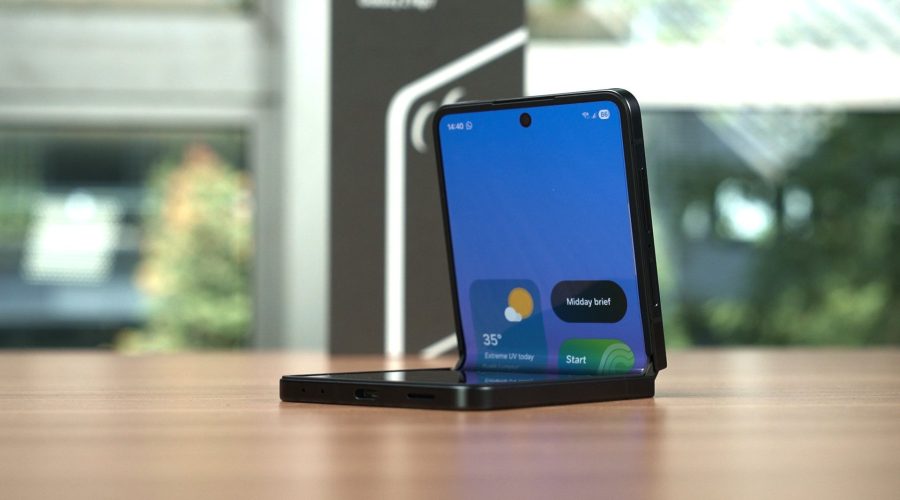
Samsung Galaxy Z Flip7 review – Big, meaningful upgrades
The new Galaxy Z Flip7 got a major revamp in terms of its design. We have a wider screen with a thinner body, a much needed upgrade on the cover display – and most importantly, the bigger battery capacity too. But, are those enough to bring excitement back to Samsung’s flip phones? And, is it let down by the Exynos 2500 chipset?
Design
Now, let’s talk about the design. The new Galaxy Z Flip7 has a bit of a readjustment to the size while being thinner at the same time. It’s not a huge change on paper or when I put it side-by-side the Z Flip6, but as someone who reviewed the previous generations of the Z Flip, I can immediately notice it and they actually make a huge difference.


I’ve seen many people saying that putting a case on a thin phone will just make it thick again – and I disagree. Putting a case on a slim phone will make it feel like what a typical phone is when they are careless.

I do have to highlight that the fingerprint scanner – which doubles as the power button – is also just as thin as the Z Fold7. That makes scanning the fingerprint a little difficult as the surface area available for the scanner to scan our fingerprint is also less. So, do remember to move your finger as much as possible to get the most coverage possible.


The corner curves also seem to have a smaller radius, which make it look a bit more like the Z Fold7, though not as aggressive.

Inner screen
The screens are where things get interesting. Let’s talk about the unfolded display first. It has been tweaked to have a resolution of 2520×1080 pixels at a larger size of 6.9-inch. Since it is a Dynamic AMOLED 2X panel, it can also go up to 120Hz refresh rate.

Just like what we did for the Z Fold7, we’re doing two tests for the screen – one for the top half and another for the bottom half.

This display is rather great as it can reach 1365 nits max auto brightness at the bottom portion, 1378 at the top portion. A bit of a discrepancy is fine as it happens on every device.

With its default out of the box settings, the screen is set to vividness level 1. From our tests, the Z Flip7 can achieve around 100% of sRGB and 89% DCI-P3 coverage for both top and bottom portions. They’re within a very small variance range.


When we redid the test with vividness level 3, both portions are basically covering 100% of both sRGB and DCI-P3 color gamuts – and that is actually to be expected from a Samsung device using the Dynamic AMOLED 2X display.
Higher DCI-P3 color gamut coverage means more vivid colors on the screen, and Samsung introduced this slider in the settings menu since the S24 series so we can choose how vivid we want the screen to be. Personally, I’m using it on vividness level 1 as anything higher kinda strains my eyes.
Wider aspect ratio
But let’s talk about the size again. The Z Flip7 is a bit wider than before – and this means Samsung can tweak the aspect ratio of the unfolded display too. This phone’s resolution actually matches the Z Fold7’s cover display at 2520×1080 pixels, which means they’re both at the ever-fantastic aspect ratio of 21:9. Many movies produced for this aspect ratio – and that is why it’s called the “cinematic 21:9”.
Watching YouTube videos will most probably have black bars on the sides as YouTube videos are typically in the standard 16:9 aspect ratio, but it’s not that huge of a deal. However, if you’re watching 21:9 movies, then it’ll fill up the entire screen.
Crease
Now, let’s talk about the crease. It’s basically the same situation as the Z Fold7 as it is also using the new Armor FlexHinge to bend the phone, and the display now curves into a water drop shape when closed. The display itself is also strengthed by a grade 4 titanium lattice underneath, and has a thicker ultra-thin glass at the top too.

I’ll just repeat everything I said about the Z Fold7 here since it’s the same. Creases will be on all foldable device – the question is, will it hold up to the test of time? Since the devices are brand new, the crease is definitely flat and not really noticeable. Though, over time, the crease might get deeper.

As of now, I can say for certain that the crease feels much better compared to what we had before. It’s very shallow and I can’t feel any weird humps when I brush my finger across it – which is something that will happen constantly when I’m doom scrolling social media for example. We’ll revisit this if we can, because this Z Flip7 is not mine.
Difficult to open?
The new FlexArmor Hinge in the Z Flip7 also behaves the same as the Z Fold7 too. What I mean by that is that it seems to have a dual-stage stiffness but to a lesser degree – as in angle degrees. Opening up the initial first few degrees is easy, then the hinge becomes stiffer. This is because if we want to use it in Flex Mode, then the Z Flip7 can stand on its own without the top half flopping around.

By the way, since the Z Flip7 isn’t as crazily thin as the Z Fold7, it’s much easier to just grab a part of the frame and open it up.
Cover display
But, once we close the phone, this is where one of the biggest upgrade is found. The new Z Flip7 has a cover display that is bigger thanks to the ultra-slim bezels, and also wraps around the entire camera module.

It’s now a 4.1-inch display, using the Super AMOLED panel, has a resolution of 948×1048 pixels, and goes up to 120Hz refresh rate. Now that’s an upgrade as the animations are very fluid and also much smoother to navigate around.

Because of the MultiStar module from Good Lock, we can launch whatever apps we want on the cover display – so we can test out the brightness and color accuracy too.
From our test, it can reach around 1388 nits in auto brightness mode and also has about the same color gamut coverage percentages as the inner display for both vividness level 1 and level 3. Oh yea I should mention that if we set the vividness to level 3 in the settings menu, the cover display will match that setting too.
Overall, I think this is an amazing upgrade and a necessary one over the previous generation Flip6.
Software
I think it’s also time to talk about the software and features. The new cover display on the Galaxy Flip7 makes the entire display look amazing. There are a few more interactive wallpapers that we can put on the cover display, and we even have the new adaptive clock that adapts around the subjects in the image too – if we can fit everything on the cover display, that is.

Other than that, the features available here are pretty much the same as the Galaxy Watch8 series. Just like before, the tiles available on Samsung’s smartwatches are “ported” over to the cover display of the Z Flip7. I mean, the interface and screen size are obviously different – but functionally the same.


We do have Google Gemini that works directly on the cover display, which I think is neat. Just hold the power button and we can start talking to it.

Now Brief and Now Bar are also part of the cover display, and the interface is also adapted to the cover display as well.

For those who like to quickly view texts, then the cover display is actually doing an amazing job here. I personally use swipe typing most of the time – and it’s perfect for this scenario. However, it’s stuck to Samsung Keyboard and we cannot change it to something else like my favorite Gboard unless we forcefully disable Samsung Keyboard via ADB. Yes, I am aware of that trick too.


While swipe typing on the cover disply though, I realized that I hit the camera bump way too many times. So, let’s talk about them right now.
Cameras
The cameras on the Galaxy Z Flip7 are basically the same as what we had previously. Nothing has changed other than the software with the ProVisual Engine and also the chipset’s ISP.
To have a look at all the pictures and videos taken with the Samsung Galaxy Z Flip7, watch our video at the top of this review.

Performance
Now, let’s talk about the performance. The Exynos 2500 will perform basically without any hitch in all scenario. Everything works well as there were no hitches or lags or anything like that – it’s just very buttery smooth and no complaints overall.
Except, if you’re playing certain games with the Z Flip7. There are actually a few things to take note of.
When a new chipset is announced, it will take time for the game developers to go “oh, there’s a new chipset and we need to ensure our games work properly on that chipset”. Since the Exynos 2500 is literally so new, games aren’t going to perform well on it.
Flip phones are just not meant for gaming. The chipset inside is sandwiched between two screens and all the other components, hindering its ability to dissipate heat. There is also no way to actually put a proper cooling system inside as there is just not enough space to do so.

You might say maybe Samsung could’ve used a better chipset and tuned it better like what they did with the Z Fold7 – but I disagree. The total surface area available between the two devices and the amount of components sandwiched inside is just not in favor of the Z Flip7.
Anyway, the gaming performance is actually quite decent overall – barring the aggressive shader caching. I need to explain what is shader caching first. It’s basically a way to “learn” how to do it for the first time, then reuse what it has learned to do the same thing again, but better. It is done on basically all modern games nowadays.
For the Exynos 2500 in the Z Flip7, it’s just too aggressive as every tiny action performed in the game will stutter a bit – sometimes a lot, just to cache the shader. I mean, the more we play the game, the smoother it’ll become. However, some games like Wuthering Waves – which is an open-world action game with lots of enemies and characters, it’s impossible to cache all the shaders.
Will this be fixed in a future update? I’m sure it can. I’m not sure if I’ll have the privilege to retest the gaming performance as this phone is not mine.
Battery life
Now, let’s talk about the battery life. We have to run MacroDroid in the background to keep touching the screen as there was an issue with PCMark’s battery life test getting stuck there. Not sure if it’s caused by Android 16 or One UI 8, but this is how we solve the issue for now.
I’m not sure how running MacroDroid will affect the overall battery life – but the upgraded 4,300mAh lasts around 14 hours and 6 minutes in our standardized battery life test.

That is great news as I thought having a bigger display would’ve negatively impacted the battery life – but we actually got quite an upgrade compared to the Z Flip6. Let’s not forget that MacroDroid was also running in the background during this test.
Charging speed
What’s not really upgraded though, is the charging speed. It’s the same as before, at only 25W maximum. One big change is that Samsung will turn on the Battery Protection feature at basic level by default. It took around 85 minutes to charge from 15% to completion – which is pretty much the same as before.


When we redid the charging test with the Battery Protection turned off, we can get around 5 minutes faster to charge from 15% to completion. Not a huge difference and I personally would just leave it in its default settings.


Samsung DeX
One big upgrade that the Z Flip7 has is Samsung DeX. That’s why I’m doing a special segment about it here because for the past 5 generations, we didn’t have DeX on the Z Flip. I’m just glad that Samsung brought the feature here as that adds more utility to the Z Flip7, making it an even better productivity workhorse alongside all of its other features, like Samsung Pay with the ability to add NFC access cards now.

A few more things to mention
A few more things to mention here – the Galaxy Z Flip7 comes with a USB 3.0 port at the bottom – and it is indeed very fast to transfer files, and also supports display output and Samsung DeX too. Amazing upgrade over the Z Flip6, honestly.
It only has a single physical SIM card slot, though.


The speakers on the Z Flip7 also sounds good. I mean, the phone isn’t as thin as the Z Fold7, so I would expect the speakers to sound at least on par or better than the Z Fold7.
Should you buy the Galaxy Z Flip7?
The question becomes – should you buy the Z Flip7? It’s an easy answer – yes. If you’re a fan of flip phones but held off last year – then this is the best time to get it. There are lots of upgrades across the board and this new Z Flip7 is just amazing through and through. Slightly wider form factor with a 21:9 aspect ratio for the unfolded display, upgraded cover display with 120Hz refresh rate, tiny bezels, and flows around the camera cutout, and great battery life. Let’s not forget that One UI is an amazing skin that brings forth many more useful features.

The gaming performance is a bit weird now due to aggressive shader caching, and there are zero optimizations from any game developers at the time of this recording. But then again, if you’re a mobile gamer, flip phones are not for you anyway.
Where to buy? (Affiliate links)
Like our Facebook Page here at NasiLemakTech.com for more news and in-depth reviews!
Also, join our Facebook Group for insightful information and memes!
Subscribe to our YouTube channel too!

