E-Invoicing Malaysia 2025 | LHDN Compliance & SME Support
E-Invoicing Malaysia Summary
What you need to know as an SME business owner?
- Malaysia’s E-Invoicing Mandate: The IRBM has made e-invoicing mandatory for all registered Malaysian businesses.
- Phased Implementation: Rolled out in phases, with the latest effective date being July 1, 2025, for companies with RM5-25 million turnover.
- Submission Methods: E-invoices can be submitted via the MyInvois portal (manual) or API integration (automated) in UBL 2.1 format (XML or JSON).
- E-Invoice Components: E-invoices are digital records with 55 fields, including seller/buyer details, transaction info, tax breakdown, and a Unique Identification Number (UIN) with QR code.
- Transaction Coverage: Applies to B2B, B2C, B2G, and some non-business transactions.
- Required Documents: Invoices, credit notes, debit notes, and refund notes.
- SME Financing Solutions: Funding Societies offers invoice financing, SME micro financing, and property-backed secured financing to assist businesses with e-invoicing transition costs.
- Government Support: Budget 2025 provides microloans, matching grants, BNM loan funds, SJPP loan guarantees, and tax deductions to support digitalisation.
This is our guide to e-invoicing Malaysia, an initiative that is already changing the way businesses work. The Inland Revenue Board of Malaysia (IRBM) has made it mandatory for all registered businesses in Malaysia to create electronic invoices (e-invoices) for every transaction.
Phase 1 started on August 1, 2024, for companies with a turnover of more than RM100 million. Phase 2 started on January 1, 2025, for companies with a turnover of more than RM25 million, and Phase 3 started on July 1, 2025, for companies with a turnover of between RM5 million and RM25 million.
“What we initially planned… was to implement the system effective July 1 (2025) for companies with annual sales of RM500,000 and above. However, we understand their concerns, especially the MSMEs, and have revised it into three additional phases.”
— Deputy Finance Minister Lim Hui Ying
These companies now use the MyInvois portal or direct API integration to send e-invoices to the IRBM in the UBL 2.1 format (XML or JSON). As the next rollout phases approach, it is critical for both large and small businesses to understand what e-invoicing is, how it operates, and how it will impact their operations.
E-Invoicing Malaysia Implementation Timeline (Latest Updates – July 2025)
If you’re curious about when your business need to start using e-invoices, the IRBM recently announced changes to the e-invoicing timelines and exemptions, which impact small and medium-sized businesses.
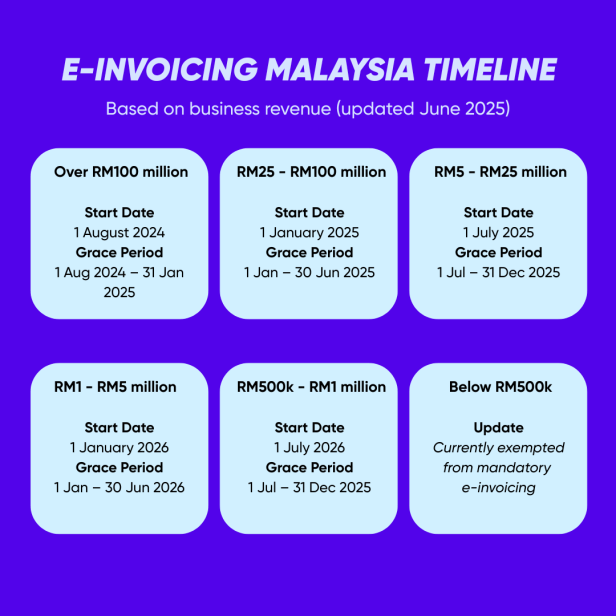
Key E-Invoicing Start Dates by Business Turnover
| Annual Turnover (RM) | E-Invoicing Start Date | Grace Period | Remarks |
|---|---|---|---|
| Over 100 million | 1 August 2024 | 6 months | Phase 1 – no change |
| 25 million – 100 million | 1 January 2025 | 6 months | Phase 2 – no change |
| 5 million – 25 million | 1 July 2025 | 6 months | Phase 3 – maintained |
| 1 million – 5 million | 1 January 2026 | 1 Jan – 30 Jun 2026 | Updated timeline |
| 500k – 1 million | 1 July 2026 | 1 Jul – 31 Dec 2026 | Newly introduced implementation phase |
| Below 500k | No start date yet | — | Currently exempted from mandatory adoption |
The latest e-invoicing timeline was updated in response to increasing concern from the business community, particularly SMEs that may not have the readiness, funds, or expertise to transition in time.
“We will look into it because e-Invoicing is very important to prevent leakages and revenue loss. But for small companies, it can be quite burdensome.”
— Prime Minister Datuk Seri Anwar Ibrahim
With the final phase of e-invoicing starting July 2026, small and micro businesses now have extra time to prepare for the transition but should still avoid delaying until the last minute. It could take weeks to set up an e-invoicing software, train the staff, and connect different systems.
E-Invoicing Guidelines for Specific Industries in Malaysia
E-invoicing rules are a little different for each industry because of different billing models and rules. The IRBM has put out official guidelines for each industry to help you figure out how e-invoicing applies to your business.
We at Funding Societies have taken these guidelines and made specific articles for key sectors, such as
Each guide explains:
- Compliant transaction types
- How to deal with common billing situations
- Tips on how to manage cash flow during the transition
For the most up-to-date information, check the official guidelines or the above resources for your industry.
What is an E-invoice and Why is Malaysia Implementing E-Invoicing?
E-invoices are digital records of transactions between a buyer and a supplier. By letting businesses create and save machine-readable, digital invoices, it eliminates the need for paper invoices while also streamlining billing and payment processes. The e-invoicing initiative also enables real-time validation and recording via the IRBM government site.
E-invoices will be generated using XML and JSON formats as required by IRBM, with 55 fields, 37 of which are necessary, including seller and buyer information, item description, quantity, price, tax, total amount, payment information, and so on. Successfully verified and generated e-invoices would additionally include a Unique Identification Number (UIN) and QR Code generated by the MyInvois Portal, allowing for online validation of the invoice.
What are the Different E-Invoicing Transaction Types?
All taxpayers who conduct commercial activities in Malaysia are required to use e-invoicing. It will make it easier to validate and save transactions between businesses (“B2B”), consumers (“B2C”), and government entities (“B2G”). It will also cover certain non-business transactions between individuals.
For certain B2C transactions whereby the end consumer does not require e-invoices for tax purposes, providers are allowed to issue standard receipts or invoices in accordance with current procedures.
Who in Malaysia Has to Adhere to E-invoicing
The following must comply with e-invoicing in accordance with the IRBM’s guidelines:
- Associations
- Body of persons
- Branches
- Business trusts
- Co-operative societies
- Corporations
- Limited liability partnerships
- Partnerships
- Property trust funds
- Property trusts
- Real estate investment trusts
- Representative offices and regional offices
- Trust bodies
- Unit trusts
Meanwhile, the following are exempt from the e-invoicing mandate:
- Foreign diplomatic offices
- Individuals that are not conducting business
- Statutory bodies and authorities: For collection of fees, taxes, or statutory levies and for transactions before 1 July 2025
- International organizations (for transactions before 1 July 2025)
- Taxpayers with annual revenue under RM150,000
What Does an E-Invoice Include?
An e-invoice is not just a digital copy of a PDF invoice, as it has to be in a format compatible with the MyInvois system, which processes the e-invoice. E-invoices in Malaysia must be in XML or JSON format so they can be submitted on MyInvois.

Every e-invoice must also include:
- Seller and Buyer Details: Name, tax identification number, business registration number, and contact info
- Invoice Metadata: Invoice number, issue date, payment terms, currency
- Itemised Transaction Details: Description of goods or services, quantity, unit price, discounts, taxes, and total payable
- Tax Breakdown: SST/Service Tax amount (if applicable), tax codes
- Unique Reference ID: Each validated e-invoice will be assigned an Invoice Reference Number (IRN)
For businesses that issue invoices across borders, it’s important to ensure that e-invoices comply with cross-border transaction guidelines and include correct foreign buyer details.
E-Invoicing Process in Malaysia

Issuing an E-Invoice
When there is a transaction, either a sale or adjustments to an e-invoice, the supplier creates an e-invoice and sends it to IRBM for validation through the MyInvois Portal or via API.
E-Invoice Validation
IRBM performs real-time validation of the e-invoice to ensure that it meets all required standards and criteria. The supplier receives a Unique Identifier Number via the MyInvois Portal or API once the e-invoice is validated.
Validated E-Invoice Notification
Once an e-Invoice is approved, both the supplier and buyer will receive notifications via the MyInvois Portal or API.
E-Invoice Sharing
Validated e-invoices have a QR code, which may be utilised to verify their existence and status on the MyInvois Portal. After the e-invoice has been cleared, suppliers can share the QR code with purchasers to ensure transparency.
E-Invoice Rejection or Cancellation
The buyer or supplier can reject or cancel the e-invoice within 72 hours of validation, as long as they provide sufficient justifications.
MyInvois Portal Accessibility
Suppliers and buyers can both request and retrieve e-Invoice data through the MyInvois Portal.
Mandatory E-Invoice Documents in Malaysia
The following documents must be created in an electronic format under Malaysia’s e-invoicing guidelines
Invoices
Invoices record transactions between suppliers and buyers. Self-billed invoices for expense tracking also fall under this category.
Credit Notes
Sellers issue credit notes to rectify an e-invoice that has already been issued, typically to reduce the original value without making a direct refund. Credit notes are used to adjust errors, apply discounts, and account for returned items.
Debit Notes
The opposite of credit notes, debit notes record additional costs related to a previously issued e-invoice.
Refund Notes
An official document that sellers issue to a buyer to record a refund.
E-Invoicing Models in Malaysia: MyInvois Portal vs API Integration
The IRBM provides two ways for businesses to submit e-invoices, depending on scale, budget, and digital readiness.
MyInvois Portal
A web-based platform suitable for small businesses or those with low invoice volumes. Invoices must be entered manually.
API Integration
Recommended for businesses with high invoice volumes. This allows automated submission of e-invoices directly from your accounting or ERP systems.
| Feature | MyInvois Portal | API Integration |
| Suitable for | Micro & small businesses | Mid to large businesses |
| Setup cost | Free (manual use) | Requires integration & vendor support |
| Invoice volume | Low | High & frequent |
| Submission method | Manual data entry | Automated system-to-system |
| Pros | No tech setup needed | Saves time, reduces manual work |
| Cons | Time-consuming for high volume | Requires upfront investment |
Bonus Option: MyInvois Mobile App
IRBM also offers a mobile app version of MyInvois for small vendors who don’t use accounting software. This is ideal for:
- Food stalls
- Market traders
- Mobile service providers
This mobile solution is meant to cater to small traders, hawkers, and roadside vendors, as they use basic digital systems and may not have use accounting tools.
The need for better government communication and support for these groups is echoed by advocacies like Wanita MCA Chairperson Wong You Fong:
“We hope that the government will provide hawkers with detailed information on the new mechanism’s specific content and implementation methods in advance to avoid disruptions to their daily operations.”
Start the transition early, regardless of the model you choose. It is easy to underestimate how long integration, testing, and training take.
Choosing the Right E-Invoicing Solution for Your Business
Not sure which e-invoicing solution would suit your business best? There a few things to consider, mainly how many invoices you send, how your business works, your resources, and even the existing tools in your day-to-day. This is true whether you run a kedai runcit, an online store, or a service agency.
Do you fall into any of these categories?
1. You issue a low volume of invoices
If you only generate a few invoices each month, the free MyInvois portal by IRBM might be enough. It allows manual data entry via web browser, making it suitable for micro businesses or those just getting started. But as your operations grow, manual entry can become time-consuming.
2. You’re already using accounting or POS software
Many accounting or POS softwares are e-invoicing ready. If you are already on a platform like SQL, AutoCount, or Xero, you may just need to enable an e-invoicing add-on in the system to comply. Since these systems are integrated, it helps to streamline or automate e-invoice submissions and reduce human error.
3. You don’t have a system yet
If you’re still using Excel or handwritten invoices, now is a good time to invest in digital tools, as it will soon be mandatory for all businesses, no matter how small. Many SME-focused solutions like Bukku or Biztory offer simple accounting features along with compliant e-invoicing functions. Consider trying those with free trials or basic plans to start with.
4. You want something simple and dedicated to e-invoicing
Prefer to keep things lightweight and focus only on e-invoicing? Standalone platforms like JomeInvoice allow you to focus only on e-invoicing without the extra accounting features. These are suitable for small teams or businesses in early stages of digital adoption and want to comply with e-invoicing.
Want more help comparing tools?
Read our full guide to choosing an e-invoice software in Malaysia.
Benefits and Challenges of E-invoicing for Malaysian Businesses
Benefits of E-Invoicing in Malaysia
- Improved Efficiency: Invoices can be made and sent automatically, which not only reduces manual work but also minimises mistakes.
- Real-Time Validation: Ensures that transactions are processed faster with correct data.
- Cost Savings: Eliminates or reduces paper, printing, and storage costs, which relieves pressure on the overall business costs.
- Better Cash Flow: By processing invoices faster, businesses can better manage expenses and cash flow.
- Regulatory Compliance: Makes it easier to file taxes in a way that meets IRBM rules.
- Support from the government: Businesses that use digital solutions, including e-invoicing, may be eligible for tax breaks and other benefits under Budget 2025.
Challenges of E-invoicing for Malaysian Companies
- Technical Integration: Accounting or ERP systems that don’t support e-invoicing may require upgrading or help from a third party.
- Costs of Implementation: Small and medium-sized businesses may find it challenging to pay for new software, onboard new vendors, and upgrade systems in a short time.
- Training and change management: Employees may need more training, while people’s hesitance to change may slow down adoption.
- Operational Disruptions: E-invoicing’s initial setup or transition phase may temporarily change how things work in the business.
- Delays in Client Adoption: B2B clients may not switch over at the same speed, which can cause problems in complying.
Financial Solutions for E-Invoicing Implementation in Malaysia
E-invoicing may offer long-term cost savings for businesses in Malaysia. However, the initial setup cost can be a major barrier for SMEs. The financial burden can add up quickly for a small business that suddenly has to invest in software integration, IT upgrades, consultation fees, and even staff training.
Many stakeholders that are affected by the e-invoicing mandate highlighted the financial burden. Wong Ching Yong, a chartered accountant and SUPP branch chairman, noted, “It is known that a new set of electronic invoice software currently costs about RM10,000, which may be inaccessible to some businesses.”
Small business owners on social media have also voiced their concerns, with a commenter on Facebook mentioning, “Buying a POS system cost around 3k, it’s a big burden for small business and hawker.”
Funding Societies offers financing solutions to help you absorb the cost of compliance. Choose from a range of financing solutions to manage working capital during the transit
Financing Solutions for E-Invoicing Costs
Invoice Financing – Get Paid Faster
If your business is waiting on customer payments, invoice financing can help unlock cash tied up in unpaid invoices. Use it to:
- Fund your e-invoice system setup
- Bridge cash flow gaps during implementation
- Cover training and consultation expenses
Learn more about invoice financing here, an ideal solution for businesses with healthy receivables but tight working capital.
SME Micro Financing – Fast Access to Working Capital
Need quick funds to get your e-invoicing system up and running? SME Micro Financing offers unsecured financing with flexible repayment terms. Use it for:
- Purchasing accounting software or system upgrades
- Hiring consultants or IT support for digital invoicing integration
- Staff training programmes and onboarding
Discover micro financing here, a fast and simple solution with minimal documentation for SMEs preparing for LHDN’s e-invoicing requirements.
Property-Backed Secured Financing – Scale With Confidence
Looking to fund a larger digitalisation project, expand infrastructure, or upgrade systems across multiple outlets? Property-Backed Secured Financing offers access to higher financing limits by leveraging existing real estate assets as collateral.
Use it to:
- Finance major tech infrastructure upgrades
- Expand your business footprint while maintaining healthy cash flow
- Support larger working capital needs as you scale e-invoicing adoption
This option is best suited for growth-stage SMEs preparing for long-term compliance and digital maturity. Learn more about property-backed secured financing here.

How to Apply for Financing
Getting started is simple; most applications are processed within a few working days.
- Choose your financing option (Invoice Financing, Micro Financing, or Property-Backed)
- Complete the online application with your business details
- Upload supporting documents, such as:
- Business registration info
- 6 months’ bank statements
- Financial statements (if applicable)
- Our team will review and get back to you within 1–3 working days
Eligibility Criteria
Our financing solutions are open to SMEs across various industries. To apply, your business should meet the following requirements:
- A registered Malaysian entity (Sole Prop, Sdn Bhd, or Partnership)
- Operational for at least 12 months
- Annual revenue between RM300,000 and RM100 million (varies by product)
Government Support & Budget 2025 Incentives
The Malaysian government is helping businesses manage e-invoicing costs through several SME-friendly incentives in Budget 2025. These incentives include direct financial assistance, loan guarantees, and tax benefits to provide comprehensive support for SME digitalisation efforts, especially for micro businesses that face budget constraints.
Here are some of the key support available:
- RM3.2 billion in microloans through TEKUN and BSN: For micro and small businesses that require capital for operational upgrades.
- RM50 million in matching grants: To subsidise digital adoption costs, including software, training, and system integration.
- RM3.8 billion in BNM loan funds: For businesses pursuing automation, digitalisation, and ESG initiatives.
- RM20 billion in SJPP loan guarantees: To help reduce barriers for businesses without collateral through the RM5 billion reserved fund.
- Up to RM50,000 in tax deductions annually (YA 2024–2027): Applicable to advisory services related to ESG and e-invoicing compliance, including consultancy fees for setup or integration.
These are additional support that businesses can use alongside private sector solutions such as micro financing and invoice financing. By combining both, SMEs can better manage short-term capital needs while staying on track with digital compliance.
Final Thoughts: Prepare Early, Stay Competitive
E-invoicing is no longer optional. It’s becoming a core requirement for doing business in Malaysia. However, compliance aside, there are advantages to e-invoicing that can help future-proof your business while eliminating outdated processes.
“While there may be initial challenges in adopting e-invoicing, the long-term benefits outweigh the drawbacks. With proper planning and support, Malaysia can successfully transition to a paperless invoicing system.” — Dato Jonathan Chai (Sarawak Business Federation)
Early preparation matters:
- Avoid last-minute disruptions
Integration, training, and testing take time. Businesses that start early are less likely to experience operational hiccups close to the deadline.
- Smooth out cash flow challenges
Delays in client payments won’t disappear overnight. By planning ahead and securing financing where needed, you can maintain healthy operations throughout the transition.
- Take advantage of the support available
From government grants to tax incentives and SME financing solutions, early movers have more options and more time to explore them.
Funding Societies is here to support Malaysian SMEs through this change. Whether you need fast working capital to get started or flexible financing to bridge costs over time, we’re ready to help.
Explore our business financing solutions as you prepare for a new era of digitalisation in Malaysia.
Sources:
- https://thesun.my/business-news/tax-matters-do-not-delay-the-implementation-of-e-invoicing-GA12034741#google_vignette
- https://www.hasil.gov.my/media/0xqitc2t/lhdnm-e-invoice-general-faqs.pdf
- https://www.hasil.gov.my/media/fzagbaj2/irbm-e-invoice-guideline.pdf
- https://www.hasil.gov.my/en/e-invoice/guidelines/e-invoice-illustration-guide/
- https://www.hasil.gov.my/media/uwwehxwq/irbm-e-invoice-specific-guideline.pdf
- https://belanjawan.mof.gov.my/ms/
- https://belanjawan.mof.gov.my/pdf/belanjawan2025/ucapan/ub25-en.pdf
- https://www.thestar.com.my/news/nation/2025/01/03/phase-2-of-e-invoicing-hits-snags
- https://www.hasil.gov.my/en/e-invoice/implementation-of-e-invoicing-in-malaysia/
e-Invoicing Malaysia Frequently Asked Questions (FAQ)
E-Invoicing is the digital exchange of invoices between a supplier’s and a buyer’s accounting systems, without the need for manual data entry or paper-based invoices.
- Phase 1 (August 1, 2024): Businesses with annual turnover exceeding RM 100 million
- Phase 2 (January 1, 2025): Businesses with annual turnover exceeding RM 25 million
- Phase 3 (July 1, 2025): Businesses with annual turnover exceeding RM 10 million
- Phase 4 (January 1, 2026): All remaining taxpayers registered for Sales and Service Tax (SST)
- Reduced administrative costs and time spent on manual invoicing.
- Faster invoice processing and payment times.
- Improved data accuracy and reduced errors.
- Enhanced security and reduced risk of fraud.
- Use the free MyInvois web portal provided by LHDN to submit e-invoices.
- Integrate your accounting or ERP system directly with LHDN’s e-Invoicing API.
- Ensuring your accounting/ERP system can generate e-invoices in the required format.
- Integrating with the MyInvois portal or LHDN’s e-Invoicing API.
- Utilising the Software Development Kit (SDK) provided by LHDN to assist with integration.
While specific penalties have not been announced yet, failure to comply with the e-Invoicing mandate may result in fines, interest charges, and even imprisonment in severe cases.