
Dell Technologies maps out how AI adoption in Asia is shifting from hype to real-world impact

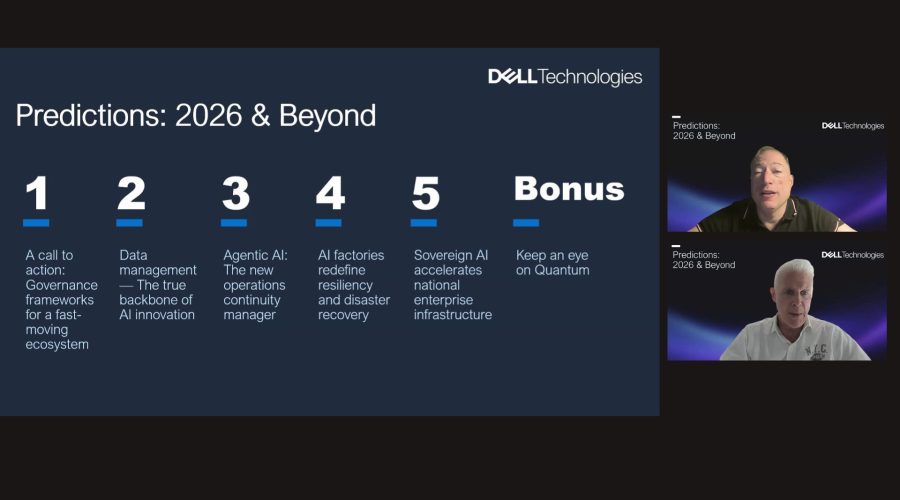
Dell Technologies recently hosted an online media talk for the ‘Predictions: 2026 & Beyond’ briefing, where Global CTO and Chief AI Officer John Roese, alongside APJC President Peter Marrs, walked through how AI is set to reshape enterprises and entire industries across the region, not just in theory, but in how companies operate day to day.

Roese painted a picture of AI accelerating so quickly that it is reengineering the fabric of enterprise and industry, changing how organisations build, operate, and innovate at a pace few expected, while Marrs brought that vision back to the ground by stressing that the conversation has clearly shifted from experimentation to real adoption.
“Conversations are on very real adoption, and AI is creating a truly transformational opportunity,” Marrs said, adding that DT is already working with customers across the region to build AI at scale.
That focus on scale is showing up in tangible examples, such as Sandisk in Malaysia, where Dell Technologies is supporting advanced AI solutions for smart manufacturing and product design, helping the company achieve up to 95% lights-out factory operations, while in India, organisations like Zoho are working with Dell to accelerate agentic AI adoption through contextual, privacy-first, and multimodal enterprise AI solutions.
As Marrs put it, “AI has become more accessible for all companies in the region, and what we’ve been doing is successfully building foundations with customers to deploy AI at scale.”
Looking ahead, Roese explained that the industry is entering what he calls the autonomous agent era, where agentic AI evolves from a helpful assistant into something that actively manages complex, long-running processes, while also stressing that enterprises need to rethink how they build resilient AI factories by bringing AI infrastructure together with cyber recovery, resiliency, and data protection.
As AI development continues at breakneck speed, both executives highlighted governance and sovereign AI as non-negotiable foundations for sustainable innovation, with Roese pointing out that volatility makes robust guardrails and controlled environments essential.
At the same time, Marrs observed that sovereign AI ecosystems are gaining momentum across APJC, as countries and enterprises alike push to build local frameworks that support trusted innovation, citing partnerships with Macquarie Data Centres in Australia and NAVER Cloud in South Korea as examples of secure, local infrastructure underpinning this next phase of AI growth. Roese echoed this outlook, noting that the sovereign AI industry is likely to become far larger than many expect, simply because every AI ambition ultimately depends on strong infrastructure.
To make all of this work, Marrs closed by emphasising the need for a strong ecosystem that brings together talent, partners, governments, and industry, pointing to initiatives like the APJ AI Innovation Hub as proof that collaboration can accelerate skills development and regional competitiveness.
“By working with experts, government, and industry peers, we’ve made unbelievable headway in fostering skill development and advancing our collective expertise,” he said, adding that DT sees Asia playing an increasingly central role in the global AI story.
Like our Facebook Page here at NasiLemakTech.com for more news and in-depth reviews!
Also, join our Facebook Group for insightful information and memes!
Subscribe to our YouTube channel too!

