Case study: how a Taiping auto-parts shop cut dispatch time from 4 hours to 35 min
A 22-year Taiping auto-parts distributor was running 4-hour order-to-dispatch cycles. We spec'd a business automation build, not a SaaS. Dispatch fell to 35 min by week 3. The numbers, the cost, what it would take for your shop.
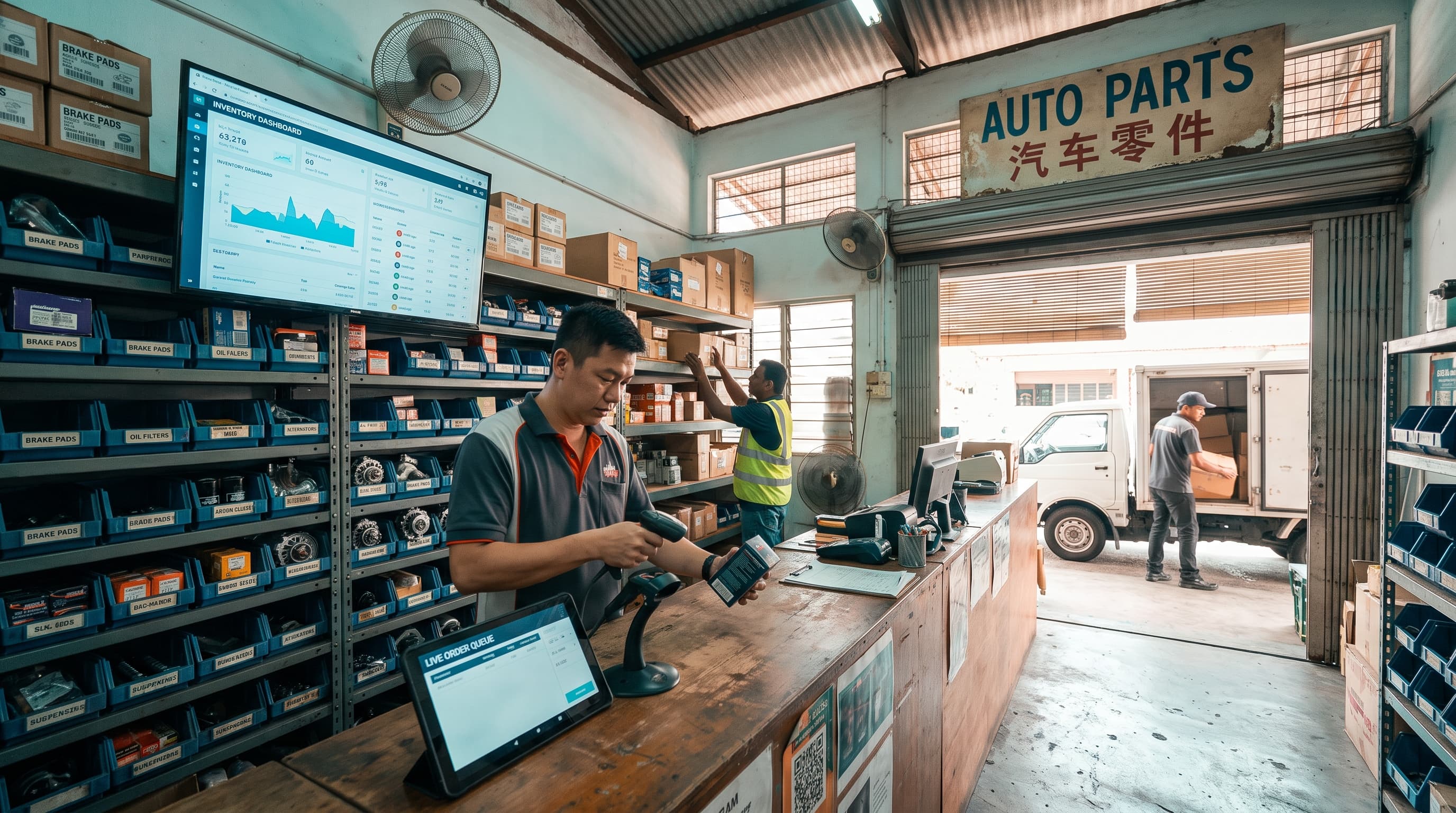
A 22-year-old family-run auto-parts distributor in Taiping, Perak was running 4-hour order-to-dispatch cycles out of a 6,000 sqft warehouse off the Kamunting road. We spec'd a business automation build, not a SaaS, not a vendor pitch. Order-to-dispatch fell from 4 hours to 35 minutes by week three. The dispatch-error rate dropped from roughly 1 in 12 to 1 in 140. This is what it cost, what it did, and what your shop would pay.
The business
A 22-year-old family-run auto-parts distributor in Taiping, Perak. Started by the current owner's father in 2003 as a single-counter spare-parts shop along Jalan Iskandar, then moved to a 6,000 sqft warehouse + retail counter in the Kamunting light-industrial belt in 2011. The second generation took over in 2018 and has since grown the operation to 14 staff: 4 counter staff, 3 warehouse pickers, 2 delivery drivers, 3 admin, and 2 in accounts.
They stock aftermarket and OEM-equivalent parts for Proton, Perodua, Honda, Toyota, Nissan, Mitsubishi, plus commercial-vehicle parts — brake chambers, kingpins, leaf springs, clutch boosters — for the lorries that run the limestone quarries out of Simpang Pulai and the palm-oil mills between Taiping and Selama. They supply about 180 workshops across Perak: Taiping, Kuala Sepetang, Changkat Jering, Selama, then south through Kuala Kangsar to the Kinta Valley. Roughly 60% of orders go out via the two delivery lorries, the rest are counter collection. Average order size: RM 280 to RM 450. Daily order volume: 180 to 220.
This is the case study for the business automation side of what we do — a tightly scoped automation build around the way a Perak parts distributor actually runs, not a generic ERP template that doesn't fit.
The problem they were actually trying to solve
Three leaks, all caused by the same root issue — orders arriving through five different channels (phone, WhatsApp text, WhatsApp voice note, walk-in, and the 6-year-old SQL Account) with no shared queue:
- The same part got sold twice. A customer at the counter bought a Camry alternator. Forty minutes later, a delivery order for the same alternator went out to a workshop in Kuala Kangsar. There was no live stock view that crossed the counter and the warehouse. This happened 4 to 6 times a month, costing roughly RM 2,500 to RM 4,000 per month in reverse logistics, goodwill refunds, and replacement parts.
- Dispatch errors were routine. Wrong part, wrong model year, right part but wrong side (left vs right brake caliper). The picker worked from a hand-written list, the counter staff re-wrote it from memory, and the driver was the only one who noticed the error on the way out. About 8 to 10% of delivery orders had an error that surfaced after dispatch.
- Order-to-dispatch was 4 hours for any non-trivial order. The voice note came in at 9am, the counter staff re-keyed it into SQL Account by 10am, the picker worked from the printout until 11:30, the driver left at 1pm. The owner was staying until 7pm three nights a week to chase the stragglers.
The owner said on the first call: "Kak, I don't need AI. I need the phone call, the voice note, the walk-in and the lorry all to land in the same pile, and I need my staff to know what's already gone out before they promise it to the next customer." That sentence is the brief.
What we built — and why this approach
A small business-automation layer built around how the shop actually runs, in four parts:
- A WhatsApp Business API line that converts voice notes and text into structured orders. Every WhatsApp order — text, voice note, even a photo of a handwritten workshop list — lands in one inbox. An LLM extraction layer reads the message, identifies the part numbers against the existing catalogue (we ingested their 14,000-SKU SQL Account export), and drops a structured draft order into the queue with a confidence score. Counter staff confirm or correct. The 70% that comes in clean the counter just hits "confirm" on. The 30% that's ambiguous goes to a human.
- A live stock dashboard that auto-updates as parts move. Every counter sale, every warehouse pick, every inter-branch transfer — single source of truth, updated in under 3 seconds. The dashboard is on a wall-mounted screen at the counter and a tablet at the warehouse supervisor's desk. Counter staff see what's available before they say yes. The "sold it twice" problem is structurally impossible now.
- An order-routing engine that splits a single order into the right lanes. Counter collection goes to the front. Warehouse pick goes to the picker. Delivery goes to the driver bay. A single phone-call order with 12 line items might split into 9 counter lines and 3 delivery lines. The picker gets a barcode-driven pick list. The driver gets a manifest on his phone.
- A barcode-driven pick-and-pack process. We barcoded the 800 fastest-moving SKUs first (the rest got labelled in the second month). The picker scans the bin, scans the part, the system confirms. Pick error rate: down 92% in the first month.
Why not just buy an off-the-shelf ERP like SAP Business One or Acumatica? Because the workflows are too specific. The voice-note culture. The "kak, ada sama tak?" — "sister, do you have the same?" — half-Malay half-Chinese hybrid part requests. The cross-reference between Proton Saga and Suzuki Cultus parts. The fact that the counter staff and the workshop owners are on a first-name basis. A 6pm delivery to a Kuala Kangsar workshop is the same price as an 11am one and they expect it either way. An ERP assumes a clean order from a clean PO. This shop doesn't have that. The custom automation was spec'd to match.
How the operation changed
Three concrete shifts inside the first 6 weeks:
- Counter staff stopped re-keying orders. A phone call came in, the counter staff listened, wrote a paper slip, and re-typed it into SQL Account later. The same data was touched 3 times. Now the order lands in the queue, the counter hits confirm, the order is live. The 4 counter staff collectively saved about 11 hours a week of re-keying time, and they redirected that time to walk-in customers — small parts, oil, filters, brake fluid — that previously went unsold.
- The owner stopped chasing at 7pm. Before, the owner was in the warehouse until 7pm three nights a week, hunting for the order that didn't get picked, didn't get invoiced, didn't get to the driver. The dashboard tells him in real-time. He's home by 6:15pm most nights now.
- The driver manifest is now a phone notification. Before, the driver got a hand-written list, drove around Taiping and Kuala Kangsar, came back at 3pm. Now he gets a manifest on his phone with each stop, the customer's WhatsApp is auto-pinged with an ETA, and he has a "mark delivered" button. He's back by 2pm most days.
The numbers, 10 weeks in
We don't do client testimonials. We do numbers. The shop's view, 10 weeks after the automation went live:
- Order-to-dispatch: 4 hours → 35 minutes for a 12-line delivery order, 18 minutes for a counter collection. Across roughly 200 orders a day, that's a recovered 60 to 70 hours of staff time per day, or roughly RM 30,000 per month of staff time redirected to higher-value work.
- Dispatch error rate: 8 to 10% → 0.7%. That's roughly 1 error in 140 orders, down from roughly 1 in 12. The owner stopped doing the 5pm apology call run.
- Daily order volume: 180 to 220 → 230 to 270. Same staff, same building, more orders. The owner is now actively recruiting 2 more pickers and 1 more driver.
- Counter re-keying time: 11 hours per week → under 1 hour. Counter upsell (oil, filters, brake fluid, wiper blades) is up 18% in the first 10 weeks.
- Owner after-hours work: 12 to 15 hours per week → 3 to 4 hours per week. A second-generation owner with two young kids, recovered 10+ hours a week.
- Total first-phase cost: RM 38,000 (one-off build) + RM 1,800/month maintenance. Includes the WhatsApp ingestion layer, the order routing engine, the live stock dashboard, the barcode pick-and-pack, and 90 days of tuning.
Payback: 14 weeks on the staff-time recovery alone, 9 weeks once the counter upsell is included.
What it would cost for your business
We don't publish a price sheet because the price depends on what you're running. Three honest bands for a Perak or Kedah parts distributor:
- RM 22,000 – RM 35,000 (one-off). A single-counter shop with one delivery driver, up to 5,000 SKUs, and a basic accounting system. Includes the WhatsApp ingestion, the order queue, and the basic stock dashboard. No barcode pick-and-pack.
- RM 38,000 – RM 70,000 (one-off) + RM 1,500 – RM 3,000 / month retainer. A 4 to 14-staff distributor with multiple delivery bays, 5,000 to 20,000 SKUs, and a barcode pick-and-pack. The band the Taiping shop sits in.
- RM 70,000 – RM 140,000 (one-off) + RM 3,000 – RM 6,000 / month retainer. A 15 to 30-staff distributor with multi-branch, inter-warehouse transfers, supplier order automation, and a credit-account layer for workshop customers. The next-phase band the Taiping shop is already talking to us about.
These are the same bands we use on the Perak services page and the Kedah services page.
What this looks like for your business
If you run a Perak or Kedah auto-parts distributor with 3 to 30 staff and you're losing sales to double-promising, eating the cost of dispatch errors, or watching your counter staff re-key the same order three times — this kind of build is the right first move. We don't sell a SaaS and we don't pitch you an ERP. We spec an automation layer around the way your shop actually runs, deploy it in 6 to 8 weeks, and hand it over.
The next step is a one-hour call, no slide deck. You tell us how many SKUs, how many staff, what your current order flow looks like. We tell you whether an automation build is the right answer, or whether a tighter process on your existing system is the cheaper fix. We won't pitch you either way. Get in touch and we'll set up the call.
If your bottleneck is on the workshop floor, our Sungai Petani workshop job-card case study shows the same kind of build from the workshop side. For AI maintenance and equipment-scheduling in Perak, see our Perak AI maintenance schedule case study. If your cross-border parts flow is the headache, our Bukit Kayu Hitam cross-border inventory case study shows the customs-codes and dual-pricing layer.
About the author
The pitchdeck.my team
I run pitchdeck.my — fifteen years building custom software, automation, and AI tooling for Malaysian SMEs, from Alor Setar family businesses to KL fintech desks. Most weeks I’m scoping a new build, writing the spec, and shipping the first version with the founder.
- AI for SMEs
- Custom software
- Malaysian markets
- Business automation
Related builds
Get automation in Perak
Frequently asked questions
The Taiping shop's first phase was 6 weeks from kickoff to live, with 4 weeks of post-handover tuning. A single-counter shop lands in 5 weeks. A multi-warehouse distributor is 9 to 12 weeks for the first two phases.
No. The build reads from your SQL Account, AutoCount, or generic CSV export. It doesn't replace your accounting, POS, or supplier ordering.
The 4 counter staff at the Taiping shop are all 40+, the oldest had never used WhatsApp Web before. They were productive in week 2. The system was spec'd to be tap-and-confirm. If your counter is older and resists screens, we say so on the first call.
You're in the smallest band, break-even 4 to 5 months. The honest answer is that the ROI maths work best at 4+ staff, because staff-time recovery is what pays the build back. If you're smaller, a tighter process on your existing accounting is the right first move.
Tell us what you run.
We’ll spec the fix in a week.
Priced like a hire, not a project — around the cost of one admin a month. Most builds pay back in 30 days or less.
Get a build specMore for Perak
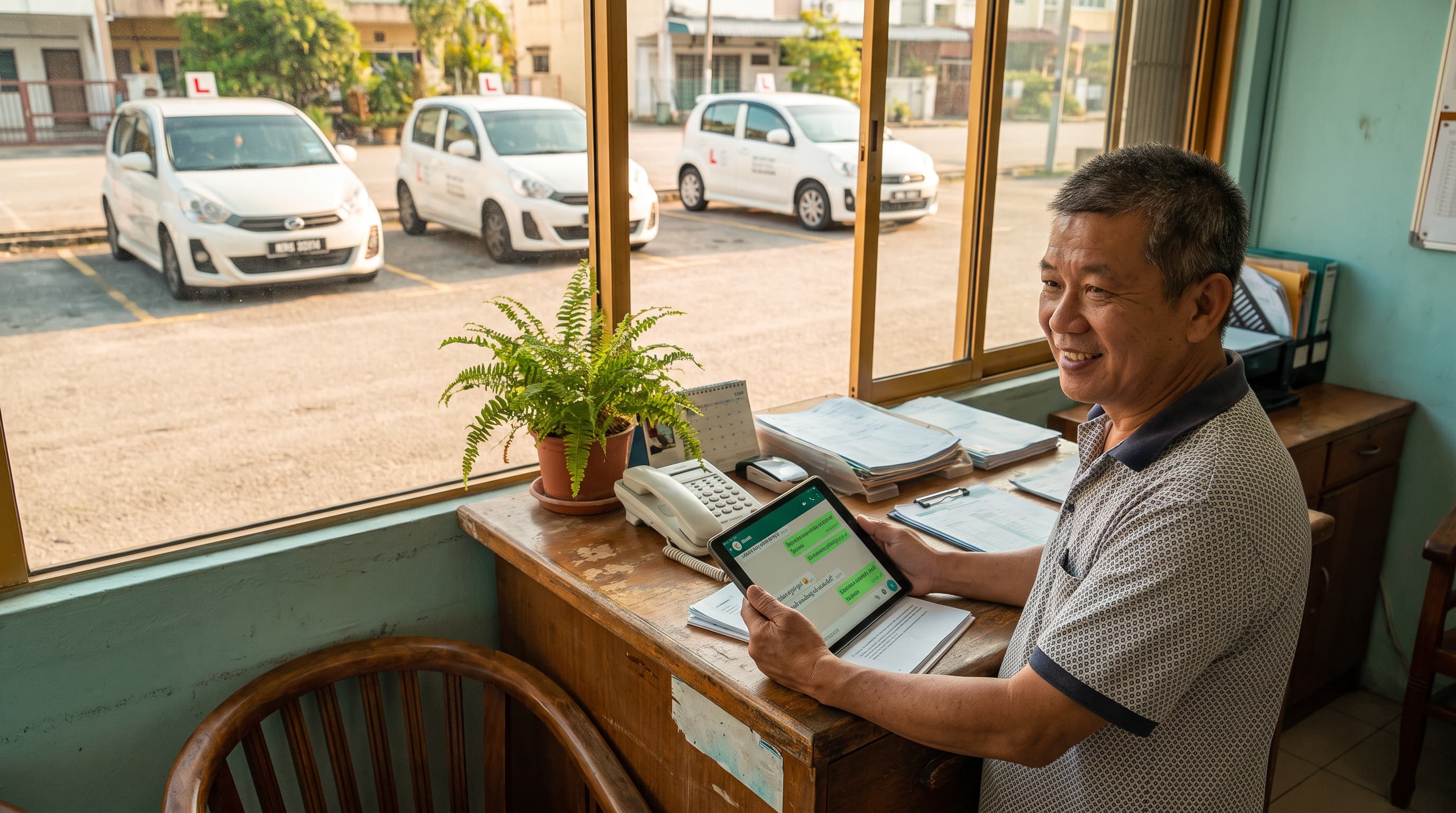
Case study: how a 3-branch Ipoh driving-school chain cut 70% of lesson-booking work with an AI WhatsApp chatbot
A 14-year, 3-branch Ipoh driving-school chain was drowning in 900+ WhatsApp messages a month — 70% lesson bookings and price FAQs. We built an AI chatbot. 12 weeks in, 70% of chats handle themselves, lesson-fill rate lifted from 71% to 89%, and the front desk is back to teaching support.
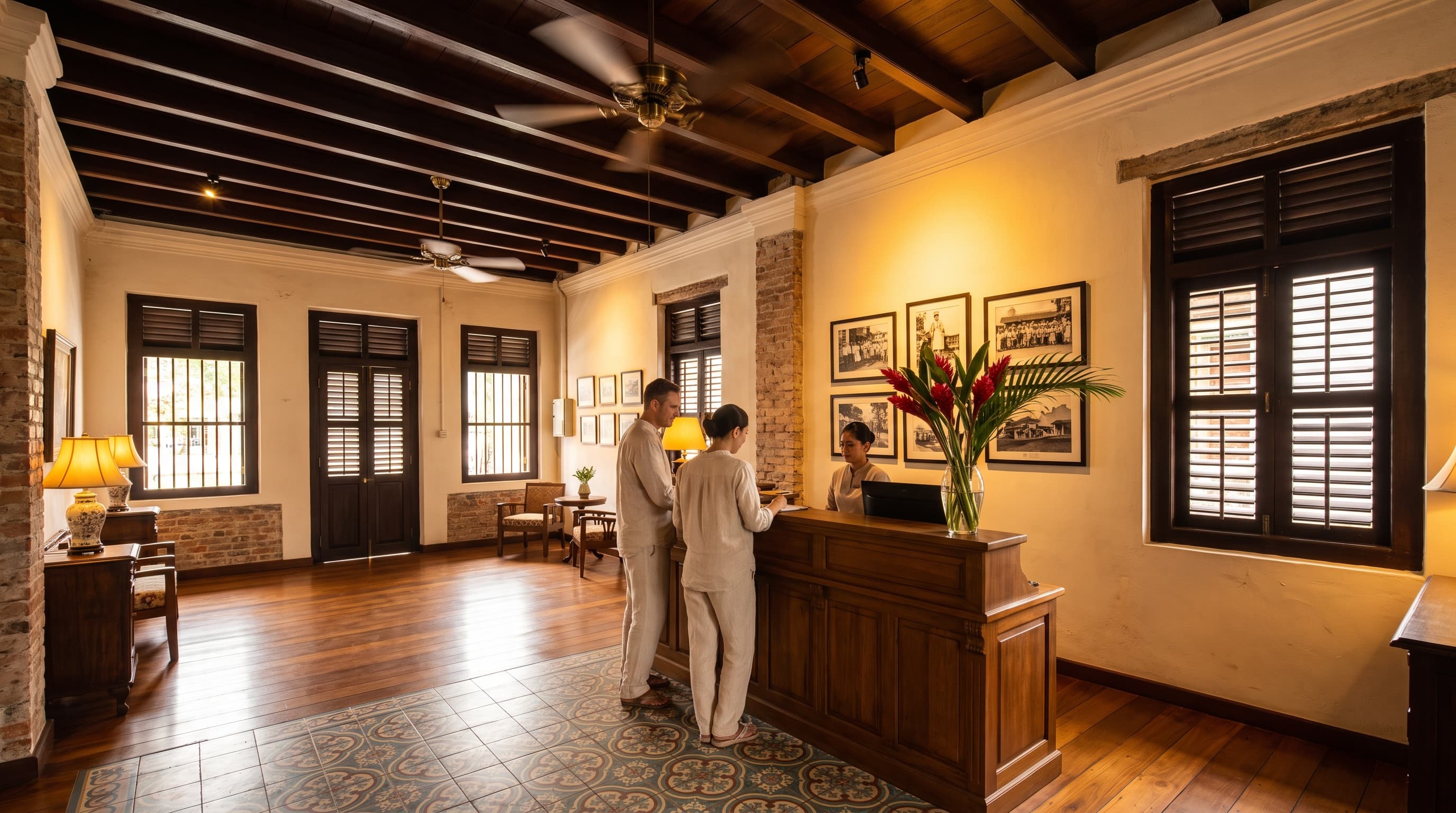
Case study: how a 3-property Taiping heritage-hotel group lifted direct revenue 4x in 8 months with a multi-currency direct-booking website
A 14-year Taiping heritage-hotel group was paying 18% Booking.com commission on every booking. We built them a direct-booking site with MYR/SGD/THB pricing. 8 months in, direct revenue is 4x what it was and OTA spend is down by RM 142k a year.