Case study: how a Kuala Kedah furniture maker took 40% of showroom enquiries off the floor
A Kuala Kedah furniture workshop moved 40% of showroom enquiries online with a 3D configurator site. 4 months in: 5-minute quotes, +41% order value, 11-week payback.
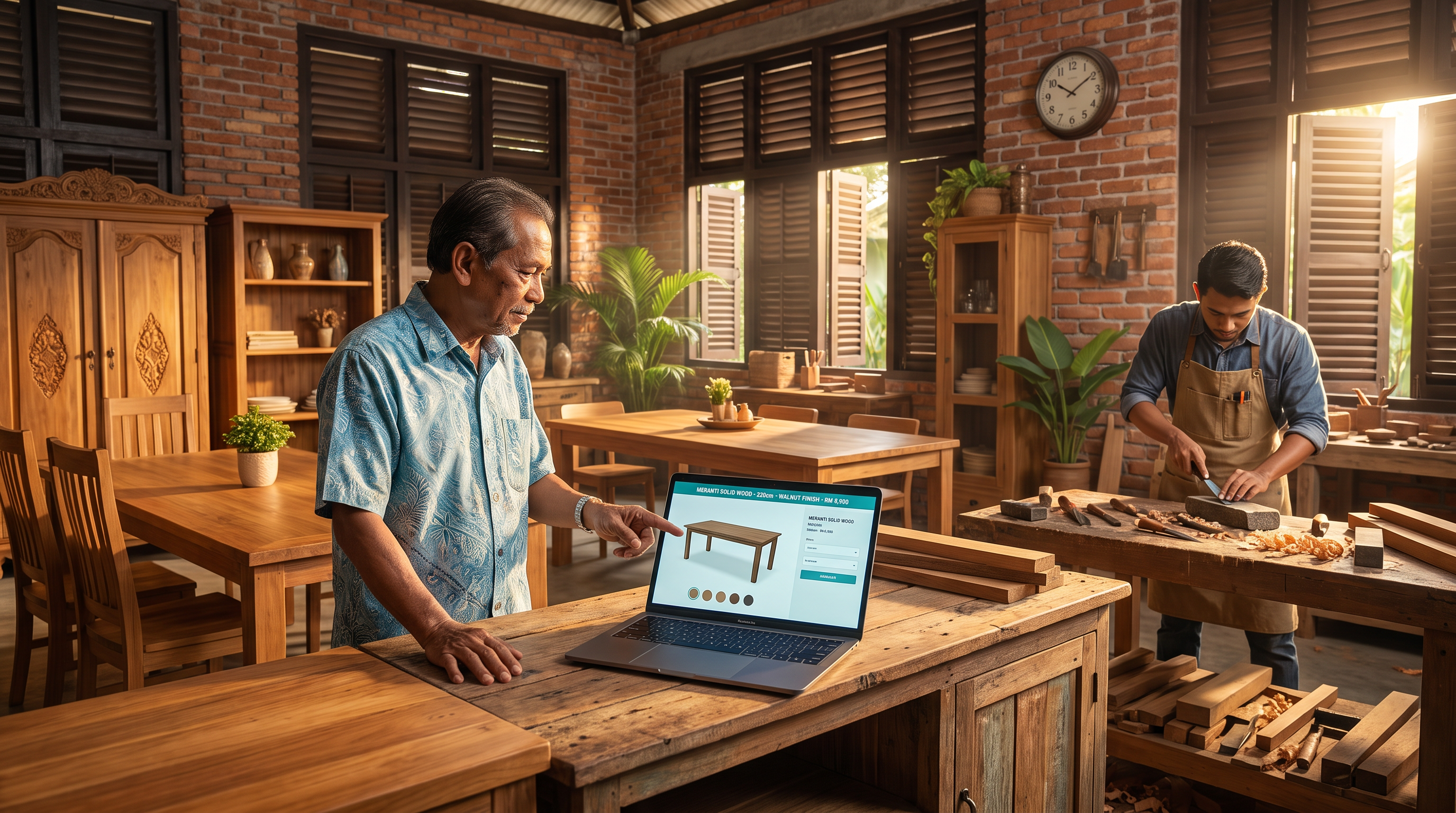
A family-run solid-wood furniture workshop in Kuala Kedah, Kedah was losing two working days a week to the same thing: people standing in a showroom, asking what a dining table would cost in meranti, and leaving without a number. We built them a direct-order website with a 3D configurator that lets a customer choose the timber, the finish, the leg style and the exact dimensions, then generates a live-priced PDF quote before they leave the house. Four months in, 40% of showroom enquiries have moved onto the site, quote turnaround went from four working days to under five minutes, and average order value is up 41%.
The business
A 24-year-old family-run solid-wood furniture workshop in Kuala Kedah, founded in 2002 by a joiner who came out of the timber trade at the Port of Kuala Kedah. Eleven craftsmen, three showroom and sales staff, one 2,000 sq ft workshop with four CNC and hand-cutting stations. The showroom is a narrow shophouse unit off the main road — two minutes from the Sultanah Najihah Mosque and the historic river quarter.
The catalogue is deliberately narrow: dining tables, wardrobes, bed frames, sideboards and restaurant tables, all built from solid timber — meranti, johar, kemuning and rubberwood through the local timber trade, plus mango wood for smaller pieces. Nothing flat-pack, no veneer. Roughly 70% of revenue is residential (families from Kuala Kedah, Jitra, Pokok Sena, Alor Setar and Kulim), the rest trade: restaurant fit-outs, guesthouse furniture and hotel pieces that ship through the Kuala Kedah ferry port to Langkawi resorts.
2025 revenue was around RM 3.2 million across roughly 640 orders, average order value RM 4,200. The workshop had never had a website — just a Facebook page with 900 followers that had not moved in six months.
The problem they were actually trying to solve
Every custom order started the same way — a person walked into the showroom, said "I want a dining table like that one, in meranti, for eight people", and the workshop had no way to answer until a carpenter free'd up, measured it, drew it, priced it in a spreadsheet, and came back three to five working days later. By then a meaningful share of the enquirers had bought elsewhere.
Three specific problems ran underneath that:
- The showroom was the only place the product existed. Roughly 140 walk-in enquiries a month, each consuming 45 to 90 minutes of a sales person's time. Only about one in three left with an order. On Saturdays and Sundays the three staff could not handle the floor and the quote follow-ups at once — effectively closed to serious buyers two days a week.
- Customers could not see the piece in their own space. A table is not a chair. Finishes change completely under the fluorescent lights of a Kuala Kedah evening dining room compared to the workshop's north-facing window, and no photograph conveyed the difference between johar and meranti in the hand. This was why customers walked out and bought a flat-pack set from a hypermarket in Jitra instead.
- Timber was bought against a guess. The workshop held 38% of purchased board-feet in stock for more than 90 days, because buying was based on what the shopkeeper thought would sell, not on what had been ordered. Meanwhile a competitor two towns over was answering custom enquiries on Instagram within two hours using rendered mockups, taking the younger homeowners from Kulim and Alor Setar.
The owner said on the first call: "I don't need more people walking in. I need people to walk in already knowing what they want — then I spend my time on the wood, not on the price."
What we built — and why this approach
A direct-order website with a browser-based 3D configurator, built as our web design engagement for the workshop. Four parts:
- A 3D configurator for the three hero products — dining table, wardrobe, bed frame. Timber species, finish (natural matte, dark walnut, whitewash, honey), leg style, dimension and drawer count, all constrained to the workshop's real machine and joinery limits. It renders in the browser with no app to install, tuned to load in 2.1 seconds on a mid-range Android, because that is what most customers hold.
- Live pricing built on their own cost model — board feet of timber, labour hours by joinery complexity, hardware, finishing, delivery and margin. Not a decorative number that lands on a contact form. The configurator generates a PDF quote the moment the customer finishes, with a 30-day validity.
- Deposit, order and delivery — 30% deposit through Billplz (FPX) or DuitNow, balance on delivery, and a production slot reserved the moment the deposit clears. A delivery calculator prices the lorry by town, including the Pulau Portik–Langkawi ferry rate.
- A cutting-list generator — every confirmed order produces a cut list and a board-foot requirement, so timber is bought against real orders rather than a hunch.
Why not the alternatives. A Facebook page cannot carry a joinery business, where the specification is the product — no configuration, no payment, no order record, no cut list. Shopify plus a 3D plugin would have given a monthly subscription, plugin constraints on the dimension matrix, and still no integration with the workshop's timber buying. A template site could look good and still fail at the one thing that mattered: quote generation.
We architected it; AI built it — the operating model on our Kedah services page: 15-plus years of software practice deciding what the system must do, AI doing the heavy lifting.
How the operation changed
Four months in, three staff roles changed shape rather than shrinking:
- The showroom stopped being a quote desk. The salesman now sends a link instead of a price, and it comes back with a configured piece and a printed quote. Weekday walk-ins need no salesperson at all — people configure, order, pay the deposit and pick up. The showroom staff moved from chasing to consulting: two booked appointments a day for people who still want to run their hand across the timber, arriving with the configuration already on screen.
- Quoting stopped consuming carpentry time. A carpenter used to be pulled off the cutting table to draw and price a table that might never be ordered. Now the drawing, price and cut list come in minutes, and the carpenter only joins once the deposit clears.
- Timber buying stopped being a gamble. The workshop buys against a live order book rather than a feel. Board-feet held over 90 days fell from 38% to 21%.
- The restaurant fit-out pipeline got a spine. The same configurator and quoting flow now handles trade work — a restaurant operator configures six tables in an afternoon instead of visiting the workshop twice for a verbal quote.
The numbers, four months in
We don't do client testimonials. We do numbers — the workshop's own figures, four months after the site went live:
- Showroom walk-in enquiries: 140/month → 84/month. A 40% drop. Of the enquiries that stopped walking in, 78% had configured online first — ordering direct or booking an appointment.
- Quote turnaround: 4 working days → under 5 minutes. No carpenter time, no spreadsheet, no callback.
- Quote-to-order conversion: 24% → 41%. Customers see the finished price in their own space before they travel.
- Average order value: RM 4,200 → RM 5,900. Up 41%, driven by customers upgrading timber and hardware once they can see the cost delta on screen.
- Configurator sessions to order: 11.4% — 2,180 sessions, 249 orders.
- Timber held over 90 days: 38% → 21% of purchased board-feet.
- Sales time on quoting: 26 hours/week → 7 hours/week across the three showroom staff.
- Program cost: RM 46,000 build + RM 1,200/month retainer. Payback in 11 weeks, on margin from order value and volume alone — before the reclaimed sales and carpentry hours.
What it would cost for your business
We don't publish a price sheet, because the price depends on what you're making and how many product families you carry. Three honest bands for a Kedah or Perak workshop or maker:
- RM 28,000 – RM 55,000 (one-off). A single-showroom workshop with one to three product families. Includes the site, a 3D configurator, live quoting, deposit checkout and delivery pricing. 6-8 week build.
- RM 55,000 – RM 110,000 (one-off) + RM 1,200 – RM 2,500 / month. Multiple product families, cutting-list and board-foot integration into production, appointment booking, and a trade-account layer for restaurant and hotel work. 10-12 week build.
- RM 110,000 – RM 220,000 (one-off) + RM 3,000 – RM 6,000 / month. Multi-outlet operation, dealer and trade pricing, production scheduling, and a configurator built on your own joinery templates rather than a generic one.
These are the same bands we use on the Kedah services page and the Perak services page.
What this looks like for your business
If you build custom furniture in Kedah or Perak and your quotes still take days because each one needs a carpenter, a drawing and a spreadsheet — that is the bottleneck. The workshop's showroom was full, but the people standing in it were not buyers yet. The configurator moves the conversation to the customer's own screen, and gives you a cut list with every order.
We've done the same direct-booking shape for an Ipoh boutique hotel group and a Taiping heritage hotel, and a catalogue-and-conversion build for a Langkawi tour operator. The furniture version goes furthest, because the configurator does the selling while the workshop does the joining. For the six must-haves of a Kedah business website first, see our Kedah web design checklist.
If you want to talk it through, book a 30-minute call. We'll look at your product families, quote turnaround and timber buying, and come back with a number and a build week. We don't pitch you either way — about a third of the workshops we talk to end up buying a second CNC and hiring a designer instead, and for a workshop at that stage that's the right answer.
About the author
The pitchdeck.my team
I run pitchdeck.my — fifteen years building custom software, automation, and AI tooling for Malaysian SMEs, from Alor Setar family businesses to KL fintech desks. Most weeks I’m scoping a new build, writing the spec, and shipping the first version with the founder.
- AI for SMEs
- Custom software
- Malaysian markets
- Business automation
Related builds
Get web design in Kedah
Frequently asked questions
It is overkill if you sell a fixed catalogue. It is the cheapest fix if you make custom pieces, because the alternative to a live configurator is a quote that takes four days and needs a carpenter. For this workshop, the configurator cost less than six months of the carpenter's time it gave back. Start with one hero product — the dining table — then add families once it converts.
Eight to ten weeks for the Kuala Kedah build: two weeks modelling the real joinery and cost model, four on the configurator and quoting, two on the site and checkout, then two weeks of tuning against the workshop's actual drawings. The hardest part is never the 3D — it is getting the pricing model right so the quote a customer sees matches the one the workshop would write.
Yes, if it loads fast. Most of the workshop's enquiries came from mid-range Android phones on mobile data, so we tuned the configurator to 2.1 seconds on that hardware rather than optimising for a desktop. Drop-off on a slow connection was 9% — a number we would have accepted on any channel, but not one worth chasing.
You need a cost model we can read, but you do not need to change what you charge. We build the configurator on your existing pricing logic — board feet, labour hours, hardware, finish, margin — so the number a customer sees is the number the workshop would quote. If your pricing lives only in a carpenter's head, we write that down first.
Tell us what you run.
We’ll spec the fix in a week.
Priced like a hire, not a project — around the cost of one admin a month. Most builds pay back in 30 days or less.
Get a build specMore for Kedah

Case study: how a Langkawi tour operator cut booking commissions 35% with a direct-booking website
A 14-year Langkawi tour operator was paying 22% commission to OTAs on every island-hopping booking. We built a direct-booking website and an AI WhatsApp concierge. 8 months in, direct is 59% of bookings and the platform bill is down RM 147k a year.
Case study: how a Langkawi ferry operator ended the month-end invoicing fire with a small automation
A 12-year-old Langkawi ferry operator had 3 admin staff buried in month-end invoicing for 22 daily sailings and 4 agent chains. We built a small ticket-to-invoice automation. 10 weeks in, the month-end close dropped from 9 days to 38 hours and the owner stopped chasing payments.