
ASEAN’s Outlook On The Wider Indo-Pacific Region
Malaysia reaffirmed its commitment to an inclusive, cooperative and sustainable regional order as it successfully hosted the ASEAN Outlook on the Indo-Pacific (AOIP) Forum 2025, held from 14 to 15 November in Kuala Lumpur.
Jointly organised by the Ministry of Foreign Affairs and the Institute of Strategic & International Studies (ISIS) Malaysia, this year’s forum carried the theme “Towards an Inclusive and Sustainable Indo-Pacific”, expanding on ASEAN’s ongoing efforts to strengthen geostrategic dialogue while aligning it with long-term development goals.
The two-day gathering brought together policymakers, senior officials, academics, and regional thought leaders to examine the evolving dynamics of the Indo-Pacific — a region that has increasingly become the centre of global strategic competition.
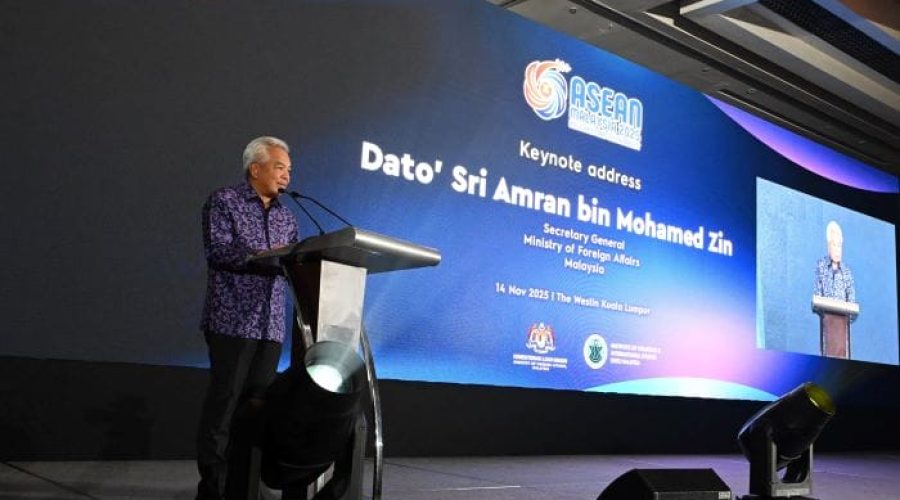
Speaking at the welcoming dinner on 14 November, Ministry of Foreign Affairs Secretary-General and Malaysia’s SOM Leader, Dato’ Sri Amran Mohamed Zin, emphasised that the AOIP remains central to ASEAN’s approach in navigating major power rivalries.
“The ASEAN Outlook on the Indo-Pacific is not about choosing sides. It reflects ASEAN’s enduring belief that the region must remain open, inclusive, and anchored in cooperation,” he said.
“For Malaysia, the AOIP is a practical expression of the future we seek — one where inclusivity is power, sustainability is strategy, and centrality is our shared responsibility.”
With Malaysia chairing ASEAN in 2025, officials have framed the AOIP as a key guiding principle for the region’s diplomatic and economic engagements.
The forum convened four thematic sessions, featuring more than 20 panellists from across the Indo-Pacific. Discussions centred on: The intersection of geopolitics and geoeconomics in the Indo-Pacific; Linking the AOIP with the ASEAN Community Vision (ACV) 2045; Confidence-building measures in the maritime domain; Synergies between various Indo-Pacific strategies.
The sessions highlighted the need for ASEAN to maintain agency amid intensifying geopolitical contestation, while ensuring regional cooperation frameworks remain relevant and adaptable.
ISIS Malaysia Chairman Datuk Prof Dr Mohd Faiz Abdullah noted that the AOIP has evolved considerably since its adoption in 2019.
“From its mainstreaming in 2022 to its renewed framing last year as the core of ASEAN’s future-proofing efforts, the AOIP is a statement of intent,” he said.
“It articulates how ASEAN wishes to engage the wider Indo-Pacific on its own terms, anchored in openness, inclusivity and cooperation.”
He added that strengthening ASEAN Centrality will be crucial in ensuring the AOIP remains an effective tool for regional engagement.
Adopted in June 2019, the AOIP sets out ASEAN’s vision for a peaceful, stable and rules-based regional architecture. It calls for enhanced cooperation through ASEAN-led platforms such as the East Asia Summit (EAS), especially as geopolitical competition among major powers intensifies.
As Malaysia continues its ASEAN Chairmanship, the outcomes of the AOIP Forum 2025 are expected to guide upcoming diplomatic engagements and shape the region’s approach to emerging challenges.
The Ministry described the forum as a timely platform to reaffirm ASEAN’s unity and collective purpose — particularly as the Indo-Pacific remains one of the most strategically contested regions in the world.

