
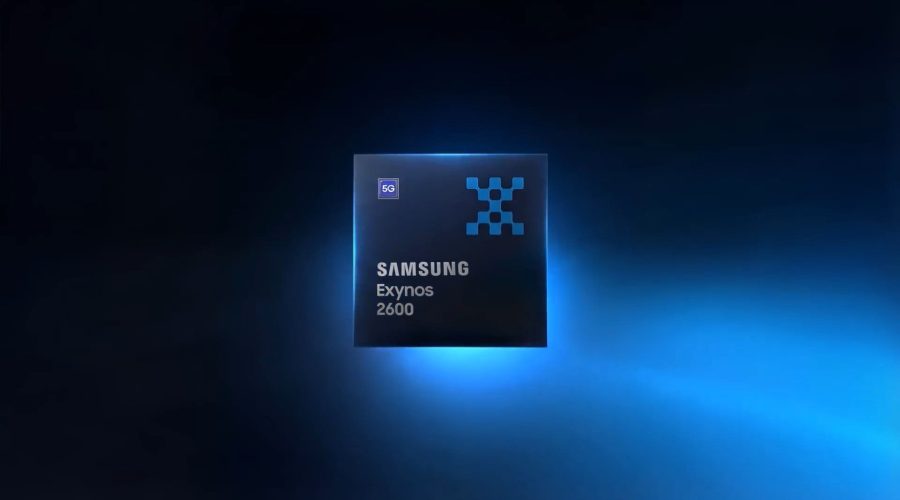
5 reasons Exynos 2600 is important
Samsung’s in-house chipset started really strong back in the days, and had gone through a rollercoaster of a time. Now, with the upcoming release of the Samsung Galaxy S26 series, it is expected that the S26 and the S26 Plus will be equipped with the Exynos 2600 – at least in certain regions, if we follow Samsung’s history. Of course, Samsung has not made any official announcements as of now, other than this official video.
We have done a lot of tests on the Galaxy S24+ with the Exynos 2400, and it was an amazing chipset and can compete with the other flagship chipsets of that time. We have talked about the 5 reasons why in our full video, which I truly suggest you watch.
But, here is a summary of why.
1. Made with 2nm process node
This is indeed a huge deal. Samsung Foundry managed to be the first to achieve the industry’s first 2nm GAA (gate-all-around) process node, and it is used to fabricate the Exynos 2600 chipset.
While the process node number – the whatever nm number – doesn’t really matter nowadays, as it does not reflect the gate length of the transistors. It is an “equivalent 2D transistor” design instead. It is mostly used to signify the “generation” of the lithography process instead.
2. Better heat transfer
Efficiency is such a huge deal when it comes to modern chipsets. We want the best battery life possible while gaming on our device. I mean, we can’t cheat physics – especially since 99% of phones and tablets are passively-cooled. To tackle this, Samsung, being the industry’s first, opted for something new called the Heat Path Block (HPB). It’s literally creating a heat path with a block of material on the die itself so that the heat has somewhere to go.

Though, when the heat gets wicked away from the chipset through the HPB, it’ll go to the phone’s frame and body. Ultimately, if there is no way to take the heat away from the phone and put it into the environment, thermal throttling is inevitable – especially if the ambient temperature is as warm as Malaysia. An active cooler is still required.
3. Performance gains
Let’s talk about the GPU first. The Exynos 2600 is equipped with the new Xclipse 960 GPU. Curiously, on the Exynos 2600’s website, it mentions “thanks to a new architecture” but never actually mentions what architecture it is using.

Either way, raw performance aside, the Exynos 2600 is also equipped with the Exynos Neural Super Sampling (ENSS) technology for upscaling and frame generation. This is definitely needed in the modern day of high-end gaming as raw performance is just turns our phones into a portable heater and thermal throttles to oblivion.
Of course, the GPU isn’t the only star of the show. The CPU configuration seems to be purely based on Arm’s v9.3 architecture, and Samsung opted for an all-big-core combo here. The Exynos 2600 has 10-cores that consist of:
- 1x C1-Ultra @ 3.8 GHz
- 3x C1-Pro @ 3.25 GHz
- 6x C1-Pro @ 2.75 GHz
We’ve already seen how these latest Arm CPUs perform since they’re basically the same CPU core design as the MediaTek Dimensity 9500 – and it’s looking to be really good. Combined with the potentially more powerful Xclipse 960 GPU, the Exynos 2600 could be an amazing chipset for gaming.
4. Vertical integration
By switching over to the Exynos 2600, Samsung essentially has more control across the board, from silicon to software. I do have to declare that this is going to have a lot of theorization, but it is indeed possible to have an amazing level of performance and efficiency in all aspects if Samsung gives it the resources and optimization it needs.
Again, in theory, since Samsung System LSI makes both Exynos ISPs and ISOCELL camera sensors, they should “know” how each other behaves and make the best out of the available hardware.
5. Competition
Oh boy, this is a huge topic on its own. Competition between companies within the same market is always better for the consumers. In this case, having competition between Snapdragon, MediaTek, and Exynos is always better for us consumers.
I don’t want the situation to happen on mobile chipsets. That’s why competition is required. While there is no solid proof of the price of the Snapdragon 8 Elite Gen 5 chipsets, it is predicted to be around $240-$280. This is, of course, due to Qualcomm’s price hikes, and also TSMC’s price hikes.
Samsung System LSI designs the Exynos chip, which is in direct competition with Qualcomm and MediaTek, while Samsung Foundry is in direct competition with TSMC. Samsung can compete in two different industries with this one product. And it all hinges on the final product and how it actually performs in the real world.
By the way, there is a new report saying that the supposed next-generation Snapdragon 8 Elite Gen 6 could be fabricated using Samsung Foundry’s 2nm process node – which is the same one used on the Exynos 2600.
The pressure is on
Currently, the Exynos 2600’s status is in mass production, according to their website. I am optimistic about what it can bring since the Exynos 2400 and Exynos 2500 showed great improvements. However, there are a lot of moving parts in this whole orchestra, and I truly hope that Samsung somehow manages to pull it off.
Like our Facebook Page here at NasiLemakTech.com for more news and in-depth reviews!
Also, join our Facebook Group for insightful information and memes!
Subscribe to our YouTube channel too!

